
Bench jewelers work very hard with little or no acknowledgement, creating and repairing treasured possessions. These stories pay tribute to these artisans.
19 Minute Read
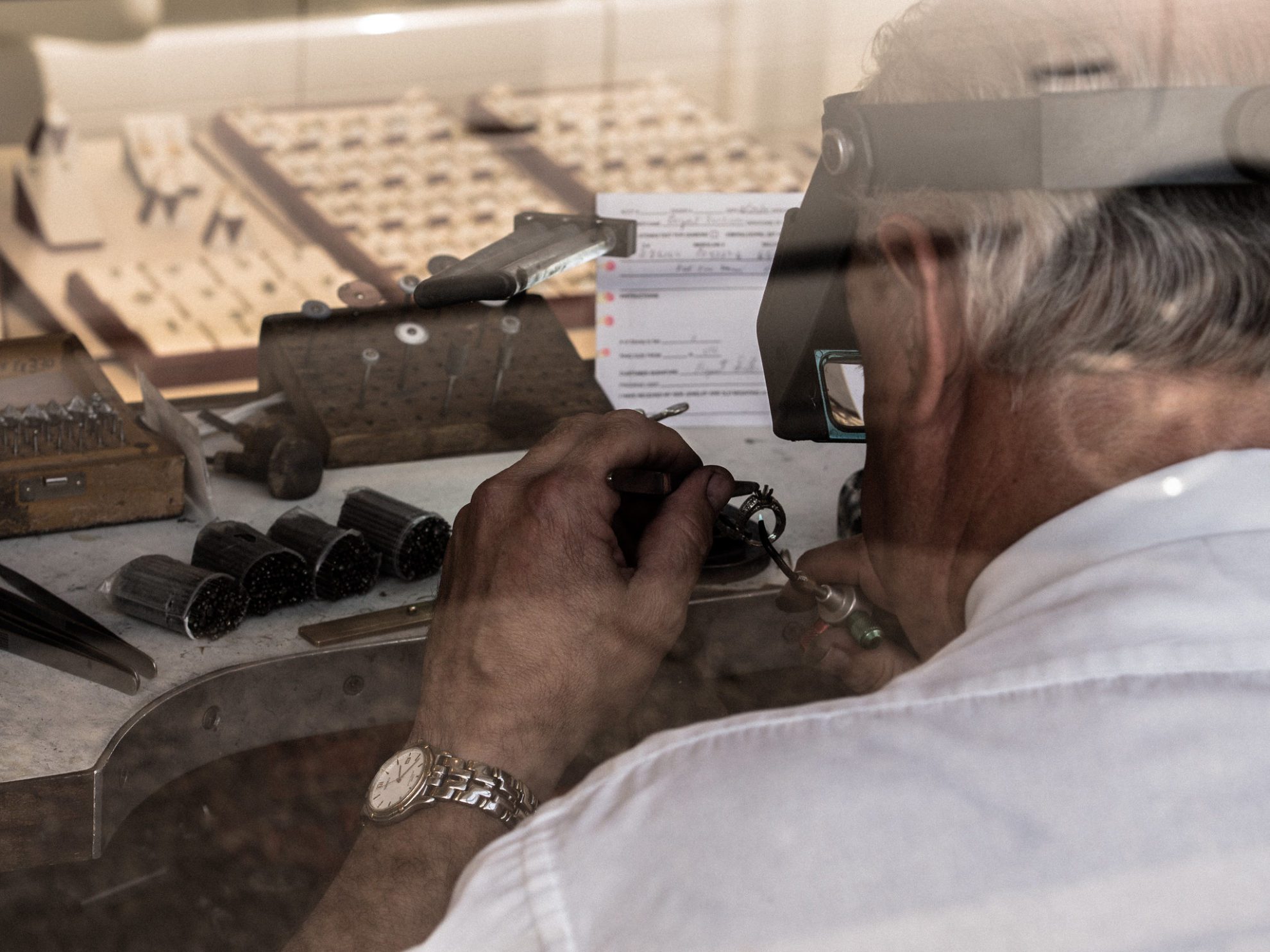
I've spent a lot of time in the back rooms of jewelry stores, watching bench jewelers at their trade. While I'm a pretty good goldsmith, their skill level boggles my mind. I remember visiting my friend Dave. We spent a half-hour telling stories and joking, all while he was pavé-setting a diamond ring. After a particularly hearty laugh, he showed me the ring. The diamonds were set with such perfection that light reflected evenly off every table in a row. To him, this was a casual activity that didn't require special attention.
Bench jewelers mend the finest of chains, carve and cast original pieces, and do it with great ease. However, their life isn't all fun and games. I've heard horror stories about jewelry bought on TV. While rings test as solid gold, the shanks are sometimes hollow and melt during otherwise routine prong replacements. I once saw an antique garnet ring brought in for a stone replacement. It tested as 14k, but one piece was plated. During polishing, the plating was removed. The jeweler had to remake the entire ring.
A friend once grieved over breaking a customer's diamond. The stone had a knife edge and it chipped while setting. He knew the risk, so I asked him why he did it. His reply was simple: "That's my job."
I've gained an immense respect for bench jewelers. They create and repair our most treasured possessions. In turn, they receive little credit for their efforts. This page is a tribute to these artisans.
If you have any comments or stories about bench jewelers, please send them to admin@gemsociety.org. I'll be glad to expand this page.
Donald Clark, CSM IMG
I've just started learning metalsmithing/jewelry making. I must say, I had no idea how difficult this type of work can be. It's not only eye-straining but also back-breaking, from sitting hunched over the bench working on the fine details. BUT, when I finish a piece, the feeling is like no other. Just knowing I've created something unique and beautiful that others will enjoy and treasure makes it worth all the effort. I think this is why the bench jewelers (and stone cutters) keep doing it.
I had a jeweler who was wonderful. She passed away suddenly a few years ago, and I've not found anyone as accommodating as she was. I bought a coral bracelet in Hawaii with wonderful stones but flimsy settings. No one else would touch it for me, but she gave me several choices. Ultimately, she set a beautiful new bracelet and even made earrings to match from two of the leftover stones.
Carol
Bench jewelers are a special breed. The type of people attracted to this tedious, eye-straining job are often patient, good humored, and creative. Somehow, they're able to sit in isolation, sawing and filing away, often for someone who'll sell their work to someone else.
If the end user likes the work, the accolades often go to the retail jeweler. Unless the retailer expresses that appreciation to the bench jewelers, those hard-working men and women won't get any feedback.
And things don't always go right. Sometimes, an unappreciative customer will complain about a detail that really means nothing, even though the bench jeweler spent hours working on the piece.
Maybe because I'm an opal cutter who often works in tandem with bench jewelers, I'd say gem cutters also need some appreciation. Often, it's a thankless job.
Take the following story as an example.
My manufacturers, John and Anita, rang me up one day with an urgent request. A local retailer's customer had broken an opal in an engagement ring. Since it was a freeform stone, it would be difficult to replace. Plus, opals are all different anyway, so this was a really big problem.
It was one of those jobs you try to avoid. However, in order to make both the customer and retailer happy, I went out of my way to search for a similar stone. After I found one, I cut it to the shape of the freeform finding and John reset it in the ring.
Everyone was happy — until I discovered that the broken stone, which was all but worthless, was missing from the bench. Nevertheless, understandably, the customer wanted the original pieces returned. We stripped the workshop but still couldn't find them.
The jeweler then received a summons for nearly $1,000 to replace the loss. We could have taken it to court and proved that the original stone was worth about $10. However, everyone knows only the solicitors win in court, so we didn't waste our time.
The jeweler looked at me and said I would have to pay, since I lost the pieces. Quite true. So I did.
The latest news is that the customer has been wearing the ring in the garden. It's taken a real bashing, and the setting has been ruined. Now, she wants another replacement.
You know what we'll do? Like the idiots we are, we'll help her again.
Peter @Opalmine
Thank you for acknowledging the discipline and artistry of bench jewelers. Most of us work in anonymity. In this trade, you know you've done a good job when you don't hear complaints. Rarely do you receive acknowledgment or compliments.
Like all of us, I repair a lot of jewelry throughout the year. Some of it is high-quality, much of it isn't. But all of it has special value to the wearer. So, you do your best in each case to restore a treasured item. A special treat for me is when an antique dealer or museum brings in a really high-end piece. It's often a learning experience to see how a master craftsman constructed the piece — and a challenge to make my repairs reach the same level of excellence.
More often than not, I receive an heirloom brooch or necklace in need of repair. Typically, the proud owners have no idea what the piece is, only that it's been in the family for a long time. They usually hopelessly overvalue what they believe are diamonds, emeralds, or rubies. In most cases, you just quietly repair the piece and make the customer happy.
I particularly enjoyed Peter's tale of opal repair, because I've been in similar situations. In the spirit of "can you top this," here's my story.
I once made a custom ring for a gentleman who had brought back a freeform black opal from Australia. He wanted to give the ring to his mother for Christmas. I completed the ring and delivered it as promised. Everyone seemed happy — until two days after Christmas.
The customer called and asked me to "repair" the ring. Had the setting come loose? Did something break? No. As the customer told it, he had presented the gift-wrapped ring to his mother on Christmas morning. As she opened the box, the ring fell into the garbage disposal in the kitchen sink. It was running at the time. Now, he had a mangled chunk of gold, no opal, and no gift for Mom.
As much as I commiserated with the customer, there wasn't anything to repair. I could only offer to create another ring with opal from my stock. The customer declined, because of the irreplaceable emotional value of the opal he personally brought back from Australia.
I still wonder… who unwraps jewelry over the kitchen sink with the garbage disposal running?
John
Thank you, John, for your story. I got a big laugh out of it.
You never know what you'll encounter when you deal with the public. I once had a customer come into my store with a 5-ct, heart-shaped, heavily included diamond, but she wouldn't let me take it to the back. She was afraid I would swap it with a lower-quality stone.
How many 5-ct, heart-shaped diamonds do you think I kept in stock?
Donald Clark, CSM IMG
My father was a partner in a manufacturing jewelry store that marketed a line of wedding bands nationwide back in the 60s. He told us stories around the dinner table about thieves — both on the customer and staff side. He also told stories of unusual pieces that came into the shop for repairs. Here in Newport Beach, there are a lot of rather well-off folks.
From my personal experience during that time, I only have one story that stands out.
A jeweler friend of ours had a customer bring in a faceted jelly opal ring. Obviously, the opal was badly abraded and needed to be replaced. The catch was that the jeweler couldn't find a suitable replacement stone. However, the original stone had a very high crown, so recutting was possible.
One weekend, we saw our friend, who asked if we'd recut the stone. I'd become good at cutting, so Dad thought it would be a good job for me. Since opal is so soft, cutting and polishing it can be tricky. He figured I'd gain some valuable experience.
So, for $20, I was going to recut the crown and reset the stone. ($20 was a princely sum at the time).
The ring was 14K yellow gold, with a simple six-prong head and a couple of gold leaves on each side. They came up from the band and fanned out on either side of the head. The unmounting went fine. I didn't even need to re-tip any prongs. Cutting the opal went very smoothly, and the stone looked good when done.
Now, a bit of background on the workspace. My Dad was originally a tool-and-die maker from Cincinnati. He made his own jewelry bench and faceting machine, which he incorporated into that bench. We used the larger 8″ diameter laps and had the capacity to cut large stones. Now, back to the story.
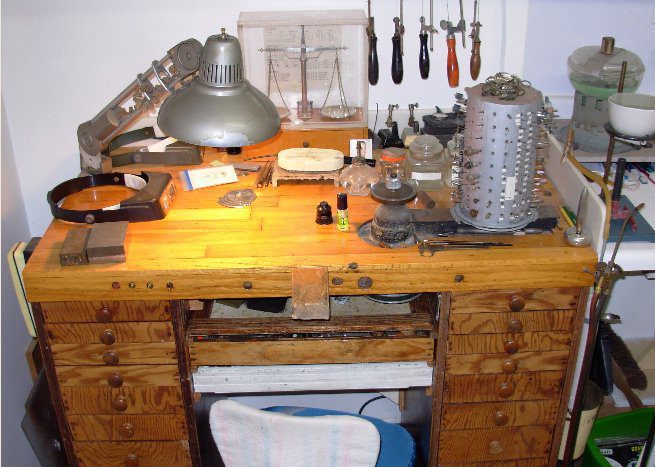
When polishing a stone, you have to wipe the facets clean to see how they're progressing. We cut a toilet tissue roll in half and used pieces to wipe the facets clean. Then, we tossed the tissue into a pile on the side and continued polishing. When we finished faceting, we gathered up the bits of tissue and threw them in the trash, cleaned up the lap catch tray, and put the faceting post and head away. Then, we'd get back to jewelry making. I finished recutting the stone late one evening, threw out the toilet paper, and put everything away.
A few days later, I grabbed a cup of coffee and went back to polish the ring and reset the stone. One problem: the ring was nowhere to be found!
For the next two days, we looked everywhere for the ring but found nothing. We could only guess what happened. The ring was laying on the bench near the toilet tissue pile. Somehow, a prong must have caught on some tissue. When I cleaned up, the ring must have also gone in the trash.
Of course, we'd already dumped the trash, and the trash had already been collected.
So, what to do? We called our jeweler friend. After some discussion, we decided the best course of action was to remake the ring as best we could remember it. If the customer was happy, nothing more would be said. If she noticed a difference, we'd fess up and do whatever it took.
We could easily obtain a new shank and crown. However, we didn't know the ring size. The jeweler hadn't recorded it on the take-in envelope, either. So, we decided to leave it just as it had come from the finding supplier: size 7.
Now, on to those four leaves. We looked everywhere but found nothing available in the right size and design. In the end, we had to make four of them by hand, sawing them out of sheet stock, chasing in the design, and finally soldering the leaf to a wire "stem" and then onto the ring shank. This took a couple of weeks.
The finished ring was beautiful. But would it pass the test?
By the time we mailed it back to the jeweler and the customer picked it up, a month and a half had passed. The jeweler showed the ring to the customer and held his breath.
The customer took one look at it and exclaimed: "IT LOOKS BRAND NEW!"
She slipped it on her finger and admired it for some time. When normal folks see a ring all polished up after years of wear, they "ooh and aah" and all that stuff. Then she said, "I guess the new diet I'm on is working because this ring used to be really tight before. Now it feels just right!"
The customer paid for her ring and left totally satisfied.
I learned a few valuable lessons. First, never leave bits and pieces laying around on the bench. It's a bit of a hassle getting them in and out of envelopes and ziplock bags, but you don't throw things like that away. Second, I'm lucky to have had someone as talented as Dad there backing me up. Third, when you have someone else's goods in your possession, you're totally responsible for them. That $20 I got for recutting the stone went up in smoke. I ended up spending about $25 paying for the findings, to say nothing of the hours spent remaking the leaves and ring.
Finally, I learned that repair work is a minefield. Now, I politely refuse most requests by saying "I only repair my own creations" and refer customers to a local jeweler.
Howard
I currently work for a large jewelry chain as a repair jeweler. I've been on the bench for over 30 years: 14 years working for an independent jeweler; 10 years running my own independent repair shop; and 7 years working for a large corporation.
Here are the basic differences from my point of view.
I could probably write a book about this, but you get the broad picture.
Bill
It's truly nice to acknowledge bench jewelers as a band of hard-working people who do what we do in spite of the endless hours of seemingly unappreciated effort. Why do we do this? Probably because we were born to do it and, for whatever reasons, we love doing it.
After 28 years at the bench, I could tell a million stories. Unexpected nightmare situations, frantic "all nighters," last-minute miracles to meet deadlines for employers, risk-taking successes (and failures), favors that backfired, hilarious practical jokes, and advice on how to maintain a good sense of humor through all the gut-wrenching stress and pressure.
At times, dealing with the public can be very frustrating as well as comical. As John remarked in another response, usually you know you've done a good job when you don't hear any complaints. However, very early in my career, I once did a routine head change-out job, repositioning and resetting a major diamond, for a lady who had been "nit-picking" things on her ring. When I completed the task, she accused me of not actually doing the work. Then, my employer did, too. Why? Ironically, because no one could see any telltale signs of bad workmanship.
Being a natural-born perfectionist, I could only chuckle to myself at the time. Instead of taking this as an insulting insinuation, I turned it into a confidence-boosting compliment.
As we strive to become good at our trade, we learn our lessons, usually the hard way. If we become accomplished veteran bench jewelers, our reward is simply knowing that at least we found success in life doing something that we naturally enjoyed doing. For most, that's reward enough. Normally, greeting the happy face of the person pleased with your work isn't part of the job. However, if you're really lucky (as I have been), the accolades don't always go to someone else.
Although I've been honored publicly for award-winning pieces, my most gratifying moment came quietly a few years ago.
A woman sent me a beautiful card. I had done some work for her through my employer at the time, but I didn't remember her. She went out of her way to personally thank me. The card contained a famous quote by award-winning ecologist, scientist, and writer Rachel Carson:

Those who contemplate the beauty of the earth find reserves of strength that will endure as long as life lasts.
And in one small sentence of gratitude, she helped me define a purpose for all those years of hard work. She wrote:
Dear Mr. Davis, Thank you for doing such a beautiful job helping me in preserving my memories.
Moral of the story? If you're never humbled by awards, or personally thanked, or see a grateful face in your career, you might think you're unappreciated. Don't be so sure. You life's work is probably more meaningful than you'll ever know.
Stanley Davis
There's so much that needs to be said about bench jewelers because they work in secret. They rarely get any credit, even from their own kind, who are often their competition. Their retail accounts see them as a lower class. Designers view them as extensions of themselves, a pair of hands for their ideas.
Some bench work requires so much skill that you have to put in more time than if you were studying to become a doctor. But do we get paid like doctors? Instead, we have to compete with cheap labor overseas and CAD/CAM casting.
Many years ago, when I was an apprentice, we made a special ring for a customer. It was a dome style with 18 bezel-set baguettes and a 3-ct center diamond. The dome part of the ring made it unusual. It was made from a steel crank shaft nut found at an auto-wrecking yard. The nut was filed into the shape of a dome ring and then blued at a gun shop.
We went to a lot of trouble to bring everything together on this one. The job was done to the highest level of perfection. However, when we showed the ring to the customer, she thought the center was crooked. The stone was straight, but we couldn't convince her.
So the master said to me, "Never do what I'm about to do."
He took a large pair of pliers, gripped the bezel-set center stone, and gave it a twist. Then, he re-tightened all the stones. In less than half an hour, he gave the ring back to the customer. Amazingly, no stones broke. It was a 50/50 shot, but it worked. The customer was happy.
Jewelers are so dedicated to their work. I knew an excellent one, the very rare kind who combined artistic design sense with business sense. Trained by a master with exceptional skill, she won design awards and worked for top firms before opening a store of her own. She purchased her building before the real estate sky rocketed in value. She surrounded herself with good people and was making all handmade pieces for the elite.
Unfortunately, she became ill with cancer. She worked at the bench until she physically and mentally couldn't anymore. One of the last things we did was to take her to an exhibit on French jewelry. A short time later, she passed away.
Eric Larson
I grew up in the jewelry and watch industry, starting at the age of eight in my family's retail business in downtown Vancouver.
It was a different time. Even so, it wasn't normal for an eight-year-old to be a job runner, traveling alone and often with very valuable pieces all over the streets of the downtown core. It didn't take me long to understand that my responsibilities far exceeded drop and pick up. I was the contact person to make sure the bench jewelers understood the directions, materials, designs, and repairs required. I was also the one who had to absorb their quiet annoyance at yet one more rush job.
By nature, I preferred quiet and loved the creative process. I was deeply passionate about gems and particularly loved estate pieces. In winter, coming off the cold and snowy streets into the workshops was a true delight. On many trips, it saved me from freezing.
What I found so amazing was that the bench jewelers all took a liking to me. Even though I was a young child, they showed respect for the responsibility and seriousness I was tasked with. My father would often call the workshops and ask why I wasn't back yet. It became the bench jewelers' and my secret that I was in no hurry to return.
I have often said the jewelry industry and "the people of the kerosene lamps," as I called the bench jewelers, have the most level playing field of any business. If you're committed, the industry will welcome you, and there will be space to work hard and prosper.
J. Jenny




When you join the IGS community, you get trusted diamond & gemstone information when you need it.
I've spent a lot of time in the back rooms of jewelry stores, watching bench jewelers at their trade. While I'm a pretty good goldsmith, their skill level boggles my mind. I remember visiting my friend Dave. We spent a half-hour telling stories and joking, all while he was pavé-setting a diamond ring. After a particularly hearty laugh, he showed me the ring. The diamonds were set with such perfection that light reflected evenly off every table in a row. To him, this was a casual activity that didn't require special attention.
Bench jewelers mend the finest of chains, carve and cast original pieces, and do it with great ease. However, their life isn't all fun and games. I've heard horror stories about jewelry bought on TV. While rings test as solid gold, the shanks are sometimes hollow and melt during otherwise routine prong replacements. I once saw an antique garnet ring brought in for a stone replacement. It tested as 14k, but one piece was plated. During polishing, the plating was removed. The jeweler had to remake the entire ring.
A friend once grieved over breaking a customer's diamond. The stone had a knife edge and it chipped while setting. He knew the risk, so I asked him why he did it. His reply was simple: "That's my job."
I've gained an immense respect for bench jewelers. They create and repair our most treasured possessions. In turn, they receive little credit for their efforts. This page is a tribute to these artisans.
If you have any comments or stories about bench jewelers, please send them to admin@gemsociety.org. I'll be glad to expand this page.
Donald Clark, CSM IMG
I've just started learning metalsmithing/jewelry making. I must say, I had no idea how difficult this type of work can be. It's not only eye-straining but also back-breaking, from sitting hunched over the bench working on the fine details. BUT, when I finish a piece, the feeling is like no other. Just knowing I've created something unique and beautiful that others will enjoy and treasure makes it worth all the effort. I think this is why the bench jewelers (and stone cutters) keep doing it.
I had a jeweler who was wonderful. She passed away suddenly a few years ago, and I've not found anyone as accommodating as she was. I bought a coral bracelet in Hawaii with wonderful stones but flimsy settings. No one else would touch it for me, but she gave me several choices. Ultimately, she set a beautiful new bracelet and even made earrings to match from two of the leftover stones.
Carol
Bench jewelers are a special breed. The type of people attracted to this tedious, eye-straining job are often patient, good humored, and creative. Somehow, they're able to sit in isolation, sawing and filing away, often for someone who'll sell their work to someone else.
If the end user likes the work, the accolades often go to the retail jeweler. Unless the retailer expresses that appreciation to the bench jewelers, those hard-working men and women won't get any feedback.
And things don't always go right. Sometimes, an unappreciative customer will complain about a detail that really means nothing, even though the bench jeweler spent hours working on the piece.
Maybe because I'm an opal cutter who often works in tandem with bench jewelers, I'd say gem cutters also need some appreciation. Often, it's a thankless job.
Take the following story as an example.
My manufacturers, John and Anita, rang me up one day with an urgent request. A local retailer's customer had broken an opal in an engagement ring. Since it was a freeform stone, it would be difficult to replace. Plus, opals are all different anyway, so this was a really big problem.
It was one of those jobs you try to avoid. However, in order to make both the customer and retailer happy, I went out of my way to search for a similar stone. After I found one, I cut it to the shape of the freeform finding and John reset it in the ring.
Everyone was happy — until I discovered that the broken stone, which was all but worthless, was missing from the bench. Nevertheless, understandably, the customer wanted the original pieces returned. We stripped the workshop but still couldn't find them.
The jeweler then received a summons for nearly $1,000 to replace the loss. We could have taken it to court and proved that the original stone was worth about $10. However, everyone knows only the solicitors win in court, so we didn't waste our time.
The jeweler looked at me and said I would have to pay, since I lost the pieces. Quite true. So I did.
The latest news is that the customer has been wearing the ring in the garden. It's taken a real bashing, and the setting has been ruined. Now, she wants another replacement.
You know what we'll do? Like the idiots we are, we'll help her again.
Peter @Opalmine
Thank you for acknowledging the discipline and artistry of bench jewelers. Most of us work in anonymity. In this trade, you know you've done a good job when you don't hear complaints. Rarely do you receive acknowledgment or compliments.
Like all of us, I repair a lot of jewelry throughout the year. Some of it is high-quality, much of it isn't. But all of it has special value to the wearer. So, you do your best in each case to restore a treasured item. A special treat for me is when an antique dealer or museum brings in a really high-end piece. It's often a learning experience to see how a master craftsman constructed the piece — and a challenge to make my repairs reach the same level of excellence.
More often than not, I receive an heirloom brooch or necklace in need of repair. Typically, the proud owners have no idea what the piece is, only that it's been in the family for a long time. They usually hopelessly overvalue what they believe are diamonds, emeralds, or rubies. In most cases, you just quietly repair the piece and make the customer happy.
I particularly enjoyed Peter's tale of opal repair, because I've been in similar situations. In the spirit of "can you top this," here's my story.
I once made a custom ring for a gentleman who had brought back a freeform black opal from Australia. He wanted to give the ring to his mother for Christmas. I completed the ring and delivered it as promised. Everyone seemed happy — until two days after Christmas.
The customer called and asked me to "repair" the ring. Had the setting come loose? Did something break? No. As the customer told it, he had presented the gift-wrapped ring to his mother on Christmas morning. As she opened the box, the ring fell into the garbage disposal in the kitchen sink. It was running at the time. Now, he had a mangled chunk of gold, no opal, and no gift for Mom.
As much as I commiserated with the customer, there wasn't anything to repair. I could only offer to create another ring with opal from my stock. The customer declined, because of the irreplaceable emotional value of the opal he personally brought back from Australia.
I still wonder… who unwraps jewelry over the kitchen sink with the garbage disposal running?
John
Thank you, John, for your story. I got a big laugh out of it.
You never know what you'll encounter when you deal with the public. I once had a customer come into my store with a 5-ct, heart-shaped, heavily included diamond, but she wouldn't let me take it to the back. She was afraid I would swap it with a lower-quality stone.
How many 5-ct, heart-shaped diamonds do you think I kept in stock?
Donald Clark, CSM IMG
My father was a partner in a manufacturing jewelry store that marketed a line of wedding bands nationwide back in the 60s. He told us stories around the dinner table about thieves — both on the customer and staff side. He also told stories of unusual pieces that came into the shop for repairs. Here in Newport Beach, there are a lot of rather well-off folks.
From my personal experience during that time, I only have one story that stands out.
A jeweler friend of ours had a customer bring in a faceted jelly opal ring. Obviously, the opal was badly abraded and needed to be replaced. The catch was that the jeweler couldn't find a suitable replacement stone. However, the original stone had a very high crown, so recutting was possible.
One weekend, we saw our friend, who asked if we'd recut the stone. I'd become good at cutting, so Dad thought it would be a good job for me. Since opal is so soft, cutting and polishing it can be tricky. He figured I'd gain some valuable experience.
So, for $20, I was going to recut the crown and reset the stone. ($20 was a princely sum at the time).
The ring was 14K yellow gold, with a simple six-prong head and a couple of gold leaves on each side. They came up from the band and fanned out on either side of the head. The unmounting went fine. I didn't even need to re-tip any prongs. Cutting the opal went very smoothly, and the stone looked good when done.
Now, a bit of background on the workspace. My Dad was originally a tool-and-die maker from Cincinnati. He made his own jewelry bench and faceting machine, which he incorporated into that bench. We used the larger 8″ diameter laps and had the capacity to cut large stones. Now, back to the story.
When polishing a stone, you have to wipe the facets clean to see how they're progressing. We cut a toilet tissue roll in half and used pieces to wipe the facets clean. Then, we tossed the tissue into a pile on the side and continued polishing. When we finished faceting, we gathered up the bits of tissue and threw them in the trash, cleaned up the lap catch tray, and put the faceting post and head away. Then, we'd get back to jewelry making. I finished recutting the stone late one evening, threw out the toilet paper, and put everything away.
A few days later, I grabbed a cup of coffee and went back to polish the ring and reset the stone. One problem: the ring was nowhere to be found!
For the next two days, we looked everywhere for the ring but found nothing. We could only guess what happened. The ring was laying on the bench near the toilet tissue pile. Somehow, a prong must have caught on some tissue. When I cleaned up, the ring must have also gone in the trash.
Of course, we'd already dumped the trash, and the trash had already been collected.
So, what to do? We called our jeweler friend. After some discussion, we decided the best course of action was to remake the ring as best we could remember it. If the customer was happy, nothing more would be said. If she noticed a difference, we'd fess up and do whatever it took.
We could easily obtain a new shank and crown. However, we didn't know the ring size. The jeweler hadn't recorded it on the take-in envelope, either. So, we decided to leave it just as it had come from the finding supplier: size 7.
Now, on to those four leaves. We looked everywhere but found nothing available in the right size and design. In the end, we had to make four of them by hand, sawing them out of sheet stock, chasing in the design, and finally soldering the leaf to a wire "stem" and then onto the ring shank. This took a couple of weeks.
The finished ring was beautiful. But would it pass the test?
By the time we mailed it back to the jeweler and the customer picked it up, a month and a half had passed. The jeweler showed the ring to the customer and held his breath.
The customer took one look at it and exclaimed: "IT LOOKS BRAND NEW!"
She slipped it on her finger and admired it for some time. When normal folks see a ring all polished up after years of wear, they "ooh and aah" and all that stuff. Then she said, "I guess the new diet I'm on is working because this ring used to be really tight before. Now it feels just right!"
The customer paid for her ring and left totally satisfied.
I learned a few valuable lessons. First, never leave bits and pieces laying around on the bench. It's a bit of a hassle getting them in and out of envelopes and ziplock bags, but you don't throw things like that away. Second, I'm lucky to have had someone as talented as Dad there backing me up. Third, when you have someone else's goods in your possession, you're totally responsible for them. That $20 I got for recutting the stone went up in smoke. I ended up spending about $25 paying for the findings, to say nothing of the hours spent remaking the leaves and ring.
Finally, I learned that repair work is a minefield. Now, I politely refuse most requests by saying "I only repair my own creations" and refer customers to a local jeweler.
Howard
I currently work for a large jewelry chain as a repair jeweler. I've been on the bench for over 30 years: 14 years working for an independent jeweler; 10 years running my own independent repair shop; and 7 years working for a large corporation.
Here are the basic differences from my point of view.
I could probably write a book about this, but you get the broad picture.
Bill
It's truly nice to acknowledge bench jewelers as a band of hard-working people who do what we do in spite of the endless hours of seemingly unappreciated effort. Why do we do this? Probably because we were born to do it and, for whatever reasons, we love doing it.
After 28 years at the bench, I could tell a million stories. Unexpected nightmare situations, frantic "all nighters," last-minute miracles to meet deadlines for employers, risk-taking successes (and failures), favors that backfired, hilarious practical jokes, and advice on how to maintain a good sense of humor through all the gut-wrenching stress and pressure.
At times, dealing with the public can be very frustrating as well as comical. As John remarked in another response, usually you know you've done a good job when you don't hear any complaints. However, very early in my career, I once did a routine head change-out job, repositioning and resetting a major diamond, for a lady who had been "nit-picking" things on her ring. When I completed the task, she accused me of not actually doing the work. Then, my employer did, too. Why? Ironically, because no one could see any telltale signs of bad workmanship.
Being a natural-born perfectionist, I could only chuckle to myself at the time. Instead of taking this as an insulting insinuation, I turned it into a confidence-boosting compliment.
As we strive to become good at our trade, we learn our lessons, usually the hard way. If we become accomplished veteran bench jewelers, our reward is simply knowing that at least we found success in life doing something that we naturally enjoyed doing. For most, that's reward enough. Normally, greeting the happy face of the person pleased with your work isn't part of the job. However, if you're really lucky (as I have been), the accolades don't always go to someone else.
Although I've been honored publicly for award-winning pieces, my most gratifying moment came quietly a few years ago.
A woman sent me a beautiful card. I had done some work for her through my employer at the time, but I didn't remember her. She went out of her way to personally thank me. The card contained a famous quote by award-winning ecologist, scientist, and writer Rachel Carson:
Those who contemplate the beauty of the earth find reserves of strength that will endure as long as life lasts.
And in one small sentence of gratitude, she helped me define a purpose for all those years of hard work. She wrote:
Dear Mr. Davis, Thank you for doing such a beautiful job helping me in preserving my memories.
Moral of the story? If you're never humbled by awards, or personally thanked, or see a grateful face in your career, you might think you're unappreciated. Don't be so sure. You life's work is probably more meaningful than you'll ever know.
Stanley Davis
There's so much that needs to be said about bench jewelers because they work in secret. They rarely get any credit, even from their own kind, who are often their competition. Their retail accounts see them as a lower class. Designers view them as extensions of themselves, a pair of hands for their ideas.
Some bench work requires so much skill that you have to put in more time than if you were studying to become a doctor. But do we get paid like doctors? Instead, we have to compete with cheap labor overseas and CAD/CAM casting.
Many years ago, when I was an apprentice, we made a special ring for a customer. It was a dome style with 18 bezel-set baguettes and a 3-ct center diamond. The dome part of the ring made it unusual. It was made from a steel crank shaft nut found at an auto-wrecking yard. The nut was filed into the shape of a dome ring and then blued at a gun shop.
We went to a lot of trouble to bring everything together on this one. The job was done to the highest level of perfection. However, when we showed the ring to the customer, she thought the center was crooked. The stone was straight, but we couldn't convince her.
So the master said to me, "Never do what I'm about to do."
He took a large pair of pliers, gripped the bezel-set center stone, and gave it a twist. Then, he re-tightened all the stones. In less than half an hour, he gave the ring back to the customer. Amazingly, no stones broke. It was a 50/50 shot, but it worked. The customer was happy.
Jewelers are so dedicated to their work. I knew an excellent one, the very rare kind who combined artistic design sense with business sense. Trained by a master with exceptional skill, she won design awards and worked for top firms before opening a store of her own. She purchased her building before the real estate sky rocketed in value. She surrounded herself with good people and was making all handmade pieces for the elite.
Unfortunately, she became ill with cancer. She worked at the bench until she physically and mentally couldn't anymore. One of the last things we did was to take her to an exhibit on French jewelry. A short time later, she passed away.
Eric Larson
I grew up in the jewelry and watch industry, starting at the age of eight in my family's retail business in downtown Vancouver.
It was a different time. Even so, it wasn't normal for an eight-year-old to be a job runner, traveling alone and often with very valuable pieces all over the streets of the downtown core. It didn't take me long to understand that my responsibilities far exceeded drop and pick up. I was the contact person to make sure the bench jewelers understood the directions, materials, designs, and repairs required. I was also the one who had to absorb their quiet annoyance at yet one more rush job.
By nature, I preferred quiet and loved the creative process. I was deeply passionate about gems and particularly loved estate pieces. In winter, coming off the cold and snowy streets into the workshops was a true delight. On many trips, it saved me from freezing.
What I found so amazing was that the bench jewelers all took a liking to me. Even though I was a young child, they showed respect for the responsibility and seriousness I was tasked with. My father would often call the workshops and ask why I wasn't back yet. It became the bench jewelers' and my secret that I was in no hurry to return.
I have often said the jewelry industry and "the people of the kerosene lamps," as I called the bench jewelers, have the most level playing field of any business. If you're committed, the industry will welcome you, and there will be space to work hard and prosper.
J. Jenny