International Gem Society
Dedicated to bringing quality information and educational services to everyone interested in gemstones.
French, German, Italian, Portugese and Spanish speakers click here.
| Material | Hard high | Hard low | SG high | SG low | RI High | RI low | Birefringence | Optic Sign | Disper- sion |
|---|---|---|---|---|---|---|---|---|---|
| MALACHITE | 4.5 | 3.5 | 4.05 | 3.60 | 1.909 | 1.655 | .254 | B- | - |
| SIDERITE | 4.5 | 3.5 | 3.96 | 3.83 | 1.873 | 1.633 | .240 | U- | - |
| SMITHSONITE | 5 | 4 | 4.45 | 4.30 | 1.848 | 1.621 | .227 | U- A | .037 |
| AZURITE | 4 | 3.5 | 3.89 | 3.30 | 1.846 | 1.63 | .106 - .110 | B+ A | - |
| RHODOCHROSITE | 4.5 | 3.5 | 3.70 | 3.40 | 1.840 | 1.574 | .201 - .220 | U- A | - |
| EPIDOTE GROUP | 7.5 | 5.5 | 4.20 | 3.10 | 1.830 | 1.640 | .004 - .049 | B+/- A | .019 - .030 |
| TOURMALINE GROUP | 7.5 | 7 | 3.90 | 2.82 | 1.820 | 1.604 | .006 - .080 | U- | .017 |
| UNAKITE | 7 | 6 | 3.20 | 2.85 | 1.760 | 1.520 | - | A | - |
| PARISITE | 4.5 | 4.5 | 4.36 | 4.25 | 1.757 | 1.676 | .081 | U+ | - |

...As nice as this is, that is just the icing on the cake. The data searching features of Gemology Tools are so powerful you can do things never before possible. The International Gem Society has developed new procedures to take advantage of this technology. This simplifies the identification process, reduces the amount of lab work required and the time involved, while reducing errors. That is a significant advancement from one single piece of inexpensive software.
...Traditional gemology teaches that when examining an unknown gem, the two most useful pieces of information are the refractive index and the specific gravity. While an RI reading is fairly quick and straight forward, specific gravity readings are time consuming and often inaccurate.
...Gemology Tools allows you to search by visual properties as well as measured data. That means that, with only a visual observation, an RI and polariscope exam, you can begin your search. Time consuming specific gravity readings and referencing huge charts are now a thing of the past.
Cut
...Is the gem well cut, or does it look like something a student was practicing on? Look for discipline in the cutting; meaning do the facets meet at well defined points and are all the facets in a tier the same size? If it is a cabochon, watch the light pass over the surface and note if the movement is smooth and even, or if it snakes across the surface.
...Also note the polish. The surface may be mirror like, or it may dull. You may find it is pitted, even with an otherwise good polish. On some gems you will find the polish does not cover the whole facet. Note all these facts.
Color
...Note everything to do with color; not just the hue, but zoning and pleochroism as well. These are very important in identification as well as value.
Inclusions
...Inclusions are some of your most important clues in gem identification. Some are identifying in and of themselves; others make important distinctions between species, or between natural and synthetic.
...Even if you are not sure what you are seeing, make a note of it. This is another case of where you do not know what may be important later.
Physical Characteristics
...Note any physical characteristics you may see. This includes any fractures and whether they are straight or curved, large or small, few or numerous. Note any little chips on the culet or edge. You may need the microscope to see them clearly. If so, just note their position for now.
...You may also find damage to the gem. This has little to do with identification, but it can have a lot to do with value, so make a note of it.

...You do not need to use the polarizing filter unless you get the same reading in both positions. That would indicate a singly refractive gem, which is an important clue. If your results still indicate a singly refractive gem, you will need to confirm that with a polariscope.

...After entering your information, it will do a search for gems that match your criteria. From the results, you can compare the properties of the possible species. Look for the properties that are shared by the fewest stones. Measure one of those properties, enter it in Gemology Tools and do another query.
...In many cases, that will be enough to make a positive identification. If not, you will have to look for another property to measure. Continue this process until you only have eliminated all but one species.
... This stone looks like a tourmaline. Part of that is based on the shape; tourmaline crystals are elongated, so rectangular gems are common. The color is green, but slightly grayish. It is certainly not an emerald or other chromium colored gem.
... With the loupe, I see that it is well cut. It has some fingerprints and fractures, but no identifying inclusions.
Color: green
Transparency: transparent
Pleochroism: strong
Luster: Vitreous
RI High: 1.643
RI Low: 1.641
Optic Character: DR
... To my surprise, I got four possible species; apatite, asparagus stone, viridine, and tourmaline. All but viridine have the same optic sign and all their specific gravities overlap. I looked further and noticed the only separating factor birefringence. That made sense, as tourmaline has a very high birefringence, (.018 to .040,) and I had just measured a tiny bit.
... I went back to the refractometer and tested another facet. I got a high RI of 1.651 and entered that in Gemology Tools. This time when I did a search I got just tourmaline.
... The total time on this identification was about 10 minutes.
... This is a transparent, blue gem. With the naked eye, I can see that it has nice color; well saturated and just slightly greenish. It is factory cut with a big window and has some long straight, inclusions.
... This told me it was either a tourmaline or an aquamarine. I took a basic RI reading and determined that it was doubly refractive. I did not bother with the optic sign, as that appeared to be unnecessary.
Color: blue
Optic Character: DR
RI High: 1.583
RI Low: 1.569
Transparency: transparent
Luster: vitreous
Magnification: hollow growth tubes
... A search gave me only one possible gem, aquamarine. That made the identification complete and it only took about 5 minutes.


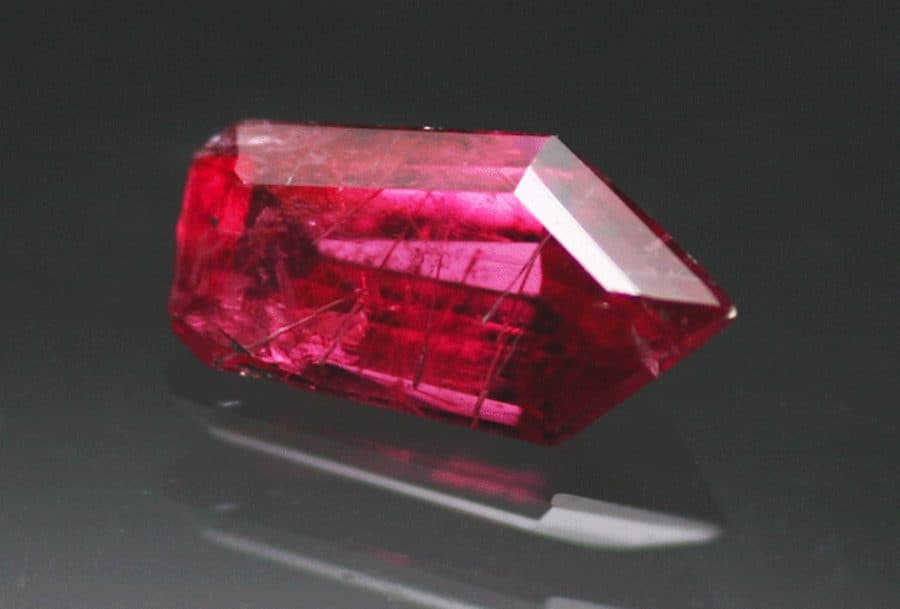
... Under 20X with back lighting, I could tell that the zoning is straight - these are not curved striae. The needles were a bit of a surprise, as they are red.
... Next I took a RI reading and measured 1.774 on the long axis. I couldn't get a reading on the short direction as it wouldn't sit flat on hemisphere. All I could get from the polariscope was that the stone is doubly refractive.
...Next I entered the following information in Gemology Tools search engine:
Color: blue
Optic Character: DR
RI High: 1.774
Transparency: Transparent
Magnification: straight growth lines
... I got assembled stones, benitoite, and sapphire for my results.
... I know this is not an assembled stone, because the inclusions run up and down through it. Benitoite has more dispersion than a diamond, at .044. If it were a benitoite, I would have seen that. So the answer is sapphire.
... Again, the identification took about five minutes.
... This ring features a big yellow stone that is eye clean. The loupe revealed a couple fine fingerprints that were only visible from side. The stone showed strong doubling. No pleochroism was observed. It has a good commercial cut, with sharp facet edges and good meets, but lots of chips and scratches in the polish.
Color: orangish yellow
Optic Character: DR U
RI High: 1.620
RI Low: 1.618
Polish Luster: Vitreous
Transparency: Transparent
... The search results gave me three possibilities: assembled stones, calcite and tourmaline.
... I went back to microscope to see if fingerprint went from the top to bottom, but I couldn't tell anything for certain. That meant I needed to do an immersion test.
... This ring was so large, I had to use a water glass to submerse the entire thing. Fortunately, I had some olive oil that was beyond its peak, so it was used. I was able to tell the stone was whole, that it was not assembled.
... That left calcite and tourmaline. Calcite is very soft, with a hardness of only 3. The facet edges were too sharp for it to be calcite, so I ended with a positive identification of tourmaline.
... This identification took about 15 minutes, with a good part of that spent cleaning the oil off the stone.
... It takes a lot of experience to become familiar with the gems and the testing procedures. There is a longer and more detailed version of this article for IGS members. To accompany this lesson, we also have a series of "What is it?" quizzes. These give examples of other practical identification problems. Together, they will give you a good idea of how to precede with your identification problems.