International Gem Society
Dedicated to bringing quality information and educational services to everyone interested in gemstones.
French, German, Italian, Portugese and Spanish speakers click here.
COLOR
CLARITY
CUT
CARAT
COLOR
...The closer a diamond is to being colorless, the greater it’s value. When the current grading system was introduced in the 1930’s, diamonds were commonly called grade A, B, or C. So the current system began color grading with the letter D, to avoid any confusion.
... Colors D, E and F are the highest grades. They are described as “colorless.”
... Colors G, H, I and J come next. They are described as "near colorless" or “white.”
... The colors from K to Z are tinted, (usually yellow or yellowish brown.) Those that are just lightly tinted, K, L and M are often said to “set white.” That means that they are so lightly tinted that they will appear white if set in yellow gold. You would however notice their color if set in white gold or platinum.
... As one gets further down the alphabet, the tinting gets stronger and the value lower. That is, until you get to the extreme. As the color becomes richer, you have a fancy colored diamond, rather than an off colored one. Then the value starts going up again.
... Color grading is done by placing a diamond next to a set of previously graded gems. The color is compared to the graded gems to see which it comes closest to matching.
... While this low tech approach is accurate, it is also expensive and time consuming. A compromise is often made on smaller gems, by grading batches within a range, rather than coming up with a specific grade. You will usually find diamonds under a carat graded as GH, or IJ, meaning that they are in that range.
... This information is meaningful and saves you quite a bit of money. It costs over $100 to accurately grade a diamond. If you have a large diamond, where subtle differences in quality grades make a significant difference in price, then it is worth while. However, that isn’t cost effective for the majority of gems.
CLARITY
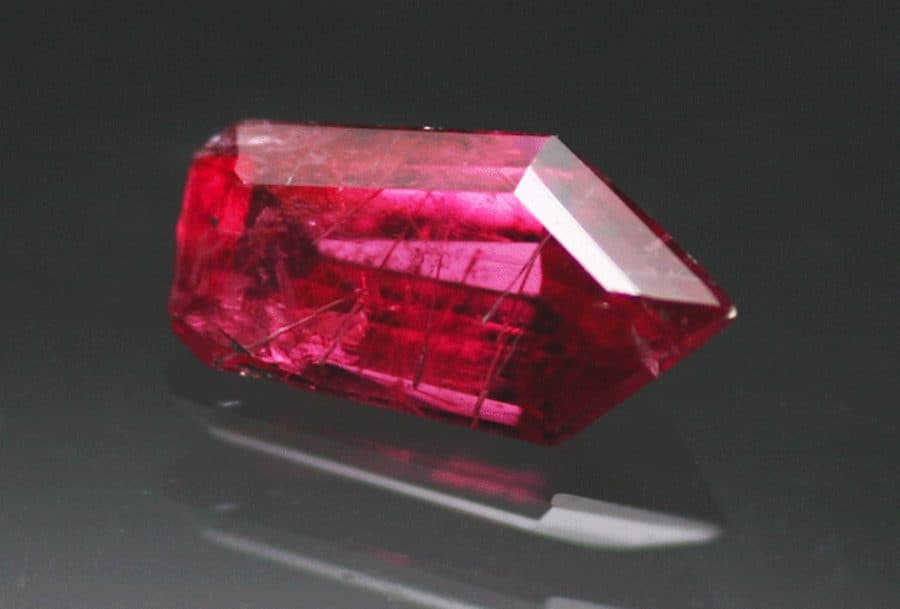
...The clarity of a diamond is determined by the size and number of inclusions inside of it. An inclusion can be another mineral, a fracture or occasionally a void. Simply put, it is anything that will interfere with the free passage of light.
... Just like with color, there are many clarity grades. They are judged by what an expert can see at 10 power magnification, under ideal conditions. The highest grade a diamond can get is Flawless. That means no inclusions can be seen at 10 power magnification. It does not mean inclusions can’t be found with higher magnification, nor should you assume it is the only grade with no inclusions visible to the naked eye.
... Clarity grades use the letters V, S and I. They stand for Very, Small, and Inclusion. Progressing from Flawless, the grades are VVSI1, (Very, Very Small Inclusions One,) VVSI2, VSI1, VSI2, SI1 then SI2. These are the grades of diamonds that have no “eye visible” inclusions, those that can’t be seen with the naked eye.
... As we progress down the grading scale, there is I1 and I2. These have eye visible inclusions, but are still considered to be gem grade.
... Then there is P1 and P2. They are not usually considered gem grade because so little light will pass through them. However, since they have the magic name diamond, they do show up on the market regularly.
... Beware of ads “1 carat diamond ring, $299.” Just because something is a diamond, doesn’t mean it is a gem. In fact, the vast majority of diamonds mined are usually considered “industrial grade” and are used as abrasives. Many of these "industrial grade diamonds," those graded as P1 and P2, find their way into jewelry simply because they had the advertising appeal of being diamonds.
CUT
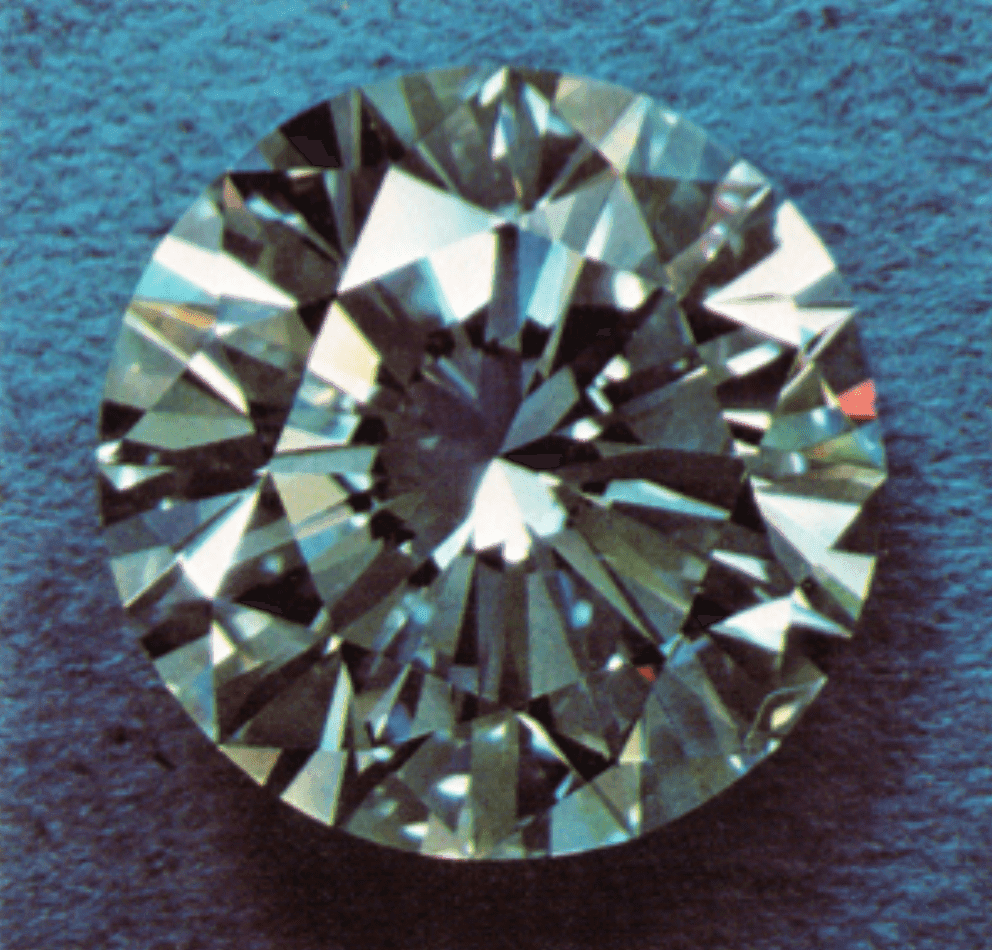
...This one of the hardest properties to judge, plus there are a number of factors to consider. The first one has to do with the brilliance of the gem.
... The pavilion facets of the gem are intended to act as mirrors, to reflect the light entering the stone, back towards the observer. However, the angle they are cut at has a lot to do with how efficiently they work. (Note: If you are unfamiliar with this terminology, see our article on “Gem Cutting Terms.")
... The ideal angle for diamond pavilion facets is 41 degrees. This is usually quite convenient, based on the shape of a standard diamond crystal. Unfortunately, not all mined diamonds are in excellent proportions. The diamond cutter is often faced with having to compromise between maximum brilliance and maximum yield. The economics are such that, if the cutter removes too much material from the original crystal, there is no profit in it. Hence, many diamonds get cut at less than ideal proportions.
... Diamonds have a high refractive index, which gives them their great brilliance. A little cheating here or there is insignificant. However, if the cutter varies a little further from the ideal the brilliance begins to suffer. Still more and you get a gem that just doesn’t stand up to others in terms of brilliance or fire.
... There are no grades for this. Most jewelers are familiar with correct proportions and can judge it from the shape. The best test for most of us is to simply compare the gems side by side. If you have two diamonds of the same grade and one is significantly brighter than the other, the cut is the difference.
... Please understand that the above discussion assumes we are talking about round diamonds. Because of their symmetrical proportions, all the major facets can be cut at the same angle. The same does not hold true for other shapes.
... Many people prefer a marquis shape. This is fine, but do not expect a marquis, or any other shape, to be as brilliant as a round. On a marquis it is necessary to cut a number of facets to accommodate the shape. The angles these facets get cut at vary, slightly to greatly, from those that give the greatest brilliance. This is a simple fact of physics: the more facets that are cut at the ideal angle, the greater the brilliance of the gem.
... When looking for diamonds you may come across the terms, "Single Cut,” “Old Mine Cut” or “European Cut.” These are gems that only have eight facets running from the girdle down and eight up to the table. That makes a total of 17 facets. A standard round brilliant cut has 57 facets.
...These “single cuts” are usually used on small accent stones, but occasionally you will find an older diamond of decent size with this cutting. Obviously, these gems won’t have the brilliance of a full cut diamond, therefore they aren’t worth as much.
... Another factor that comes under the heading of cut have to do with the shape of the gem. An ideal cut gem should be symmetrical, not lop sided. This point should be obvious, but sometimes it is helpful to point it out. A misproportioned gem can be camouflaged in it’s setting and you might not notice it until you have paid for it. This may not bother you, but it might lead to dissapointment.
... Though hard, diamonds are also somewhat brittle. (If this doesn’t make sense to you, see the article on Hardness and Wearability.) The girdle of the gem is the widest part when viewed from the top and the thinnest when viewed from the side. If cut too thin, it can present a weak area that is just asking for trouble. These illustrations will give you an idea of what normal proportions are. Some girdles get cut to a knife edge and this is definitely something to be avoided.
CARAT
...This is by far the easiest of the factors to understand. Simply put, smaller diamonds are more common than large ones. Therefore smaller diamonds cost less per carat than large ones.
... If you were to see a diamond broker's price list, under each grade, the price per carat would go up with size. A grade of diamond that would cost $900 per carat in the ½ carat size might cost $1100 per carat at ¾ of a carat and $4000 in a full carat.

... There is occasionally a difference between a diamond graded SI1 and SI2. (SI1 is defined as “small inclusions, somewhat easy to find.” SI2 is defined as “small inclusions easy to find.”) When I look at a gem graded SI1 I usually see something like the first illustration. One or two tiny dark spots that have no effect on the brilliance of the gem.
![]()