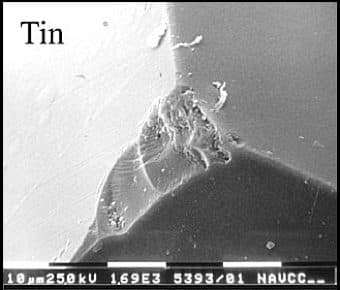
Which laps and polishes can produce the flattest facets and sharpest edges on gemstones? Our lap testing compares tin, Corian, and ceramic.
4 Minute Read
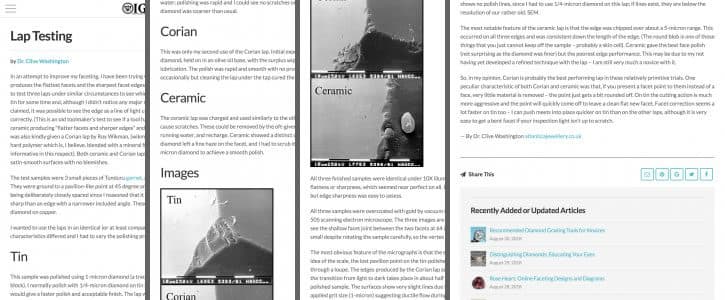
I had been using tin for some time. Although I didn’t notice any major rounding of the edges, as some people have claimed, it was possible to see the edge as a line of light under a 20X glass if the illumination was arranged correctly. (This is an old toolmaker’s test to see if a tool has a sharp cutting edge).
I had read reports of ceramic producing “flatter facets and sharper edges,” so I obtained a ceramic lap from a US supplier.
I was also kindly given a Corian lap for a trial. Corian is a rather hard polymer. I believe it’s blended with a mineral filler. (Alumina, I think, but the DuPont site isn’t very informative in this respect).
Both the ceramic and Corian laps were new and half an inch thick. They had satin-smooth surfaces with no blemishes.
For test samples, I used three small pieces of garnet from Tunduru, Tanzania, about 4 mm, dopped with hard wax. They were ground to a pavilion-like point at a 45º angle at indices 0, 32, 64, and 65. I wanted the last two indices deliberately closely spaced, since I reasoned that it…

When you join the IGS community, you get trusted diamond & gemstone information when you need it.
I had been using tin for some time. Although I didn’t notice any major rounding of the edges, as some people have claimed, it was possible to see the edge as a line of light under a 20X glass if the illumination was arranged correctly. (This is an old toolmaker’s test to see if a tool has a sharp cutting edge).
I had read reports of ceramic producing “flatter facets and sharper edges,” so I obtained a ceramic lap from a US supplier.
I was also kindly given a Corian lap for a trial. Corian is a rather hard polymer. I believe it’s blended with a mineral filler. (Alumina, I think, but the DuPont site isn’t very informative in this respect).
Both the ceramic and Corian laps were new and half an inch thick. They had satin-smooth surfaces with no blemishes.
For test samples, I used three small pieces of garnet from Tunduru, Tanzania, about 4 mm, dopped with hard wax. They were ground to a pavilion-like point at a 45º angle at indices 0, 32, 64, and 65. I wanted the last two indices deliberately closely spaced, since I reasoned that it…
Which laps and polishes can produce the flattest facets and sharpest edges on gemstones? Our lap testing compares tin, Corian, and ceramic.

“I have never known or heard of an organization that offers so much for its members, and at such a low cost.”
— Ernest Roisch, Rainbow Rocks LTD
That's less than $0.01 per article. Get instant access to 1,700+ premium articles, courses, and gem pricing data.