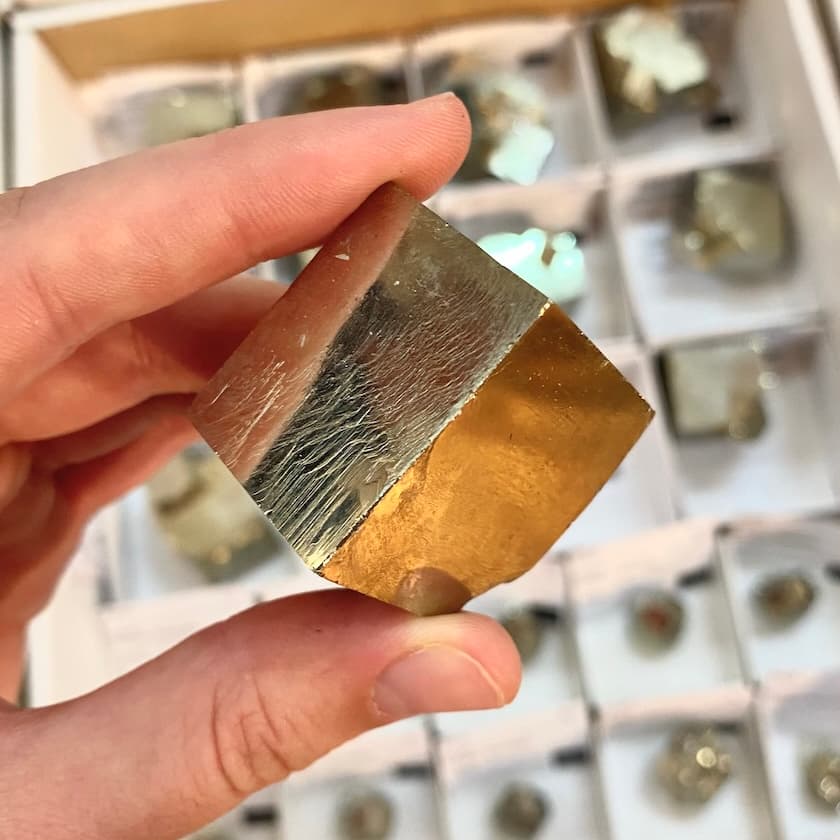
Sulfides and sulfosalts are important sources of elements crucial to modern industry. Learn how to identify these minerals.
12 Minute Read
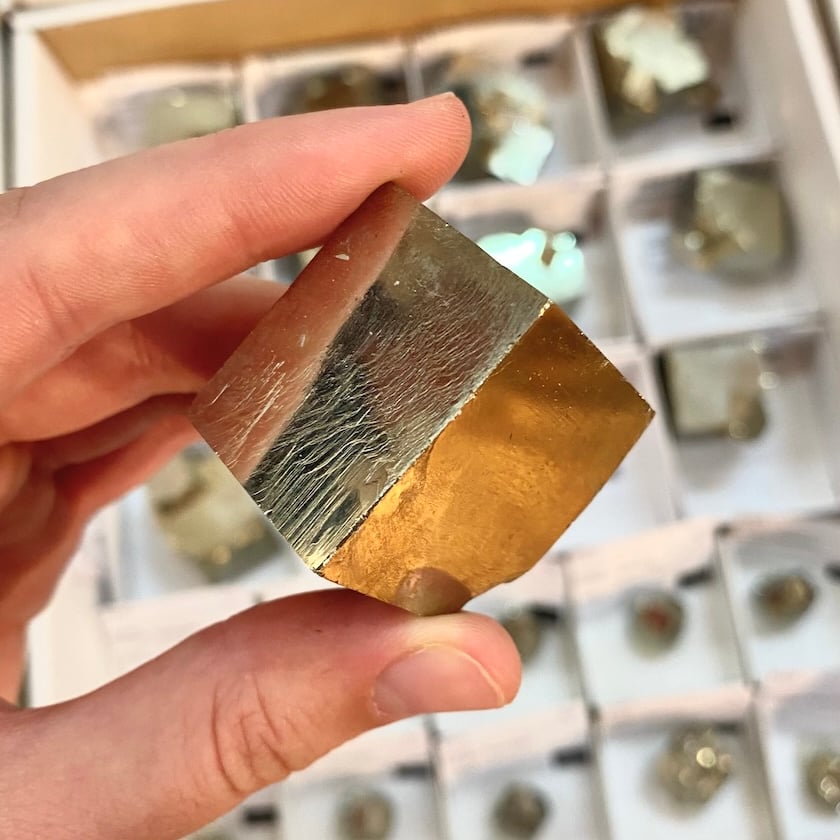
The sulfides and sulfosalts mineral class has a general formula of AmXn, where A represents a metallic element (Fe, Cu, Zn, Pb, As, Sb, Mo, etc.), and X is a sulfide – an anion of sulfur (S2-). The letters m and n are simply integers. Sometimes, the A (metallic element) position can be shared between several elements, as in chalcopyrite (CuFeS2).
Sulfides are crucial ore minerals. They are primary ores for cobalt, arsenic, nickel, molybdenum, lead, and copper. These elements have many applications in construction, medicine, chemical, electronics, and other technologies, had important roles in the development of civilization, and played an essential part in the nanotechnology revolution. (Pearce et al., 2006)
There are several hundred known species of sulfide minerals. Pyrite (FeS2), pyrrhotite (Fe1−xS (x = 0 to 0.17)), galena (PbS), sphalerite (ZnS), and chalcopyrite (CuFeS2) are the most common and can be categorized as “rock-forming,” with pyrite and pyrrhotite dominant. (Bowles et al., 2011)
Don’t be afraid pyrrhotite’s strange-looking formula. Certain sulfides exhibit a non-stoichiometric formula.
…


When you join the IGS community, you get trusted diamond & gemstone information when you need it.

The sulfides and sulfosalts mineral class has a general formula of AmXn, where A represents a metallic element (Fe, Cu, Zn, Pb, As, Sb, Mo, etc.), and X is a sulfide – an anion of sulfur (S2-). The letters m and n are simply integers. Sometimes, the A (metallic element) position can be shared between several elements, as in chalcopyrite (CuFeS2).
Sulfides are crucial ore minerals. They are primary ores for cobalt, arsenic, nickel, molybdenum, lead, and copper. These elements have many applications in construction, medicine, chemical, electronics, and other technologies, had important roles in the development of civilization, and played an essential part in the nanotechnology revolution. (Pearce et al., 2006)
There are several hundred known species of sulfide minerals. Pyrite (FeS2), pyrrhotite (Fe1−xS (x = 0 to 0.17)), galena (PbS), sphalerite (ZnS), and chalcopyrite (CuFeS2) are the most common and can be categorized as “rock-forming,” with pyrite and pyrrhotite dominant. (Bowles et al., 2011)
…Don’t be afraid pyrrhotite’s strange-looking formula. Certain sulfides exhibit a non-stoichiometric formula.

Sulfides and sulfosalts are important sources of elements crucial to modern industry. Learn how to identify these minerals.
“I have never known or heard of an organization that offers so much for its members, and at such a low cost.”
— Ernest Roisch, Rainbow Rocks LTD
That's less than $0.01 per article. Get instant access to 1,700+ premium articles, courses, and gem pricing data.