Diamond Fundamentals Mini Course
Diamond Buying and the Four Cs, Part 3: Evaluating Diamond Cuts
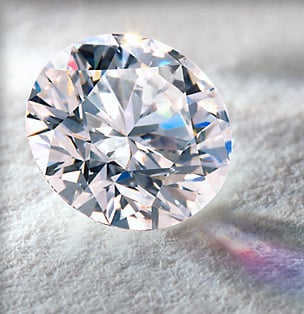
Choosing and executing diamond cuts successfully takes an understanding of light and angles. No wonder famed diamond cutter Marcel Tolkowsky was also a mathematician! Cutting is critical to the optical performance of diamonds. Unfortunately, when most people view a diamond, carat size usually makes the biggest impression. In reality, cut greatly affects how large a diamond appears and the light pattern it shows. It also largely determines its brilliance — how much light it returns — and dispersion — how much internal “fire” it displays. If poorly executed, the cut can ruin these most prized aspects of diamonds, not something you want in an engagement ring!
Diamond Cut Grades
For round brilliant diamonds, cut grades are as follows:
- Excellent
- Very good
- Good
- Fair
- Poor
Lasers do most of the cutting nowadays, so most diamonds should fall in the Very Good to Excellent range.
The only reason diamonds ever have a less than Excellent cut is because the diamond cutter is trying to save weight. Diamond cutting is usually a compromise between saving weight and maintaining good brightness, pattern, and symmetry.
A diamond of a larger
…

Never Stop Learning
When you join the IGS community, you get trusted diamond & gemstone information when you need it.