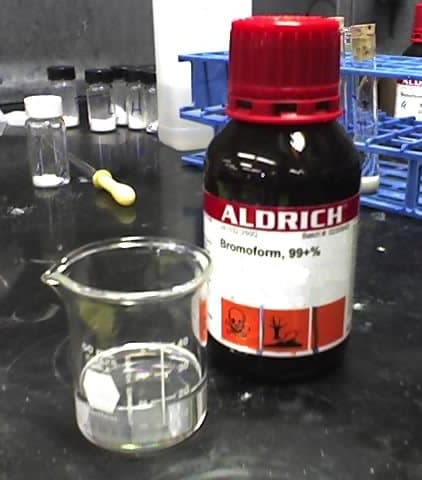
Using heavy liquids to measure a gemstone's specific gravity poses some health hazards. Learn the techniques and precautions that gemologists take.
2 Minute Read
The Gemological Institute of America (GIA) offers a set with densities of 2.57, 2.62, 2.67, 3.05, and 3.32. Other manufacturers offer sets with different ranges.
Most heavy liquids are solvents, in the same family as thinners, and toxic. Don’t inhale their vapors or get any on your skin or clothing. Heavy liquids are also flammable, so keep them away from heat sources at all times. Follow all the manufacturer’s safety instructions for whatever set you choose.
You can learn more about gemology and lapidary safety here.
The theory behind using heavy liquids is simple. If you put a gem in a liquid with the same density, it’ll stay in place. Should the gem have a greater density, it’ll sink. So it follows that the gem will float if it has a lower density.
How fast the gem sinks or floats will give you some indication of how much its specific gravity varies from the liquid’s. If the difference is just a couple hundredths of a point, it will drift slowly up or down. A difference of a…

When you join the IGS community, you get trusted diamond & gemstone information when you need it.
The Gemological Institute of America (GIA) offers a set with densities of 2.57, 2.62, 2.67, 3.05, and 3.32. Other manufacturers offer sets with different ranges.
Most heavy liquids are solvents, in the same family as thinners, and toxic. Don’t inhale their vapors or get any on your skin or clothing. Heavy liquids are also flammable, so keep them away from heat sources at all times. Follow all the manufacturer’s safety instructions for whatever set you choose.
You can learn more about gemology and lapidary safety here.
The theory behind using heavy liquids is simple. If you put a gem in a liquid with the same density, it’ll stay in place. Should the gem have a greater density, it’ll sink. So it follows that the gem will float if it has a lower density.
How fast the gem sinks or floats will give you some indication of how much its specific gravity varies from the liquid’s. If the difference is just a couple hundredths of a point, it will drift slowly up or down. A difference of a…
Using heavy liquids to measure a gemstone's specific gravity poses some health hazards. Learn the techniques and precautions that gemologists take.

“I have never known or heard of an organization that offers so much for its members, and at such a low cost.”
— Ernest Roisch, Rainbow Rocks LTD
That's less than $0.01 per article. Get instant access to 1,700+ premium articles, courses, and gem pricing data.