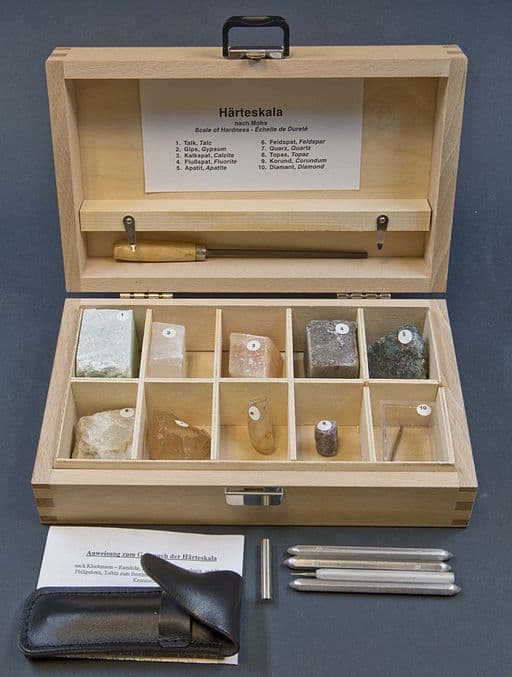
Gemstone scratch testing can help determine the Mohs hardness value of a mineral sample. Learn how to conduct this destructive gem test safely.
3 Minute Read
Scratch testing (or hardness testing) is one of the most destructive gemstone tests. Never perform a scratch test on a finished stone. This can fracture or shatter the gem, even if tested on an inconspicuous area.
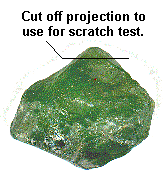
Gem rough can be scratch tested, but caution is needed. Keep in mind that the rough may have incipient fractures invisible to the naked eye or internal stress that will open up easily to pressure. For these reasons, perform scratch testing only on small protrusions. Whenever possible, saw a piece off of the main rough stone for testing.
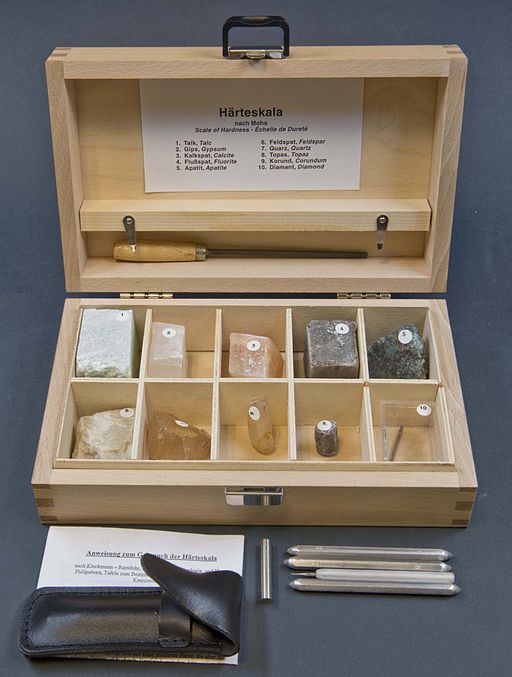
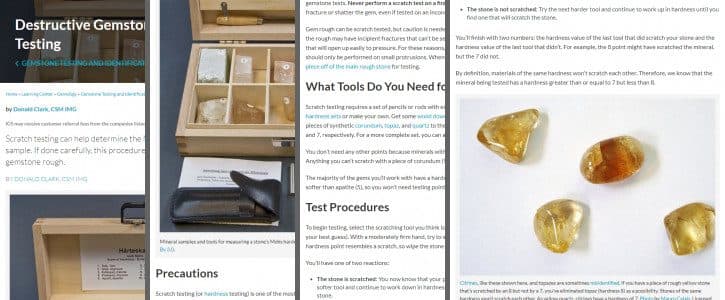
Scratch testing requires a set of pencils or rods with ends of known Mohs hardness value. You can buy hardness sets or make your own. Get some wood dowels about the size of a pencil. Attach small, sharp pieces of synthetic corundum, topaz, and quartz to the ends of individual dowels and label them 9, 8, and 7, respectively. For a more complete set, you can add feldspar and apatite, 6 and 5, respectively.
…

When you join the IGS community, you get trusted diamond & gemstone information when you need it.
Scratch testing (or hardness testing) is one of the most destructive gemstone tests. Never perform a scratch test on a finished stone. This can fracture or shatter the gem, even if tested on an inconspicuous area.
Gem rough can be scratch tested, but caution is needed. Keep in mind that the rough may have incipient fractures invisible to the naked eye or internal stress that will open up easily to pressure. For these reasons, perform scratch testing only on small protrusions. Whenever possible, for testing.
…Scratch testing requires a set of pencils or rods with ends of known Mohs hardness value. You can buy hardness sets or make your own. Get some wood dowels about the size of a pencil. Attach small, sharp pieces of synthetic corundum, topaz, and quartz to the ends of individual dowels and label them 9, 8, and 7, respectively. For a more complete set, you can add feldspar and apatite, 6 and 5, respectively.
Gemstone scratch testing can help determine the Mohs hardness value of a mineral sample. Learn how to conduct this destructive gem test safely.
“I have never known or heard of an organization that offers so much for its members, and at such a low cost.”
— Ernest Roisch, Rainbow Rocks LTD
That's less than $0.01 per article. Get instant access to 1,700+ premium articles, courses, and gem pricing data.