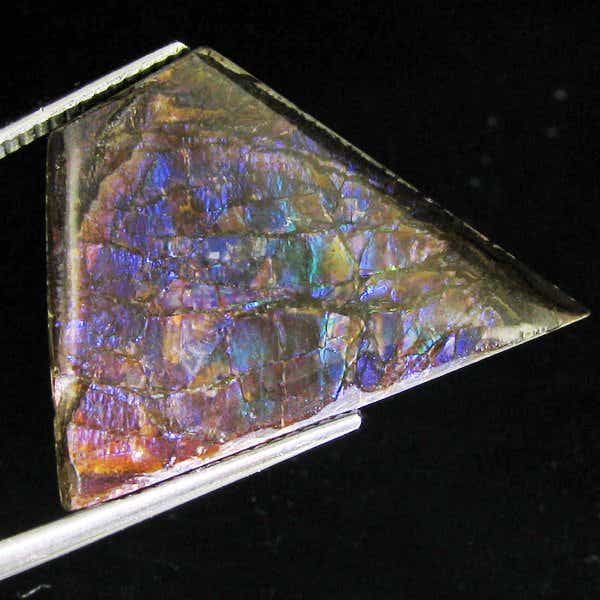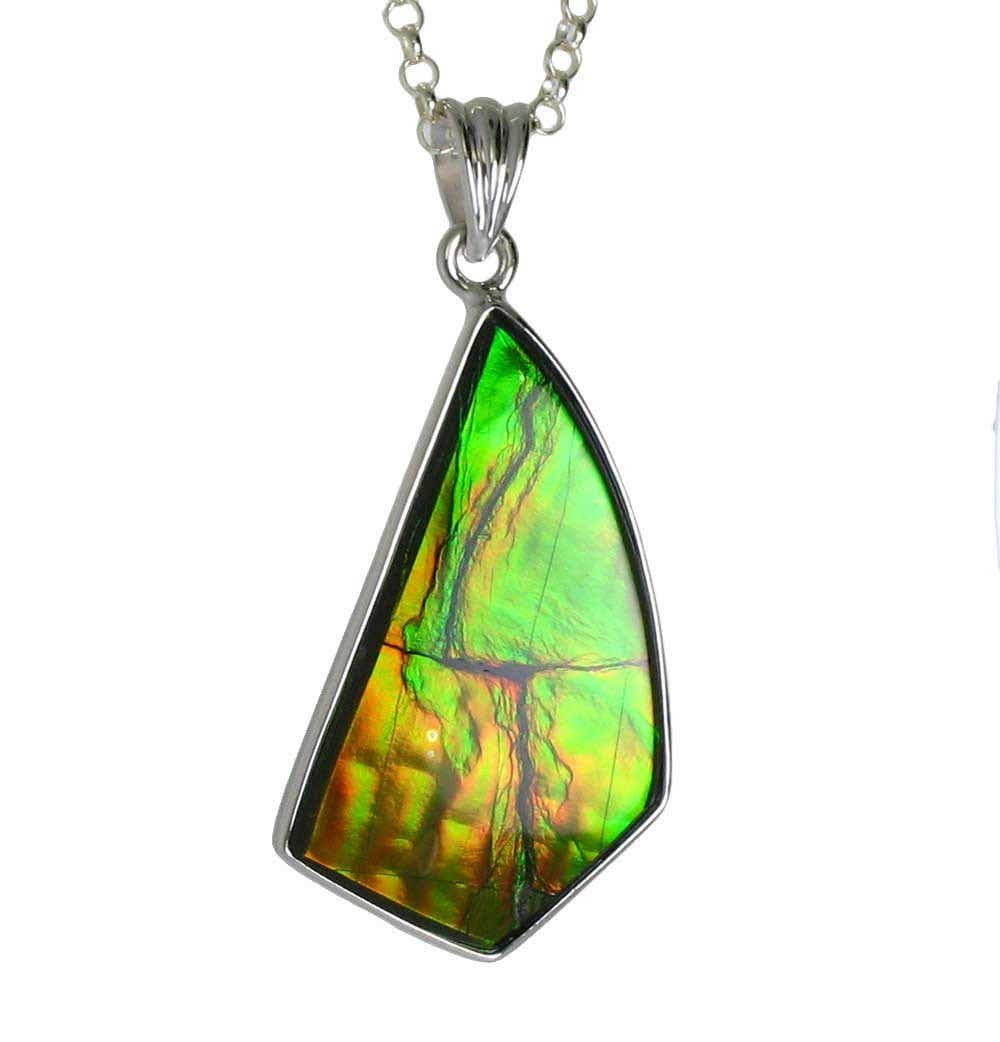
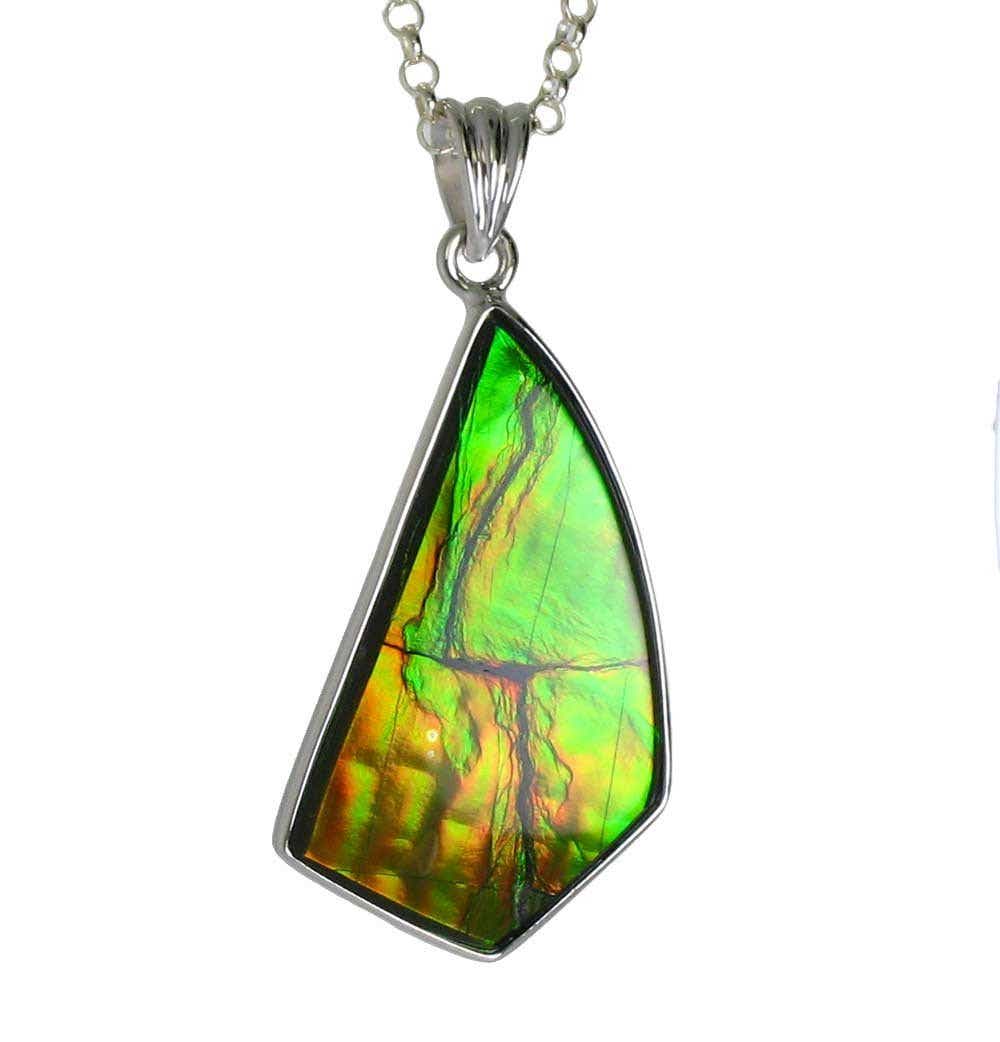
Ammolite is a rare, iridescent, gem-quality material cut from the fossilized shells of extinct sea creatures. Found only in the Bearpaw Formation in Alberta, Canada, this organic gemstone has a dazzling range of colors and patterns and is highly desired for cabochons and assembled jewelry pieces.
6 Minute Read
Ammolite was first used for commercial jewelry in the 1960s. It was only recognized as an organic gemstone in 1981 by the Coloured Stones Commission of the World Jewellery Confederation (CIBJO).
Ammolite is also known as calcentine and by the trade name Korite. The mining company Korite International Ltd. is the largest commercial supplier of this gemstone. In Siksika, the language of the native Blackfoot people, the stone is called aapoak, meaning "small, crawling stone."
You may find the terms ammolite and ammonite sometimes used interchangeably. However, ammonite, strictly speaking, refers to the fossil shells of ammonites, whether gem-quality or not. Ammolite refers to the gem-quality material made from fossils of particular species of ammonites.
Ammonites were marine mollusks that became extinct around 65 million years ago. There were many species of ammonites, and their fossils have been found across the globe. The fossils of Placenticeras meeki,Placenticeras intercalare, and Baculites compressus can yield gem-quality ammolite. To date, this material has been found only in Alberta, Canada.
Other gem-quality ammonite exists, such as lumachelle, which lapidaries cut from the fossils of Carnites floridus found in Austria. Although this iridescent material resembles ammolite, its mineral composition differs.
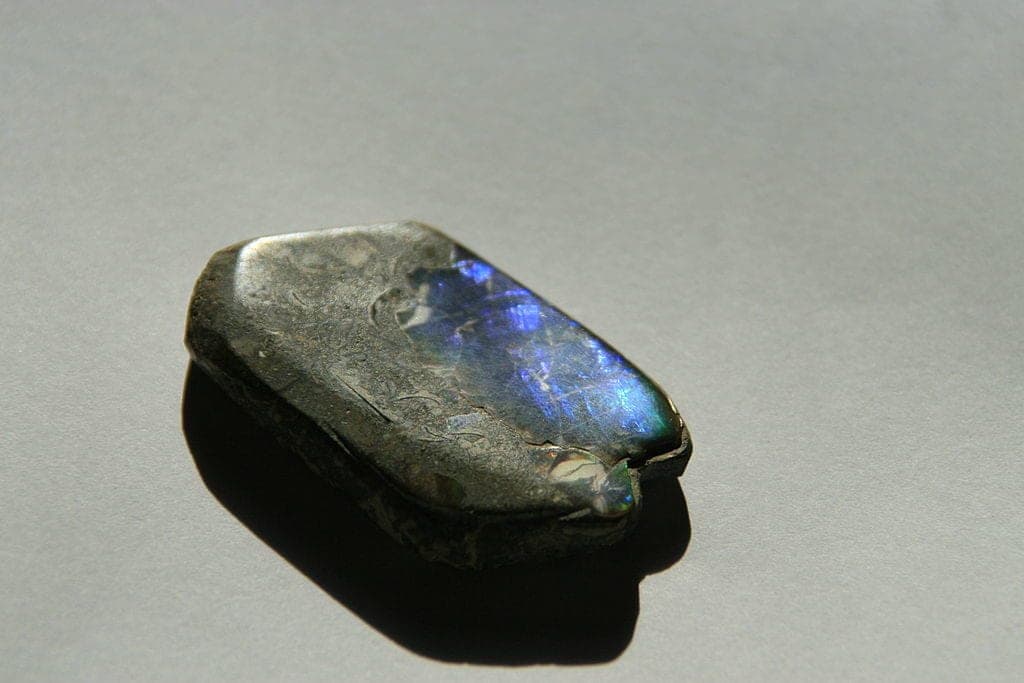
Only about 5% of the ammonites found in Alberta have any suitable gem material. This only occurs on the shell surface. Of those specimens, gem cutters can typically use only about 20% of the shell. All ammolites come from that small amount of usable gem-quality material. These percentages make these gems extremely rare.
Fossilized ammonite shell is comprised primarily of aragonite (the major constituent mineral of pearl) with trace elements of aluminum, barium, chromium, copper, iron, magnesium, manganese, silicon, strontium, titanium, and vanadium. The iridescent outer layers may be 0.5-8.0 mm thick before polishing and 0.1-3.0 mm thick after polishing.
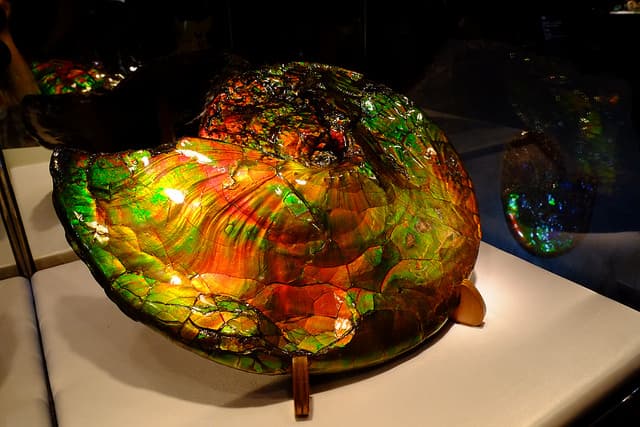
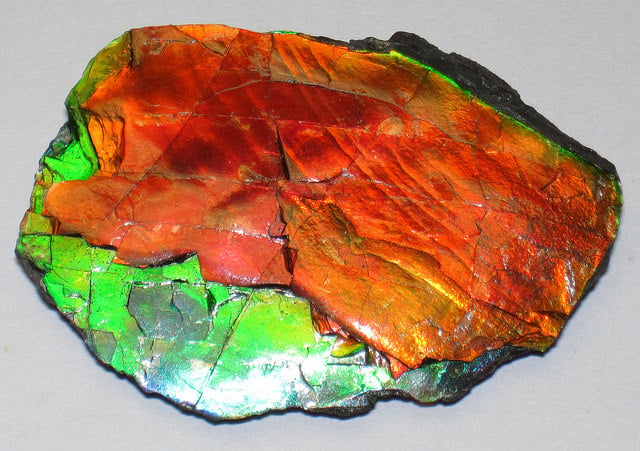
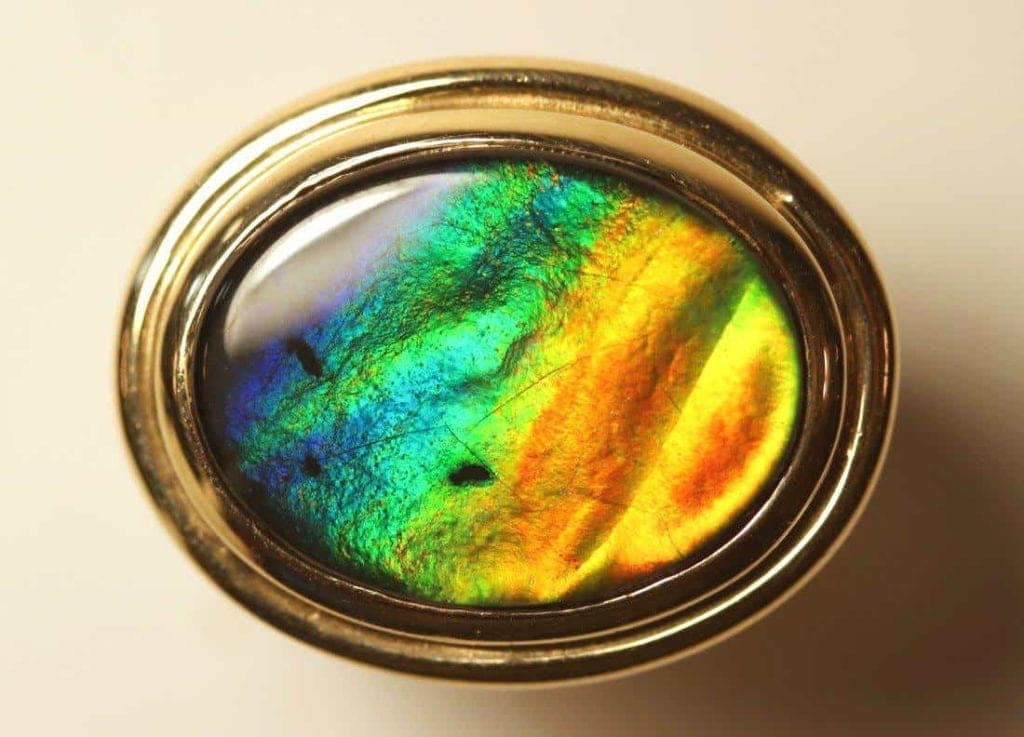
High-grade ammolites will have either a very strong, bright, single color or a range of bright colors. These gems can show any color of the rainbow. (Sometimes, they seem to show more than that!) Low-grade gemstones will show less vibrant colors in a more limited range. Generally, red and green are more common than blue or purple. Certain hues, like crimson, violet, and gold, are very rare and in high demand.
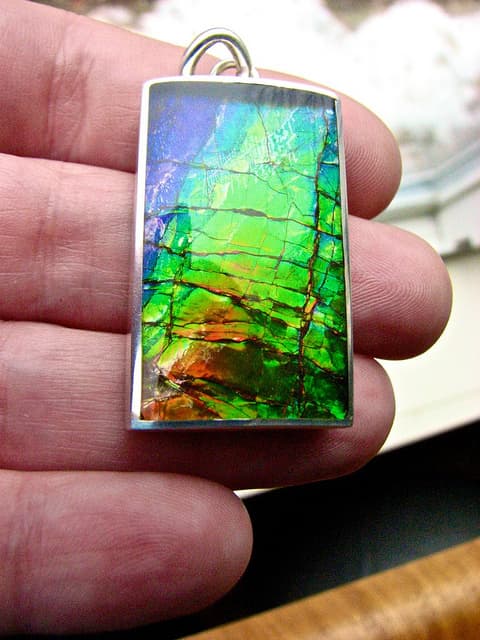
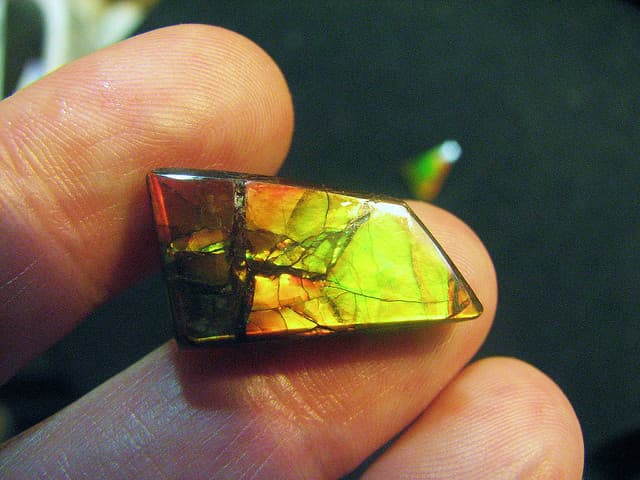
Ammolites can show striking patterns of healed fractures and colors. These have various descriptive names, such as:
The geological layers in which ammonites fossilized affected the formation of these patterns. (See "Sources" below).
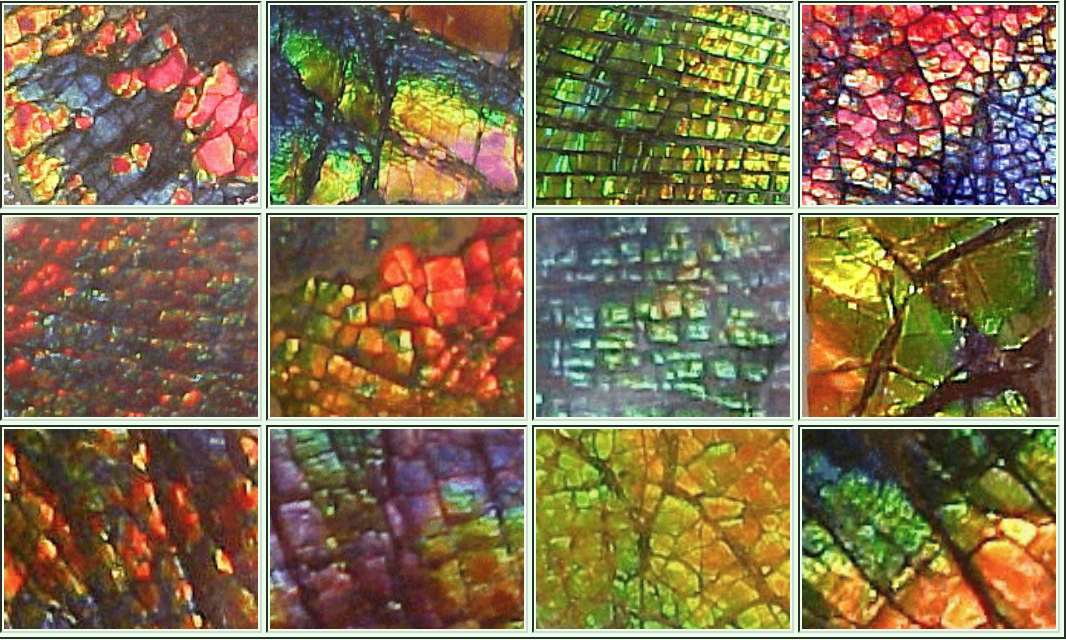
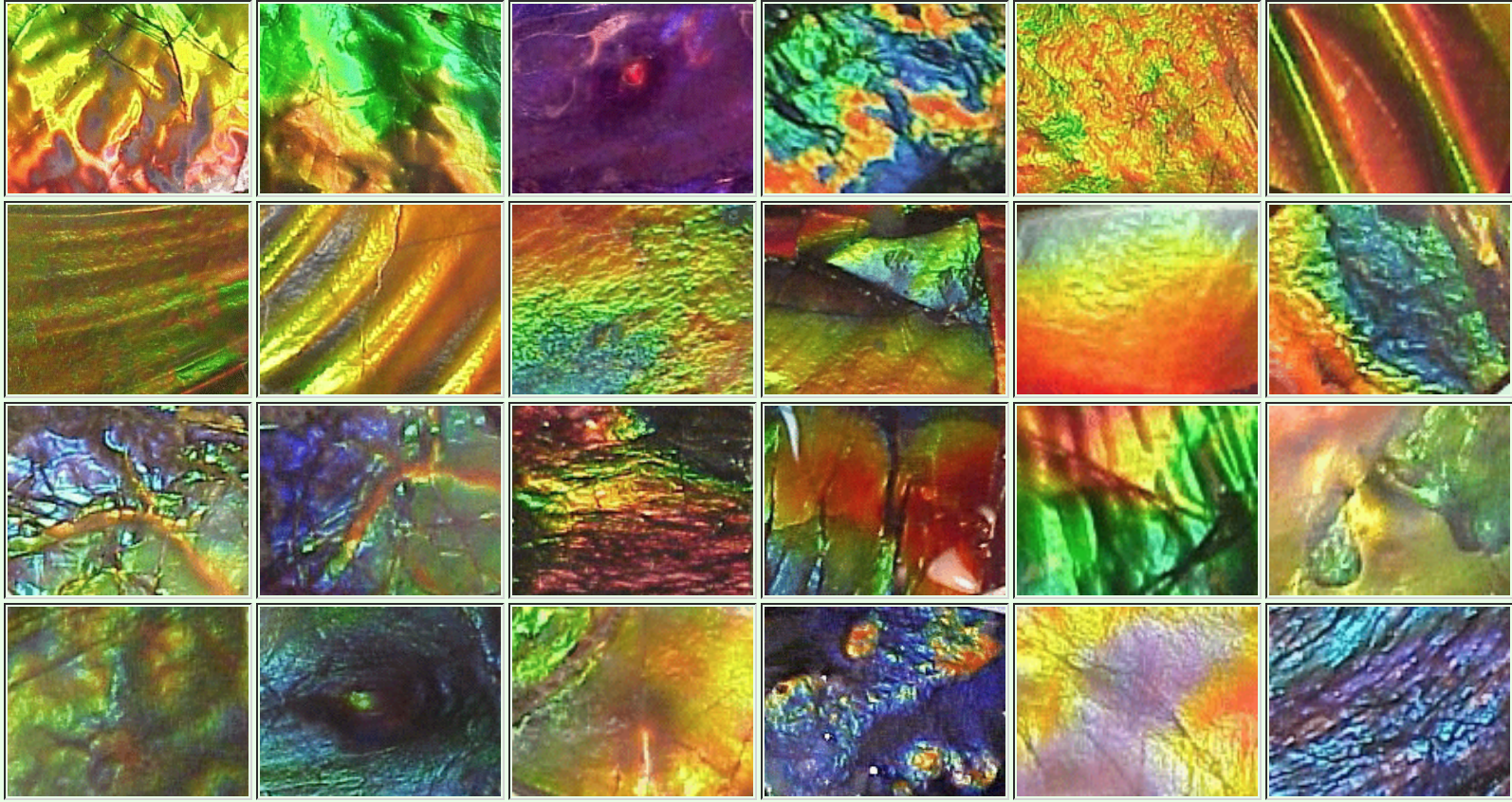
Iridescence is the property that creates the incredible colors across the surface of ammolites. The surface of gem-quality fossil shells is composed of closely-packed, tabular crystals of aragonite, with their c-axis oriented vertical to the shell surface. They form thin lamellae (plates or scales). The thickness of the aragonite lamellae is of the same scale as the wavelengths of the spectral colors that make up white light. Thus, when white light enters the regularly spaced, thin layers of aragonite, diffraction occurs, visible as flashes of spectral colors.
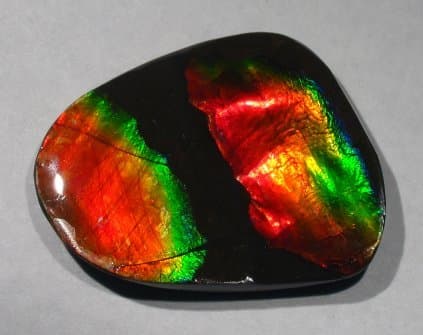
The plates of aragonite crystals vary in thickness: ordered, thick stacks for red gems, less ordered, thinner stacks for green, and unordered, very thin stacks for blue ones. Additionally, trace elements are randomly arranged and interspersed with inclusions of organic material (conchiolin). These factors determine the colors and intensity of the diffraction. The best gems will have brilliant, vibrant iridescence, continually dancing with changing colors as the angle of incident light changes.
The color of ammolite depends on the angle of light and the viewer's perspective. Sometimes, a chromatic shift occurs. This can be subtle or spectacularly dramatic. In a dichromatic shift, red will shift to green, green will shift to blue, etc. Some gem material will have shift restricted to hues within the same primary color group. This shift is called monochromatic. However, the best material has spectrochromatic shift. The color will shift through the entire spectrum depending on the light source and angle of observation.
Some material won't show strong, vibrant colors through 360° of rotation. When these stones are rotated, the brightness decreases and darkens to black. This is due to organic inclusions in the aragonite blocking light wave diffraction. A high-grade gemstone must show a brilliant color through 360° of rotation.
Gems are sometimes Opticon Fracture Sealer & Hardener for stabilization.
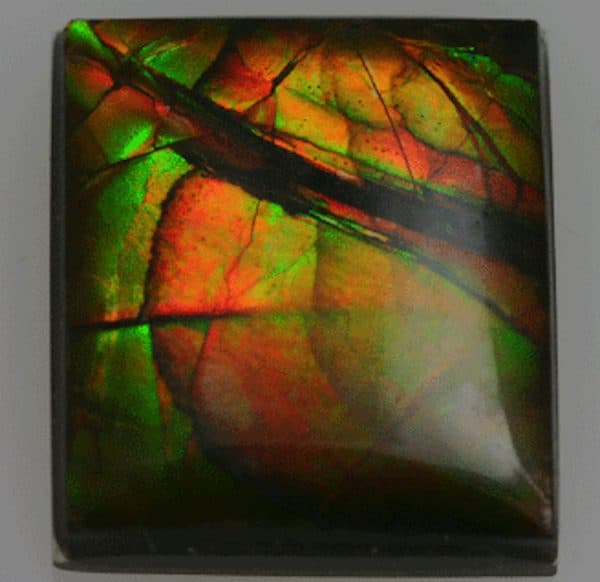
Ammolite is only found in the Bearpaw Formation, which extends from Alberta to Saskatchewan in Canada and south to Montana in the US. The best gem-quality ammolite is found along high-energy river systems on the eastern slopes of the Rocky Mountains in southern Alberta. Most commercial mining takes place along the banks of the St. Mary River, south of Lethbridge.
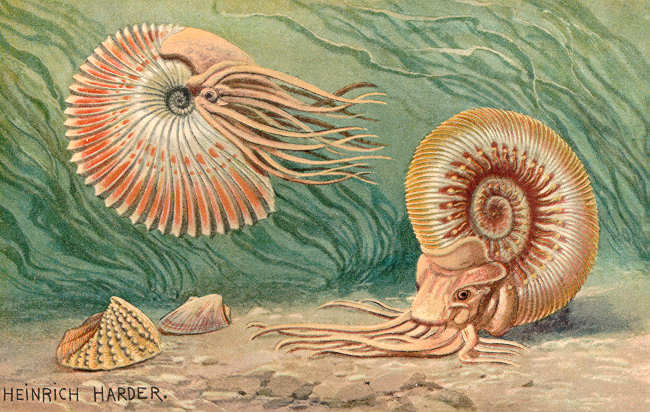
75 to 70 million years ago, this was the northwestern edge of the Bearpaw Sea (also known as the Western Interior Seaway). This shallow, warm body of water teemed with life. One of its most prolific inhabitants was the ammonite. These creatures thrived in every ecological niche open to them. They were deep-water bottom feeders as well as jet-propelled predators. Ammonites had big brains, too.
Cataclysmic volcanic activity from the growing Rockies periodically covered huge areas with meters of ash. As the ash settled slowly on the shallow ocean floor, it killed all life below. A heavy, semi-impermeable layer of mineral-rich clay (bentonite) sealed their remains. Over time, ash buried the St. Mary River area over 4 km deep. Through many glacial periods, the area underwent geological uplift and, eventually, surface exposure. High concentrations of iron and magnesium created a regionally unique condition, which led to sedimentary digenesis. This impeded the oxidization process that converts the aragonite of the ammonite shell to stable calcium carbonate (CaCO3).
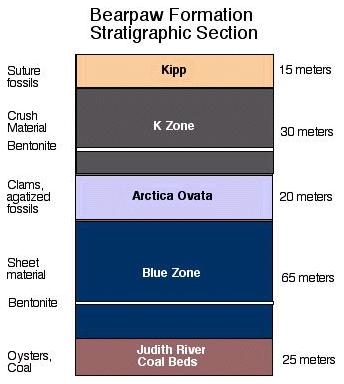
Protected by either large ironstone concretions (siderite or FeCO3) or a thin layer of iron pyrite (FeS2), ammolites formed in two distinct geological horizons known as the K Zone (crush) and the Blue Zone (sheet). The infill rate of seaborne sediment into the ammonite chambers could explain the iron pyrite difference between crush and sheet material.
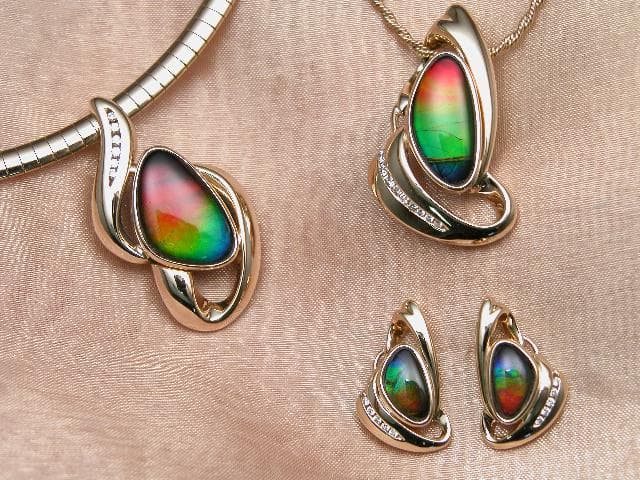
Freeform "naturals" make excellent choices for brooches, pendants, or earrings. For rings, use triplets.
The care recommendations for pearls also apply to ammolite naturals. Avoid using mechanical systems like ultrasonic and steam cleaners. Preferably, clean these gems with warm, soapy water and a brush. Excessive heat, acids, and some perfumes or hairsprays may damage them or cause a loss of iridescence.
You may clean triplets in ultrasonic systems. Although the cap should protect the ammolite from scratches, make sure you suspend your piece off the bottom of the machine. Strong jolts during cleaning could separate the layers.
Consult our gemstone jewelry cleaning guide for more information.

When you join the IGS community, you get trusted diamond & gemstone information when you need it.
Ammolite was first used for commercial jewelry in the 1960s. It was only recognized as an organic gemstone in 1981 by the Coloured Stones Commission of the World Jewellery Confederation (CIBJO).
Ammolite is also known as calcentine and by the trade name Korite. The mining company Korite International Ltd. is the largest commercial supplier of this gemstone. In , the language of the native Blackfoot people, the stone is called , meaning "small, crawling stone."
You may find the terms ammolite and ammonite sometimes used interchangeably. However, ammonite, strictly speaking, refers to the fossil shells of ammonites, whether gem-quality or not. Ammolite refers to the gem-quality material made from fossils of particular species of ammonites.
Ammonites were marine mollusks that became extinct around 65 million years ago. There were many species of ammonites, and their fossils have been found across the globe. The fossils of Placenticeras meeki,Placenticeras intercalare, and Baculites compressus can yield gem-quality ammolite. To date, this material has been found only in Alberta, Canada.
Other gem-quality ammonite exists, such as lumachelle, which lapidaries cut from the fossils of Carnites floridus found in Austria. Although this iridescent material resembles ammolite, its mineral composition differs.
Only about 5% of the ammonites found in Alberta have any suitable gem material. This only occurs on the shell surface. Of those specimens, gem cutters can typically use only about 20% of the shell. All ammolites come from that small amount of usable gem-quality material. These percentages make these gems extremely rare.
Fossilized ammonite shell is comprised primarily of aragonite (the major constituent mineral of pearl) with trace elements of aluminum, barium, chromium, copper, iron, magnesium, manganese, silicon, strontium, titanium, and vanadium. The iridescent outer layers may be 0.5-8.0 mm thick before polishing and 0.1-3.0 mm thick after polishing.
High-grade ammolites will have either a very strong, bright, single color or a range of bright colors. These gems can show any color of the rainbow. (Sometimes, they seem to show more than that!) Low-grade gemstones will show less vibrant colors in a more limited range. Generally, red and green are more common than blue or purple. Certain hues, like crimson, violet, and gold, are very rare and in high demand.
Ammolites can show striking patterns of healed fractures and colors. These have various descriptive names, such as:
The geological layers in which ammonites fossilized affected the formation of these patterns. (See "Sources" below).
Iridescence is the property that creates the incredible colors across the surface of ammolites. The surface of gem-quality fossil shells is composed of closely-packed, tabular crystals of aragonite, with their c-axis oriented vertical to the shell surface. They form thin lamellae (plates or scales). The thickness of the aragonite lamellae is of the same scale as the wavelengths of the spectral colors that make up white light. Thus, when white light enters the regularly spaced, thin layers of aragonite, diffraction occurs, visible as flashes of spectral colors.
The plates of aragonite crystals vary in thickness: ordered, thick stacks for red gems, less ordered, thinner stacks for green, and unordered, very thin stacks for blue ones. Additionally, trace elements are randomly arranged and interspersed with inclusions of organic material (conchiolin). These factors determine the colors and intensity of the diffraction. The best gems will have brilliant, vibrant iridescence, continually dancing with changing colors as the angle of incident light changes.
The color of ammolite depends on the angle of light and the viewer's perspective. Sometimes, a chromatic shift occurs. This can be subtle or spectacularly dramatic. In a dichromatic shift, red will shift to green, green will shift to blue, etc. Some gem material will have shift restricted to hues within the same primary color group. This shift is called monochromatic. However, the best material has spectrochromatic shift. The color will shift through the entire spectrum depending on the light source and angle of observation.
Some material won't show strong, vibrant colors through 360° of rotation. When these stones are rotated, the brightness decreases and darkens to black. This is due to organic inclusions in the aragonite blocking light wave diffraction. A high-grade gemstone must show a brilliant color through 360° of rotation.
Gems are sometimes Opticon Fracture Sealer & Hardener for stabilization.
Ammolite is only found in the Bearpaw Formation, which extends from Alberta to Saskatchewan in Canada and south to Montana in the US. The best gem-quality ammolite is found along high-energy river systems on the eastern slopes of the Rocky Mountains in southern Alberta. Most commercial mining takes place along the banks of the St. Mary River, south of Lethbridge.
75 to 70 million years ago, this was the northwestern edge of the Bearpaw Sea (also known as the Western Interior Seaway). This shallow, warm body of water teemed with life. One of its most prolific inhabitants was the ammonite. These creatures thrived in every ecological niche open to them. They were deep-water bottom feeders as well as jet-propelled predators. Ammonites had big brains, too.
Cataclysmic volcanic activity from the growing Rockies periodically covered huge areas with meters of ash. As the ash settled slowly on the shallow ocean floor, it killed all life below. A heavy, semi-impermeable layer of mineral-rich clay (bentonite) sealed their remains. Over time, ash buried the St. Mary River area over 4 km deep. Through many glacial periods, the area underwent geological uplift and, eventually, surface exposure. High concentrations of iron and magnesium created a regionally unique condition, which led to sedimentary digenesis. This impeded the oxidization process that converts the aragonite of the ammonite shell to stable calcium carbonate (CaCO3).
Protected by either large ironstone concretions (siderite or FeCO3) or a thin layer of iron pyrite (FeS2), ammolites formed in two distinct geological horizons known as the K Zone (crush) and the Blue Zone (sheet). The infill rate of seaborne sediment into the ammonite chambers could explain the iron pyrite difference between crush and sheet material.
Freeform "naturals" make excellent choices for brooches, pendants, or earrings. For rings, use triplets.
The care recommendations for pearls also apply to ammolite naturals. Avoid using mechanical systems like ultrasonic and steam cleaners. Preferably, clean these gems with warm, soapy water and a brush. Excessive heat, acids, and some perfumes or hairsprays may damage them or cause a loss of iridescence.
You may clean triplets in ultrasonic systems. Although the cap should protect the ammolite from scratches, make sure you suspend your piece off the bottom of the machine. Strong jolts during cleaning could separate the layers.
Consult our gemstone jewelry cleaning guide for more information.


Ammolite is a rare, iridescent, gem-quality material cut from the fossilized shells of extinct sea creatures known as ammonites. Found only in the Bearpaw Formation in Alberta, Canada, this organic gemstone has a dazzling range of colors and patterns and is highly desired for freeform natural cabochons and assembled jewelry pieces.
Ammolite “naturals” are freeform cabochons with a non-coated hand finish. They’re backed by the original shale of the fossil and can range in size up to 10 carats and 6 inches across. These are priced by carat weight, but the backing thickness shouldn’t exceed 1.5 mm.
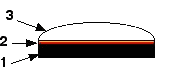
Gem cutters can also create ammolite doublets or triplets. Doublets are freeform cabs bonded to a backing. Ammolite triplets are usually constructed on a dark gray wafer of natural shale (1) below a thin layer of ammolite (2). On top, there’s usually a calibrated cap of optical quartz or synthetic spinel (3). This structure allows the ammolite to show the most brilliant flash while protecting it in a setting durable enough for everyday jewelry wear.
The ammolite industry has yet to agree on any one grading system. However, most systems refer to color, brightness, iridescence, etc.
| Gem Grade | AA | A+ | A | A- |
| Colors | 3 or more | 1 or 2 | 1 or Pale | Dark/Pale |
| Iridescence | Brilliant | Bright | Included | Dull/Dark |
| Chromatic Shift | Spectro | Di | Mono | Little |
| Rotational Range | 360° | 240° | 180° | 90° |
For more information on ammolite quality factors consult the IGS buying guide.