17 Minute Read
Twenty years ago, my father made an observation that troubled him. "You know what you never see anymore," he said, "business names that end with '& sons'".
For him, a first-generation American growing up in 1930's Connecticut, he saw so many of his peers working in their family's businesses, eventually taking the reins as their parents reached retirement age. Often, he noted, there were no discussions about this.
Families who were fortunate enough to have a successful business of any kind expected that the next generation would remain in the trade and continue to build on the hard-won foundation. It turns out that my dad is not the only person to worry. Quite a few participants at the 2026 Tucson gem shows expressed concerns that there were very few "young people" willing to take the reins of their family businesses.
The fine gem and jewelry shows AGTA and GJX are extremely important events in the trade. Some of the attendees have made the annual pilgrimage for decades and look forward to seeing long-time colleagues and friends. Business there happens at all levels of the supply chain - from buying rough directly from miners to acquiring finished jewelry ready for the retail market.
The atmosphere is excited, but also intense. People are making deals of serious magnitude. The success of their businesses rests on getting the quality of goods they need at a fair price. In past centuries, the trade was made up of a tight-knit group of people who sold luxury items to just a select few rich and powerful individuals. Yet, this business was, and remains today, a cash-poor industry with money tied up in inventory. A single purchase of overpriced goods could end a career.
To alleviate some of the risk that comes with dealing with high-priced goods, past gem and jewelry professionals created dense social networks where people worked with just a few trusted contacts. Distrust ran rampant, and breaking into the industry was extremely difficult. Many trusted only their kin, leading to the formation of multi-generational businesses. This just made sense. A child raised in their family's workplace learned not only the ins and outs of that operation, but they also formed those important bonds with established business contacts that would help them continue a close and mutually beneficial relationship into the future.
This is a pattern that was maintained for hundreds of years, but it appears things are changing as the upcoming generations are significantly less likely to follow their forebearers' career paths.
There are multiple consequences of having an aging population without an influx of younger energy. It is a natural result of maturing that people slow down and rely on their established habits and patterns. This is especially problematic considering the recent explosion of social media, which has fundamentally changed how people communicate.
Here is what the professionals attending AGTA and GJX had to say about changing demographics and how it foretells a drastic change in how the trade operates.
Steve Helmich of Kostbar International is part of a multi-generational jewelry family, but said that the upcoming generation rarely opts to work for their family's business - "seeing kids who take over are few and far between." He attributed this to a number of different factors, including the fact that owning a jewelry store "is not an easy thing." Indeed, Helmich was the first of many people to cite the labor-intensive nature of the business as a primary reason for children of jewelry professionals to seek different careers.
Helmich explained that he has changed how Kostbar International does business without a dedicated younger person involved. "I am no longer travelling to most shows. There is a great risk and expense in doing them. If I were twenty years younger, it would be different." The benefits of attending shows, he says, have also decreased. So much business is now done virtually that newer buyers are often choosing to skip many in-person events.
"Right now," Helmich said," I am happy where we are now in terms of the business. In the last few years, we have lost many of our long-term clients and it is too hard to actively find new connections." While Helmich will continue working at what he loves, he is not actively chasing growth.
Similar to Helmich, Harold Solomon, owner of Harry H. Solomon Co., Inc., is a third-generation jewelry professional. Solomon shared how the business model for his business evolved responding to societal changes from the time of its founding in 1920. Initially Solomon's grandfather's store in Boston was a retail operation.
Skipping forward a generation, Solomon's father transitioned to a wholesale role and inked memo deals with giant brands like Kay's. Solomon explained that he witnessed firsthand a change in the economy between 1980 and 1985 when it became difficult to get reimbursed for those memo deals in a timely fashion. This led him to change the focus of the business a third time, focusing now on estate jewelry.
Solomon likes this model and says that he considers the business a hobby more than a job. He has no employees and does not have to deal with loans. He makes his own hours, buys jewelry with the money that he has in the bank, and gets paid in full when clients make a purchase. Yet, in spite of having created a stable business, he has turned his children away from the trade and will close Harry H. Solomon Co., Inc. when he retires - "you don't get rich doing this. My kids already make more money in their careers than I do."
Additionally, Solomon shared his observations from the perspective of a brick-and-mortar store owner about how the needs of buyers is changing. "Younger people live a disposable lifestyle and want disposable jewelry. They are, for example, choosing lab-grown diamonds over naturals." Older buyers who are interested in the high-quality jewelry he sells are a disappearing breed.
Thomas Trozzo of Trozzo also pushed his daughter away from the gems and jewelry world. "The jewelry business is tough, and it is seasonal. Gold prices are now forcing people out of the industry. There is no stability. If a young person gets a good education, they can get a secure job with a steady money. That is not this trade."
Unlike Solomon and Trozzo, Fran Mastoloni has not banned his three children from continuing his pearl business Mastoloni, saying that they have each chosen to follow other paths. Mastoloni sees several reasons for this. First, it takes a special type of connection between a parent and child for them to want to work with each other in a professional capacity.
Moreover, the current culture encourages upcoming generations to go into the world and find their place apart from their families. Trozzo likened the situation to farming families. A plot may have been worked by a family for many generations, but the inheritors are more likely to sell the land and take the money to seek less strenuous and more profitable employment elsewhere.
Social norms aside, Mastoloni said that he sees two reasons that make working in the industry less appealing to younger people.
Firstly, the level of stimulation is less than in years past. "The adventure of the trade is gone. You no longer travel to exotic locations to find rare stones. All you need is an internet connection."
To demonstrate this point, Mastoloni walked us through what happens when a customer comes to him with a special request. "The whole cycle from initial request to final sale can take as little as one week. They come by the office on a Monday, and I immediately reach out to other dealers and get images with specifications by Tuesday. I request that the best options be sent to me, and they typically arrive by Friday. Before the end of the weekend, the client had come to the office to see the merchandise and made a purchase."
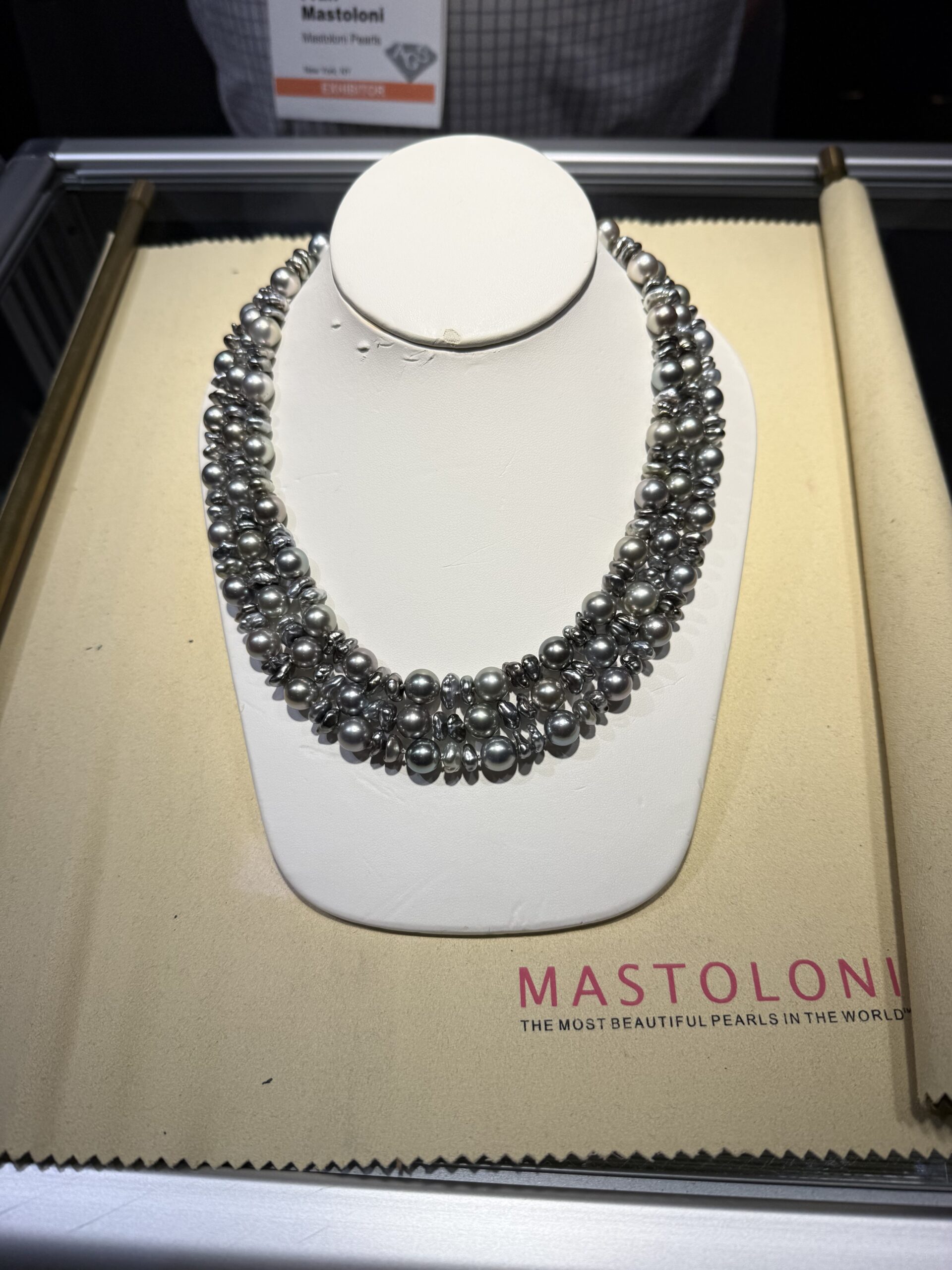
Secondly, Mastoloni agreed with both Helmich and Solomon regarding tight profit margins, saying, "You don't get rich working with pearls, but you can live a comfortable life." While Mastoloni loves this "comfortable life" he has created for himself, he admits that it may not be enough to attract new generations. Mastoloni said that one of his children has a true aptitude for pearls, but she makes four times as much as she would working with him than she already does in the healthcare industry.
House of Gems was in the minority, having two young professionals without familial connections attending their booth. Managing director Kunal Sheth and office manager Thea Politidis discussed how traditional communication between dealers and clients is off-putting to younger generations. "The old guard let high-priced goods speak for themselves." Marketing to a wide audience is unnatural to them. "Aging sellers", Sheth said, "have very little innovation in how they communicate." The consequence of outdated communication styles further alienates younger people, widening generational gaps.
CEO of House of Diamonds, Inc., Ari Jain, a millennial eighth-generation diamond seller, is a great advocate for updated communication methods within the trade. For him, the choice to continue in the trade was as natural as breathing, and he is indescribably proud to be part of such a long familial chain. What makes Jain special is that he is part of both worlds, having worked alongside his older relatives while representing a younger generation. This awards him both insight into the past as well as the energy and innovative spirit to bring the natural diamond business into the future.
The key, Jain said, is having a presence in the virtual world of social media. "Young people are learning on social media, that is where they get their information. The problem with this system is that no one polices it for accuracy. It is people with personalities that get views, not experts lacking charisma."
Unfortunately, Jain said that most of the "experts" from prior generations have little interest in a presence on social media, and he cited a few reasons for this. First, the traditional natural diamond business was all about rarity and singular beauty. The value of fine goods also restricted the potential clientele list. "For those who grew up in the world where that was the natural trade, posting their inventory online for everyone to see runs counter to their ingrained concept of rarity and exclusivity. Seasoned businesspeople in the trade don't sell like that. They are not looking to make mass-sales of low-cost goods."
The lab-grown diamond business, Jain said, is in many ways the antithesis of the natural diamond industry. The people who work with low-cost synthetics tend to be young and are very active online. Social media accounts promoting lab-grown stones cite not only a price difference, but they also claim, without proof, that their product is superior to natural stones for social and environmental reasons. Jain says that rebukes from diamond experts are rare, and those videos that are made get only a tiny fraction of views compared to the original posts.
While social media is filled with misinformation about natural diamonds, Jain says that there is no denying its place in the trade. "Natural diamond sellers," he said, "are simply going to have to make it work. That is what I am trying to do. We have to own the digital narrative," citing an interview he gave on @ridethenews on Instagram. "The path forward is very cloudy, but we do need to make creative content. Every one of us in the natural diamond industry needs to share the magic of natural diamonds online!"
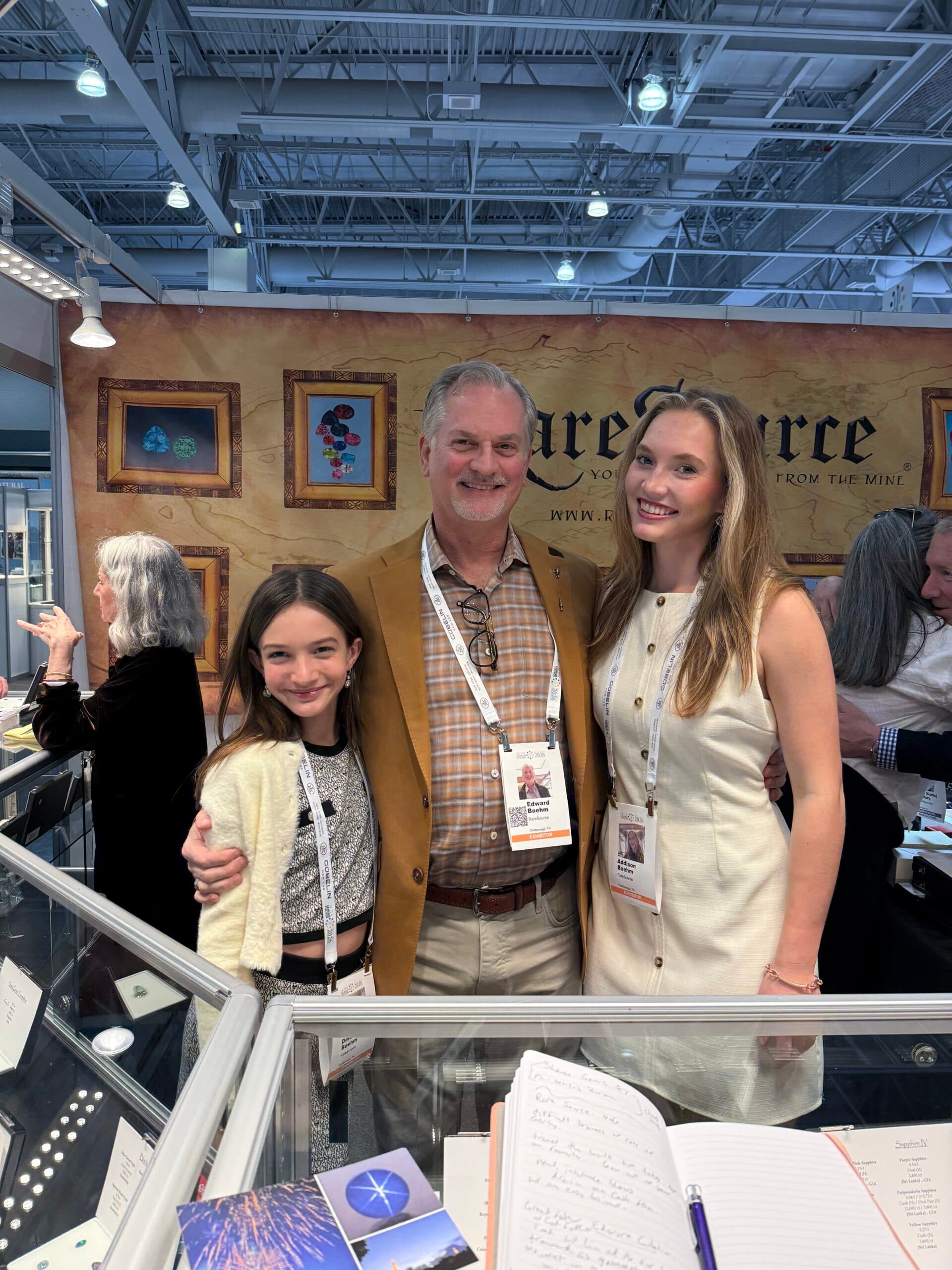
While Jain always felt that his lifepath would be to continue the family business, there are others who do not feel pressured to continue in their ancestral trade. Edward Boehm of Rare Source is the grandson of famed gemologist Dr. Edward Gübelin. He fondly recalled spending a summer living with his grandfather, learning about gemology. Boehm later studied geology and mineralogy before attending GIA. At AGTA, Boehm's two daughters, Addison and Delancy, helped him run the booth. It was easy to see the warmth between each of them, and the atmosphere was upbeat and positive. However, neither daughter plans to pursue gemology as a career. Addison is interested in the medical field, while Delancy is drawn to show business.
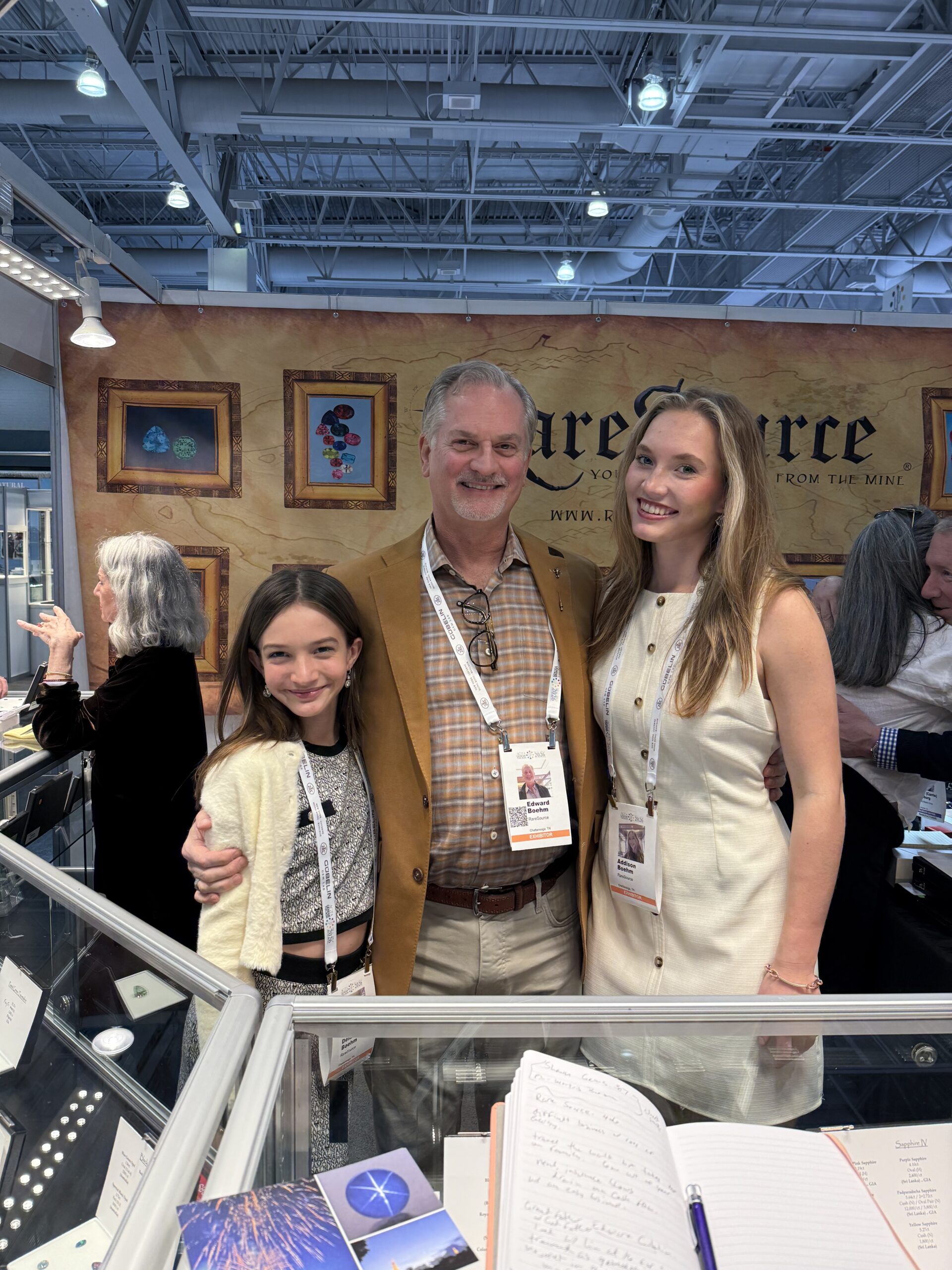
Boehm completely understands their position. "This is a difficult business that requires a lot of energy. You also deal with a lot of expenses such as rent, insurance, and the costs associated with shows that constantly drain your available cash."
Two brothers who made the opposite choice are Nicolai and Joshua Israileff of ASBA USA Inc. Like Boehm, the Israileff's parents did not exert pressure on their sons to continue the brand they founded in 1981. However, Nicolai said that he and his brother were included by their parents in the business from the beginning. He recounted visiting pearl farms and the family's jewelry factory - "We were both integrated into the business as a family. We were just part of it."
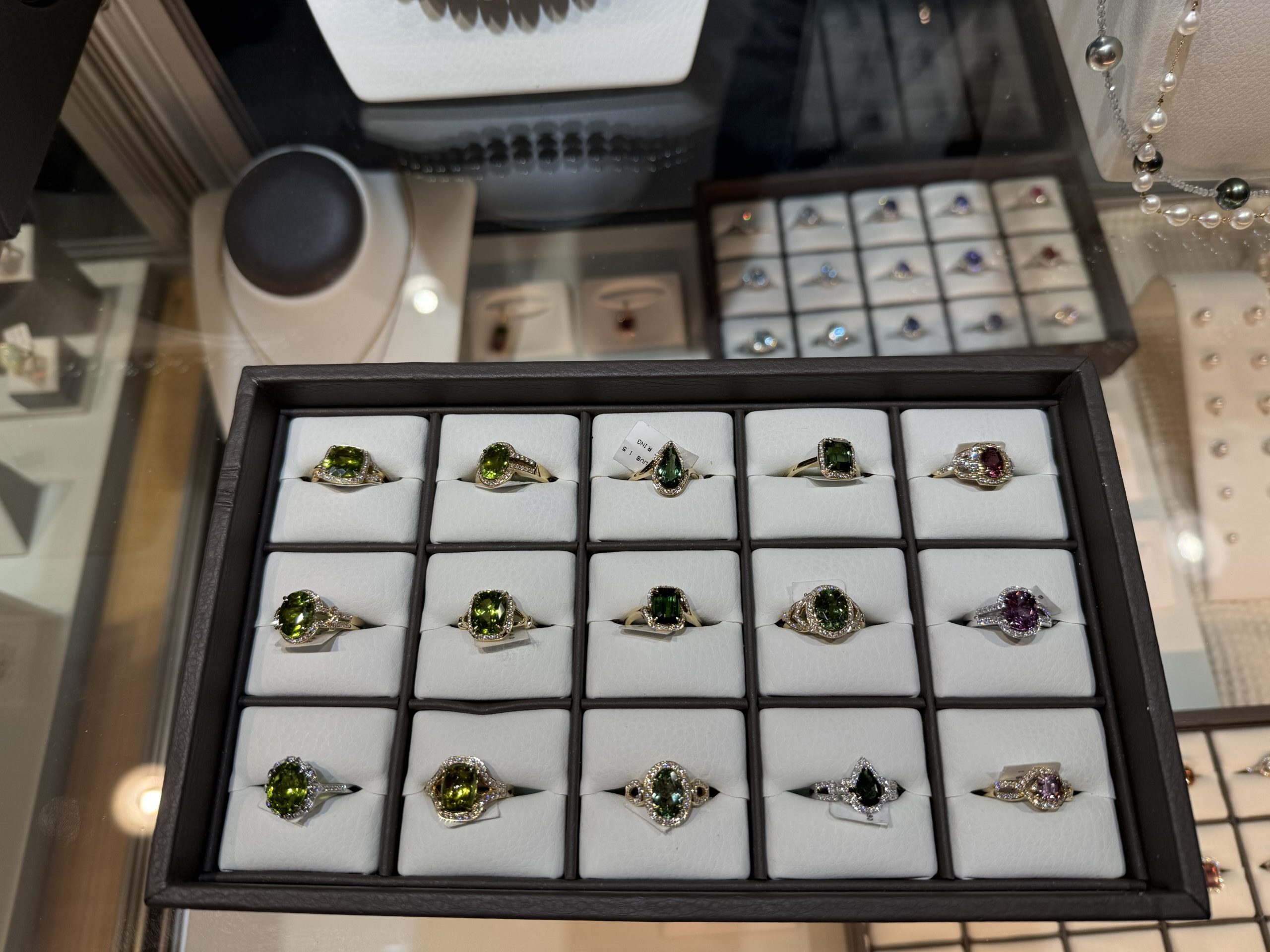
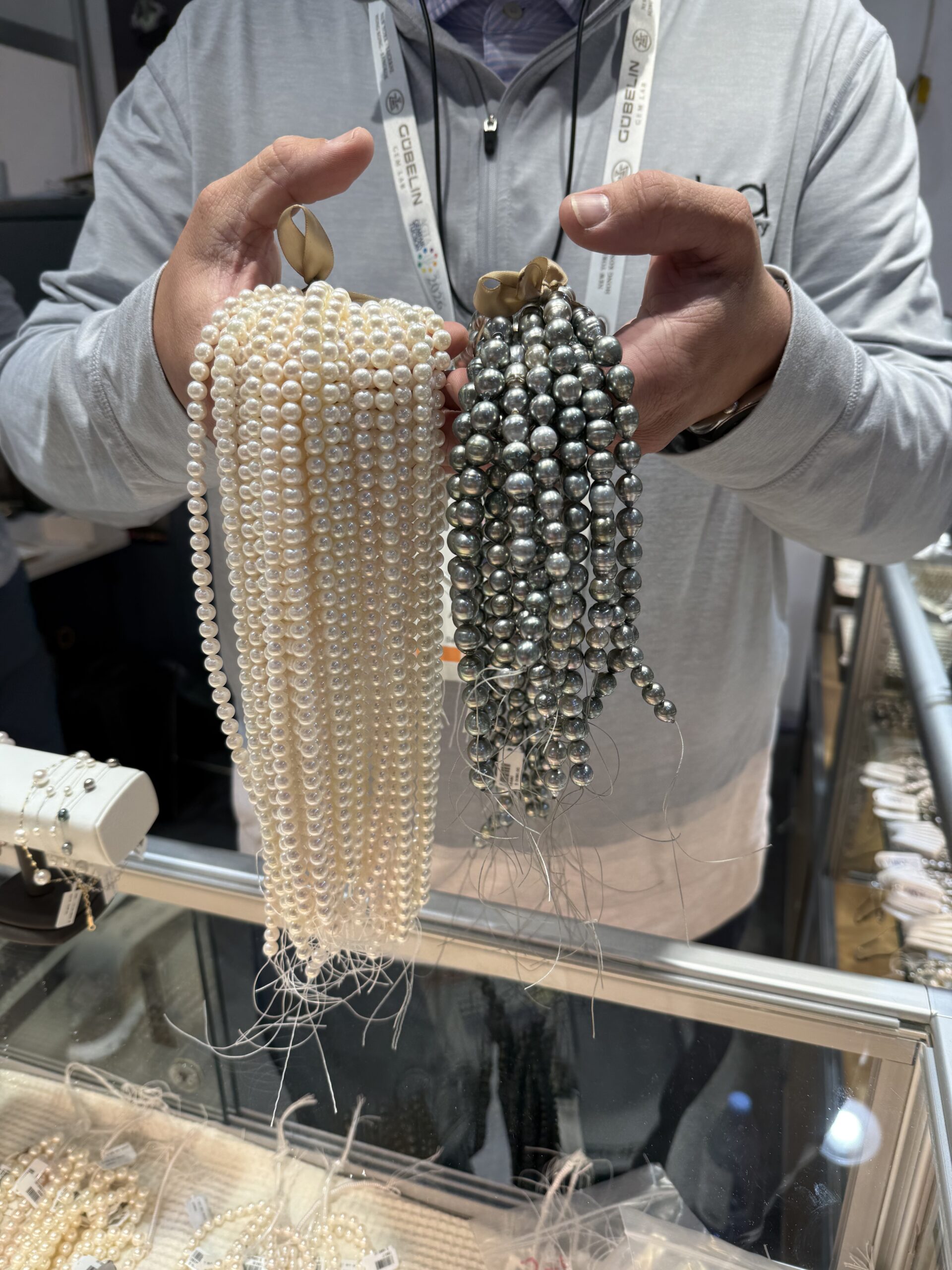
The brothers acknowledge that their choice to continue the business and work together as a family is unusual - "hands down, we are the youngest people in the pearl business. More and more of our competition doesn't have the next generation stepping in." Nicolai theorized that part of the reason so many of his peers are turning away from the industry is that it is such labor-intensive work. The gemstones featured in each piece of jewelry sold by ASBA, as well as every pearl they sort into strands, are hand-selected.
In the weeks preceding the show, Joshua welcomed his first child. When I asked if he would want his son to follow in his footsteps, it was clear this was something the new father hadn't considered. He pulled back and expressed his hope that his son would find his own path. He said he would welcome his son into the business someday, but stressed that he has no intention of applying any pressure.
The jewelry industry is a global one, connecting cultures that have differing family values. Sparkles and Colors USA (IG sparklesandcolors), based in India, now employs their fourth-generation cousins, Drishti Lakhi and Aishwarya Lakhi.
Both women said that they have independently chosen to work with their family without experiencing pressure from their elders to do so. Previous generations, they said, "didn't have that option." While they "made the choice with pride," Drishti noted that they are in the minority amongst their peers, "I would say that maybe 30% of kids in the trade are electing to stay with the family business." Interestingly, they said that things may have been different if they were male. Sons, they said, would have been expected, or at least strongly encouraged, to continue the business.
Lee Collins of Lee Collins Gems ( IG leecollinsgems) explained that expert jewelers are also experiencing an exodus of their children and are failing to recruit new talent. "Traditional designers (and skilled jewelers) are aging out. As a result, the fine one-of-a-kind jewelry they specialize in is becoming impossible to replace. As their businesses close, bigger brands are taking over."
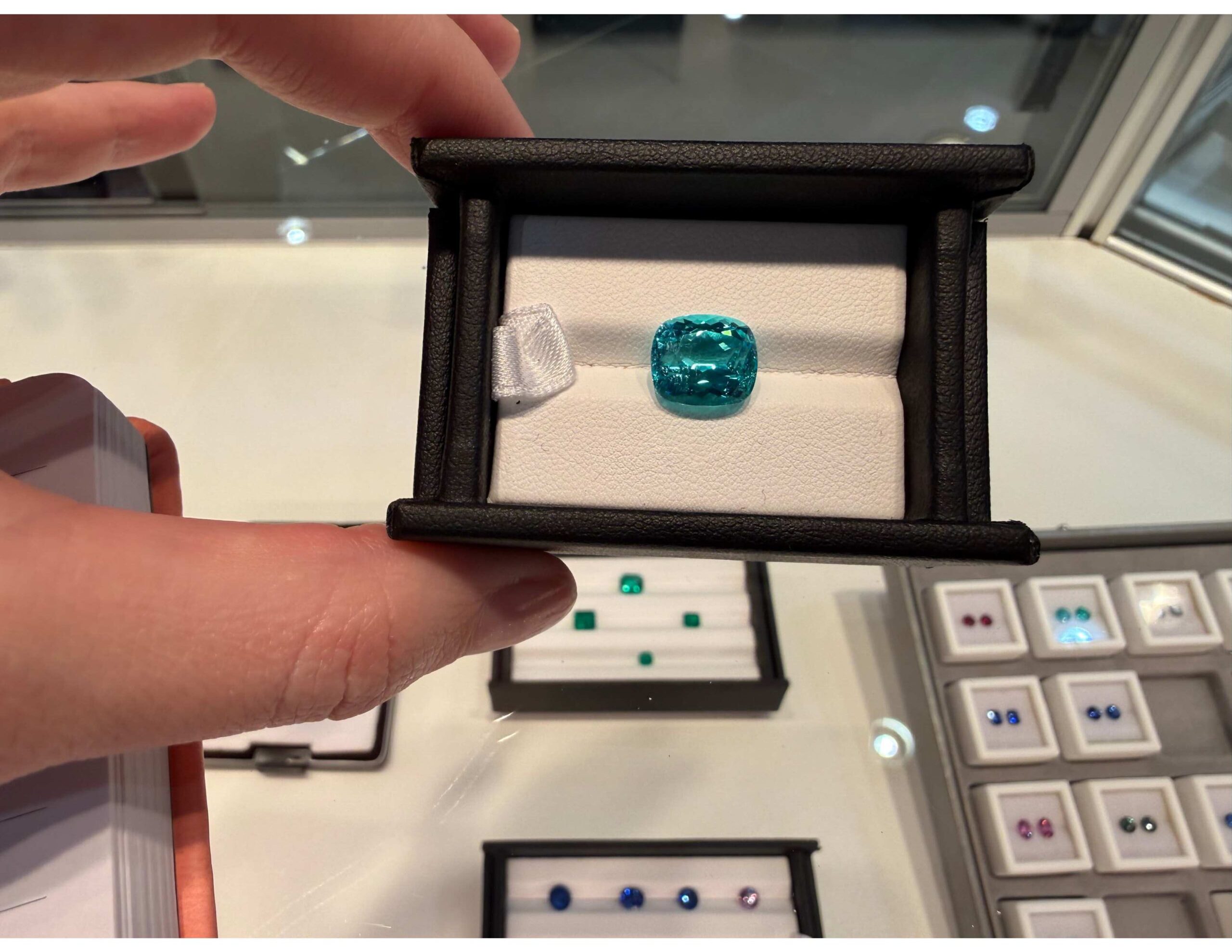
The final business we interviewed was Wolfgang Vaatz (IG wolfgangvaatzjewelry), a nature-inspired fine jewelry line. Wolfgang Vaatz maintained two booths, one at AGTA where he and his wife Kerstin Wiederhold worked, and the other at GJX, which was run by their children Katja and Frederick with help from Frederick's girlfriend Emilee Borquez. It was immediately clear that the Vaatz family dynamics are something special.
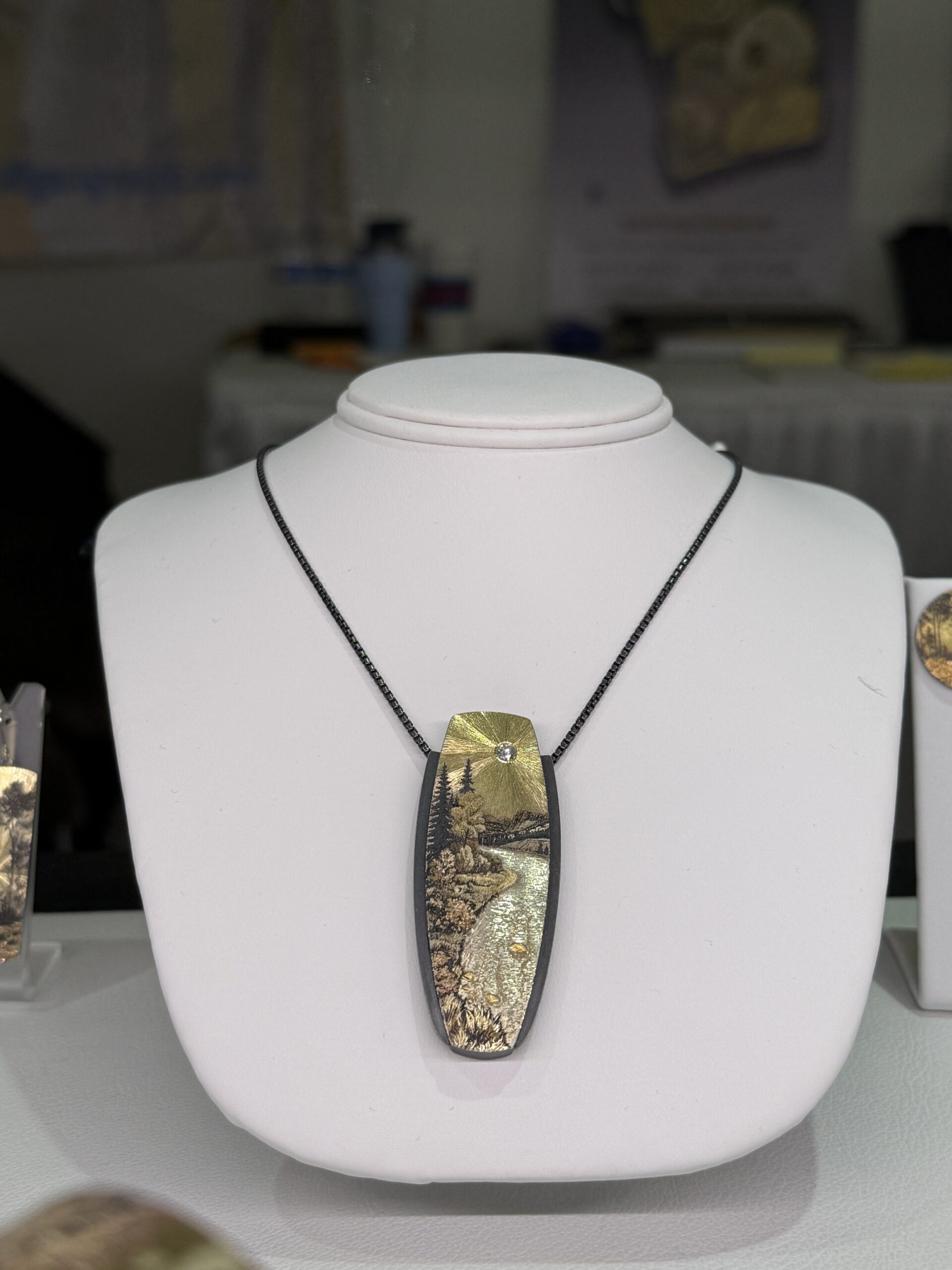
Speaking first with Frederick and Katja, they described the Wolfgang Vaatz brand as being a manifestation of gratitude and wonder at the beauty of nature. Frederick explained that their father was a trained sculptor and painter who took up jewelry-making twelve years ago as a means of making "three-dimensional wearable sculpture." From the very beginning, admiration of the natural world was at the center of his designs, which meant treating the natural metals and stones with respect. Katja said that he hates jewelry that "kills the stone" by hiding or distorting inherent beauty. Wolfgang's goal was to fashion a creative outlet for himself that respected raw materials.
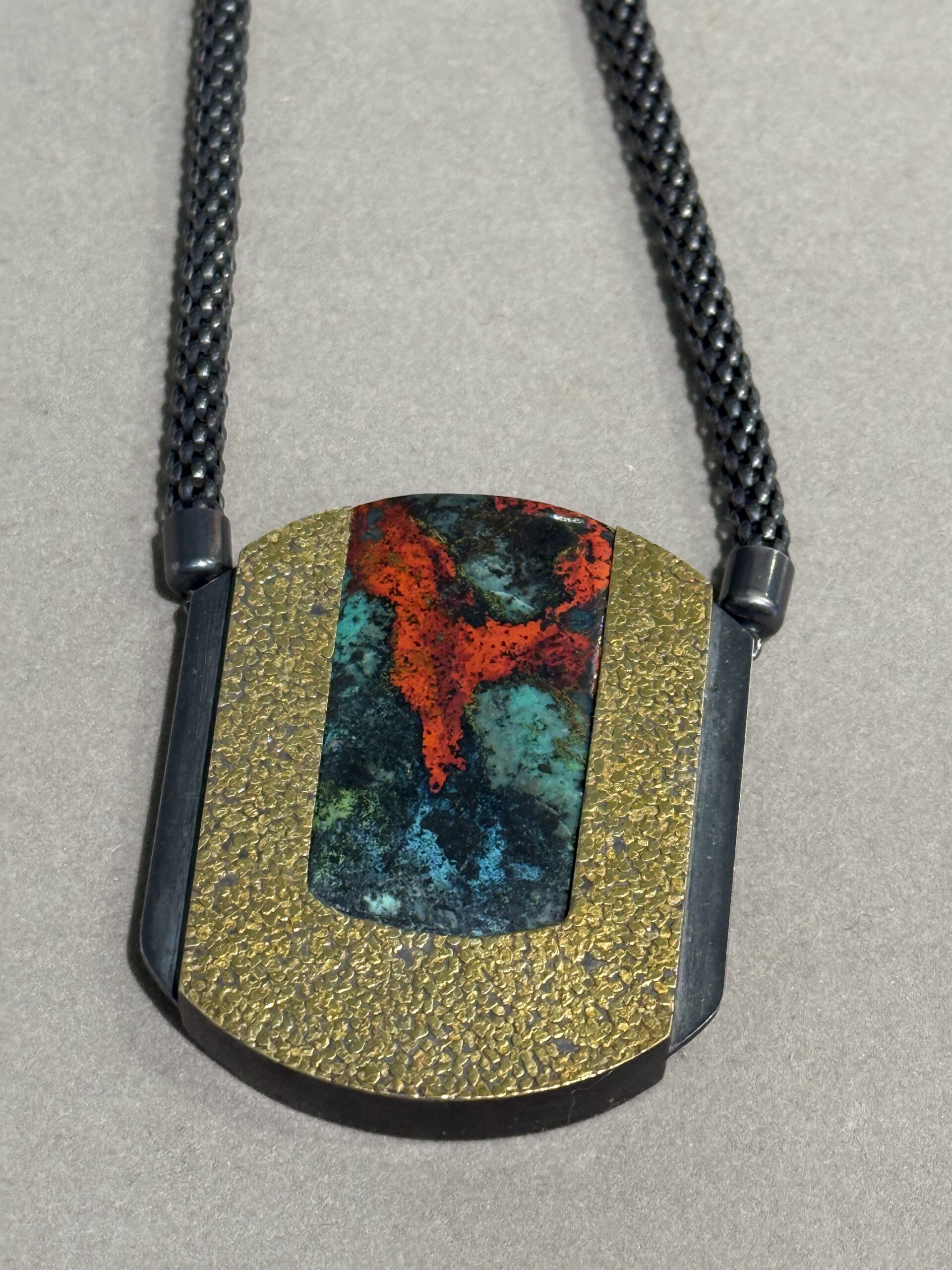
Similar to the Israileff brothers, Frederick and Katja described how their tight familial relationship came from spending quality time together. They fondly spoke about going into nature and focusing on feeling connected to the world and each other. Ironically, while their father didn't set out to make a multi-generational business, the values he instilled in his children are what kept them tightly bound to each other and happy to work within the brand.
At first, Frederick thought that working for his dad was just a job. He quickly realized it was much more - "I related to my dad's passion and saw the emotions of people at shows viewing his work. It is now what I see myself doing, whether within my dad's brand or on my own. I feel a drive to create, to breathe life into materials with inspiration from nature. To make art with heart. We ask ourselves, 'What can we do to make people fall in love with nature?'"
Katja echoed her brother's sentiments, "I have a great interest in artistic forms very much connected to nature themes. The work feels important and fulfilling. I think that jewelry is a special way to make art. Unlike static paintings, jewelry is a companion that goes with you."
The GJX booth had examples of designs by both Frederick and Katja. They said that they took elements from their dad's designs and added personal touches. Both said that they felt proud to expand on their dad's creative ideas, saying that he acts as a mentor, giving them the freedom to express their unique artistic voices.
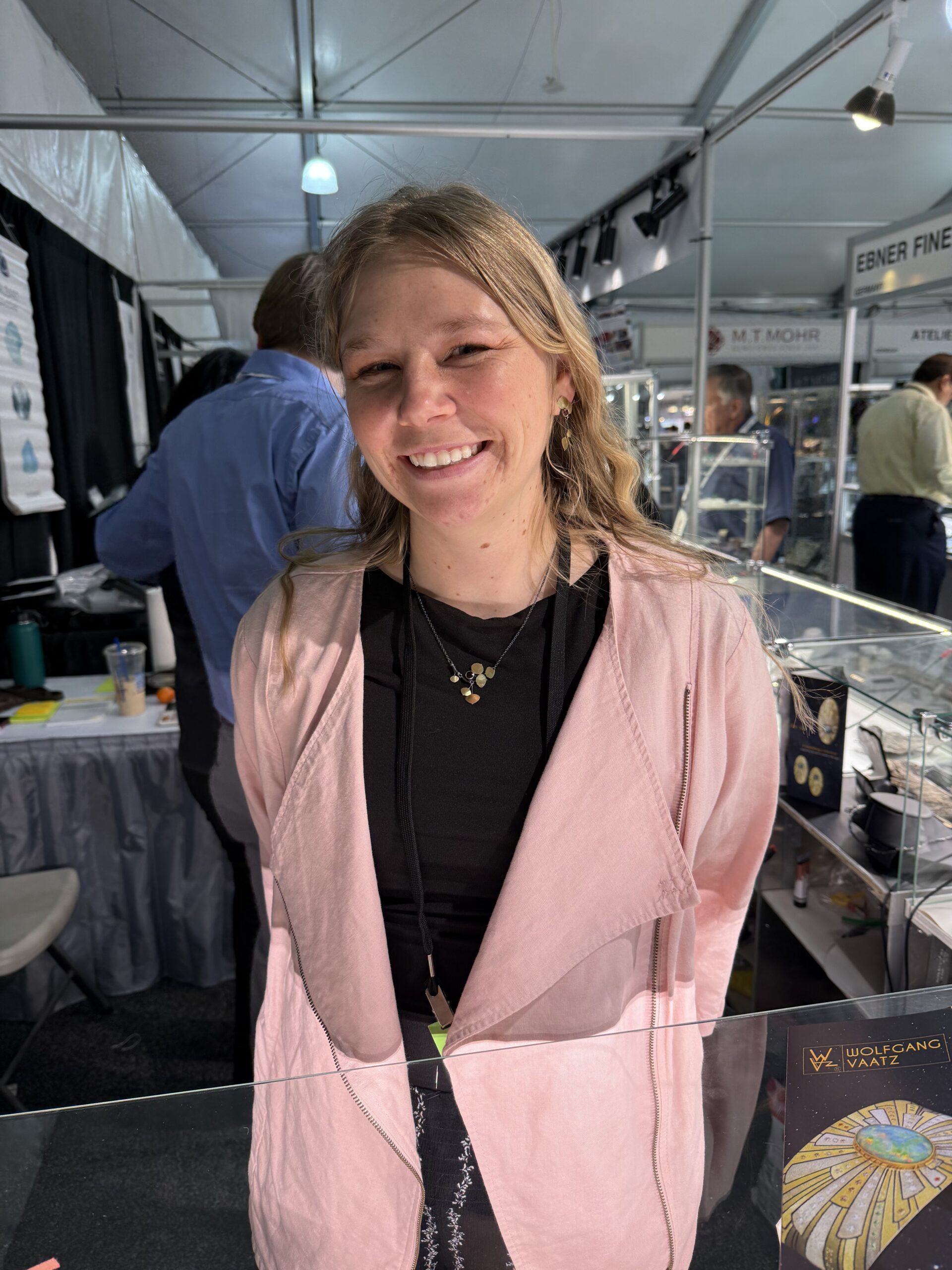
Frederick said that when he realized that he wanted to make jewelry professionally, the initial plan was to branch out and work for another company. This expected path, he said, didn't stay in place for very long - "At school I realized, why throw away what I already have here with my dad? I want to build on what already exists. I can get established with my dad before going out on my own."
The second-generation Vaatz's have created a haven for themselves, with each person trained by GIA to do something different. Frederick earned the Graduate Jeweler degree while Katja studied jewelry design. Frederick's girlfriend Emilee learned to use CAD - "we are a complete team." Interestingly, Emilee's experience is very different from the Vaatz's. She said that her parents discouraged her from studying art because it involves so much manual work without substantial financial compensation. Katja acknowledged this truth, saying, "We see that art is a hard job, but we also see that our parents are slowly building success."
Speaking with Wolfgang and Kerstin, both stressed that they worked hard to never impose expectations on their children. Kerstin said that she wanted to encourage independent exploration by giving Frederick and Katja tools and opportunities - "if they want to take advantage of what we have achieved, that is great!" Their priority as parents, Wolfgang said, was to instill sensitivity and a connection to nature. He is happy to offer his original designs as a base for Frederick and Katja "to create their own interpretations and find their own solutions."
Wolfgang also cited practical reasons why he is happy to have his children working under his brand rather than building their own businesses from scratch; "it is already so hard to start a business. Now, with gold being at $5,000, it is a harsh reality." Both parents also addressed the difficulties that come with transitioning from a parental role to co-workers. Wolfgang said, "there is a distinction between parenting and working with adult children."
When we asked how Wolfgang and Kerstin would feel about their children carrying on their self-named brand, both were careful with their answers. Wolfgang said that his family never had a multi-generational occupation, while Kerstin summed things up nicely - "We want our kids to be rooted where they are, not bound by the past."





When you join the IGS community, you get trusted diamond & gemstone information when you need it.

Twenty years ago, my father made an observation that troubled him. "You know what you never see anymore," he said, "business names that end with '& sons'".
For him, a first-generation American growing up in 1930's Connecticut, he saw so many of his peers working in their family's businesses, eventually taking the reins as their parents reached retirement age. Often, he noted, there were no discussions about this.
Families who were fortunate enough to have a successful business of any kind expected that the next generation would remain in the trade and continue to build on the hard-won foundation. It turns out that my dad is not the only person to worry. Quite a few participants at the 2026 Tucson gem shows expressed concerns that there were very few "young people" willing to take the reins of their family businesses.
The fine gem and jewelry shows AGTA and GJX are extremely important events in the trade. Some of the attendees have made the annual pilgrimage for decades and look forward to seeing long-time colleagues and friends. Business there happens at all levels of the supply chain - from buying rough directly from miners to acquiring finished jewelry ready for the retail market.
The atmosphere is excited, but also intense. People are making deals of serious magnitude. The success of their businesses rests on getting the quality of goods they need at a fair price. In past centuries, the trade was made up of a tight-knit group of people who sold luxury items to just a select few rich and powerful individuals. Yet, this business was, and remains today, a cash-poor industry with money tied up in inventory. A single purchase of overpriced goods could end a career.
To alleviate some of the risk that comes with dealing with high-priced goods, past gem and jewelry professionals created dense social networks where people worked with just a few trusted contacts. Distrust ran rampant, and breaking into the industry was extremely difficult. Many trusted only their kin, leading to the formation of multi-generational businesses. This just made sense. A child raised in their family's workplace learned not only the ins and outs of that operation, but they also formed those important bonds with established business contacts that would help them continue a close and mutually beneficial relationship into the future.
This is a pattern that was maintained for hundreds of years, but it appears things are changing as the upcoming generations are significantly less likely to follow their forebearers' career paths.
There are multiple consequences of having an aging population without an influx of younger energy. It is a natural result of maturing that people slow down and rely on their established habits and patterns. This is especially problematic considering the recent explosion of social media, which has fundamentally changed how people communicate.
Here is what the professionals attending AGTA and GJX had to say about changing demographics and how it foretells a drastic change in how the trade operates.
Steve Helmich of Kostbar International is part of a multi-generational jewelry family, but said that the upcoming generation rarely opts to work for their family's business - "seeing kids who take over are few and far between." He attributed this to a number of different factors, including the fact that owning a jewelry store "is not an easy thing." Indeed, Helmich was the first of many people to cite the labor-intensive nature of the business as a primary reason for children of jewelry professionals to seek different careers.
Helmich explained that he has changed how Kostbar International does business without a dedicated younger person involved. "I am no longer travelling to most shows. There is a great risk and expense in doing them. If I were twenty years younger, it would be different." The benefits of attending shows, he says, have also decreased. So much business is now done virtually that newer buyers are often choosing to skip many in-person events.
"Right now," Helmich said," I am happy where we are now in terms of the business. In the last few years, we have lost many of our long-term clients and it is too hard to actively find new connections." While Helmich will continue working at what he loves, he is not actively chasing growth.
Similar to Helmich, Harold Solomon, owner of Harry H. Solomon Co., Inc., is a third-generation jewelry professional. Solomon shared how the business model for his business evolved responding to societal changes from the time of its founding in 1920. Initially Solomon's grandfather's store in Boston was a retail operation.
Skipping forward a generation, Solomon's father transitioned to a wholesale role and inked memo deals with giant brands like Kay's. Solomon explained that he witnessed firsthand a change in the economy between 1980 and 1985 when it became difficult to get reimbursed for those memo deals in a timely fashion. This led him to change the focus of the business a third time, focusing now on estate jewelry.
Solomon likes this model and says that he considers the business a hobby more than a job. He has no employees and does not have to deal with loans. He makes his own hours, buys jewelry with the money that he has in the bank, and gets paid in full when clients make a purchase. Yet, in spite of having created a stable business, he has turned his children away from the trade and will close Harry H. Solomon Co., Inc. when he retires - "you don't get rich doing this. My kids already make more money in their careers than I do."
Additionally, Solomon shared his observations from the perspective of a brick-and-mortar store owner about how the needs of buyers is changing. "Younger people live a disposable lifestyle and want disposable jewelry. They are, for example, choosing lab-grown diamonds over naturals." Older buyers who are interested in the high-quality jewelry he sells are a disappearing breed.
Thomas Trozzo of Trozzo also pushed his daughter away from the gems and jewelry world. "The jewelry business is tough, and it is seasonal. Gold prices are now forcing people out of the industry. There is no stability. If a young person gets a good education, they can get a secure job with a steady money. That is not this trade."
Unlike Solomon and Trozzo, Fran Mastoloni has not banned his three children from continuing his pearl business Mastoloni, saying that they have each chosen to follow other paths. Mastoloni sees several reasons for this. First, it takes a special type of connection between a parent and child for them to want to work with each other in a professional capacity.
Moreover, the current culture encourages upcoming generations to go into the world and find their place apart from their families. Trozzo likened the situation to farming families. A plot may have been worked by a family for many generations, but the inheritors are more likely to sell the land and take the money to seek less strenuous and more profitable employment elsewhere.
Social norms aside, Mastoloni said that he sees two reasons that make working in the industry less appealing to younger people.
Firstly, the level of stimulation is less than in years past. "The adventure of the trade is gone. You no longer travel to exotic locations to find rare stones. All you need is an internet connection."
To demonstrate this point, Mastoloni walked us through what happens when a customer comes to him with a special request. "The whole cycle from initial request to final sale can take as little as one week. They come by the office on a Monday, and I immediately reach out to other dealers and get images with specifications by Tuesday. I request that the best options be sent to me, and they typically arrive by Friday. Before the end of the weekend, the client had come to the office to see the merchandise and made a purchase."
Secondly, Mastoloni agreed with both Helmich and Solomon regarding tight profit margins, saying, "You don't get rich working with pearls, but you can live a comfortable life." While Mastoloni loves this "comfortable life" he has created for himself, he admits that it may not be enough to attract new generations. Mastoloni said that one of his children has a true aptitude for pearls, but she makes four times as much as she would working with him than she already does in the healthcare industry.
House of Gems was in the minority, having two young professionals without familial connections attending their booth. Managing director Kunal Sheth and office manager Thea Politidis discussed how traditional communication between dealers and clients is off-putting to younger generations. "The old guard let high-priced goods speak for themselves." Marketing to a wide audience is unnatural to them. "Aging sellers", Sheth said, "have very little innovation in how they communicate." The consequence of outdated communication styles further alienates younger people, widening generational gaps.
CEO of House of Diamonds, Inc., Ari Jain, a millennial eighth-generation diamond seller, is a great advocate for updated communication methods within the trade. For him, the choice to continue in the trade was as natural as breathing, and he is indescribably proud to be part of such a long familial chain. What makes Jain special is that he is part of both worlds, having worked alongside his older relatives while representing a younger generation. This awards him both insight into the past as well as the energy and innovative spirit to bring the natural diamond business into the future.
The key, Jain said, is having a presence in the virtual world of social media. "Young people are learning on social media, that is where they get their information. The problem with this system is that no one polices it for accuracy. It is people with personalities that get views, not experts lacking charisma."
Unfortunately, Jain said that most of the "experts" from prior generations have little interest in a presence on social media, and he cited a few reasons for this. First, the traditional natural diamond business was all about rarity and singular beauty. The value of fine goods also restricted the potential clientele list. "For those who grew up in the world where that was the natural trade, posting their inventory online for everyone to see runs counter to their ingrained concept of rarity and exclusivity. Seasoned businesspeople in the trade don't sell like that. They are not looking to make mass-sales of low-cost goods."
The lab-grown diamond business, Jain said, is in many ways the antithesis of the natural diamond industry. The people who work with low-cost synthetics tend to be young and are very active online. Social media accounts promoting lab-grown stones cite not only a price difference, but they also claim, without proof, that their product is superior to natural stones for social and environmental reasons. Jain says that rebukes from diamond experts are rare, and those videos that are made get only a tiny fraction of views compared to the original posts.
While social media is filled with misinformation about natural diamonds, Jain says that there is no denying its place in the trade. "Natural diamond sellers," he said, "are simply going to have to make it work. That is what I am trying to do. We have to own the digital narrative," citing an interview he gave on @ridethenews on Instagram. "The path forward is very cloudy, but we do need to make creative content. Every one of us in the natural diamond industry needs to share the magic of natural diamonds online!"
While Jain always felt that his lifepath would be to continue the family business, there are others who do not feel pressured to continue in their ancestral trade. Edward Boehm of Rare Source is the grandson of famed gemologist Dr. Edward Gübelin. He fondly recalled spending a summer living with his grandfather, learning about gemology. Boehm later studied geology and mineralogy before attending GIA. At AGTA, Boehm's two daughters, Addison and Delancy, helped him run the booth. It was easy to see the warmth between each of them, and the atmosphere was upbeat and positive. However, neither daughter plans to pursue gemology as a career. Addison is interested in the medical field, while Delancy is drawn to show business.
Boehm completely understands their position. "This is a difficult business that requires a lot of energy. You also deal with a lot of expenses such as rent, insurance, and the costs associated with shows that constantly drain your available cash."
Two brothers who made the opposite choice are Nicolai and Joshua Israileff of ASBA USA Inc. Like Boehm, the Israileff's parents did not exert pressure on their sons to continue the brand they founded in 1981. However, Nicolai said that he and his brother were included by their parents in the business from the beginning. He recounted visiting pearl farms and the family's jewelry factory - "We were both integrated into the business as a family. We were just part of it."
The brothers acknowledge that their choice to continue the business and work together as a family is unusual - "hands down, we are the youngest people in the pearl business. More and more of our competition doesn't have the next generation stepping in." Nicolai theorized that part of the reason so many of his peers are turning away from the industry is that it is such labor-intensive work. The gemstones featured in each piece of jewelry sold by ASBA, as well as every pearl they sort into strands, are hand-selected.
In the weeks preceding the show, Joshua welcomed his first child. When I asked if he would want his son to follow in his footsteps, it was clear this was something the new father hadn't considered. He pulled back and expressed his hope that his son would find his own path. He said he would welcome his son into the business someday, but stressed that he has no intention of applying any pressure.
The jewelry industry is a global one, connecting cultures that have differing family values. Sparkles and Colors USA (IG sparklesandcolors), based in India, now employs their fourth-generation cousins, Drishti Lakhi and Aishwarya Lakhi.
Both women said that they have independently chosen to work with their family without experiencing pressure from their elders to do so. Previous generations, they said, "didn't have that option." While they "made the choice with pride," Drishti noted that they are in the minority amongst their peers, "I would say that maybe 30% of kids in the trade are electing to stay with the family business." Interestingly, they said that things may have been different if they were male. Sons, they said, would have been expected, or at least strongly encouraged, to continue the business.
Lee Collins of Lee Collins Gems ( IG leecollinsgems) explained that expert jewelers are also experiencing an exodus of their children and are failing to recruit new talent. "Traditional designers (and skilled jewelers) are aging out. As a result, the fine one-of-a-kind jewelry they specialize in is becoming impossible to replace. As their businesses close, bigger brands are taking over."
The final business we interviewed was Wolfgang Vaatz (IG wolfgangvaatzjewelry), a nature-inspired fine jewelry line. Wolfgang Vaatz maintained two booths, one at AGTA where he and his wife Kerstin Wiederhold worked, and the other at GJX, which was run by their children Katja and Frederick with help from Frederick's girlfriend Emilee Borquez. It was immediately clear that the Vaatz family dynamics are something special.
Speaking first with Frederick and Katja, they described the Wolfgang Vaatz brand as being a manifestation of gratitude and wonder at the beauty of nature. Frederick explained that their father was a trained sculptor and painter who took up jewelry-making twelve years ago as a means of making "three-dimensional wearable sculpture." From the very beginning, admiration of the natural world was at the center of his designs, which meant treating the natural metals and stones with respect. Katja said that he hates jewelry that "kills the stone" by hiding or distorting inherent beauty. Wolfgang's goal was to fashion a creative outlet for himself that respected raw materials.
Similar to the Israileff brothers, Frederick and Katja described how their tight familial relationship came from spending quality time together. They fondly spoke about going into nature and focusing on feeling connected to the world and each other. Ironically, while their father didn't set out to make a multi-generational business, the values he instilled in his children are what kept them tightly bound to each other and happy to work within the brand.
At first, Frederick thought that working for his dad was just a job. He quickly realized it was much more - "I related to my dad's passion and saw the emotions of people at shows viewing his work. It is now what I see myself doing, whether within my dad's brand or on my own. I feel a drive to create, to breathe life into materials with inspiration from nature. To make art with heart. We ask ourselves, 'What can we do to make people fall in love with nature?'"
Katja echoed her brother's sentiments, "I have a great interest in artistic forms very much connected to nature themes. The work feels important and fulfilling. I think that jewelry is a special way to make art. Unlike static paintings, jewelry is a companion that goes with you."
The GJX booth had examples of designs by both Frederick and Katja. They said that they took elements from their dad's designs and added personal touches. Both said that they felt proud to expand on their dad's creative ideas, saying that he acts as a mentor, giving them the freedom to express their unique artistic voices.
Frederick said that when he realized that he wanted to make jewelry professionally, the initial plan was to branch out and work for another company. This expected path, he said, didn't stay in place for very long - "At school I realized, why throw away what I already have here with my dad? I want to build on what already exists. I can get established with my dad before going out on my own."
The second-generation Vaatz's have created a haven for themselves, with each person trained by GIA to do something different. Frederick earned the Graduate Jeweler degree while Katja studied jewelry design. Frederick's girlfriend Emilee learned to use CAD - "we are a complete team." Interestingly, Emilee's experience is very different from the Vaatz's. She said that her parents discouraged her from studying art because it involves so much manual work without substantial financial compensation. Katja acknowledged this truth, saying, "We see that art is a hard job, but we also see that our parents are slowly building success."
Speaking with Wolfgang and Kerstin, both stressed that they worked hard to never impose expectations on their children. Kerstin said that she wanted to encourage independent exploration by giving Frederick and Katja tools and opportunities - "if they want to take advantage of what we have achieved, that is great!" Their priority as parents, Wolfgang said, was to instill sensitivity and a connection to nature. He is happy to offer his original designs as a base for Frederick and Katja "to create their own interpretations and find their own solutions."
Wolfgang also cited practical reasons why he is happy to have his children working under his brand rather than building their own businesses from scratch; "it is already so hard to start a business. Now, with gold being at $5,000, it is a harsh reality." Both parents also addressed the difficulties that come with transitioning from a parental role to co-workers. Wolfgang said, "there is a distinction between parenting and working with adult children."
When we asked how Wolfgang and Kerstin would feel about their children carrying on their self-named brand, both were careful with their answers. Wolfgang said that his family never had a multi-generational occupation, while Kerstin summed things up nicely - "We want our kids to be rooted where they are, not bound by the past."