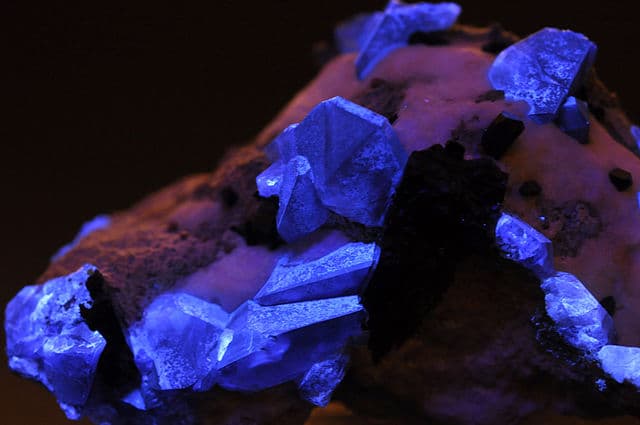
Ultraviolet testing can be crucial for gemstone identification. Learn the basics of this technique as well as how to make your own UV viewing box.
7 Minute Read
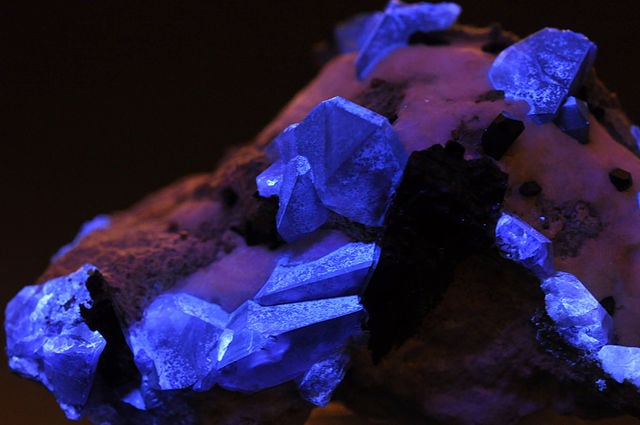
Additionally, ultraviolet testing can expose some gemstone treatments and assembled stones. The enhanced layers of diffusion-treated gems, oils used as fillers in emeralds and other gems, and the components of assembled stones often have different fluorescent qualities than the rest of the specimen material. Seeing this at an early stage of your examination can save time later.
Never look at your ultraviolet (UV) light. Shortwave (SW) UV light can damage your eyes, even to the point of blindness. If you’re ever unsure if your UV light source is on, check the switch. Better yet, a flame-fusion ruby will tell you instantly if the light is on or not. (All rubies fluoresce, but these synthetic rubies fluoresce very strongly).
Just beyond the visible light spectrum lies infrared and UV light. For gem identification, we use longwave (LW) light, 315 to 400 nm, and SW light, 200 to 280 nm. The range in between isn’t used.
For gem testing purposes, you need lights that will show
…

When you join the IGS community, you get trusted diamond & gemstone information when you need it.
Additionally, ultraviolet testing can expose some gemstone treatments and assembled stones. The enhanced layers of diffusion-treated gems, oils used as fillers in emeralds and other gems, and the components of assembled stones often have different fluorescent qualities than the rest of the specimen material. Seeing this at an early stage of your examination can save time later.
Never look at your ultraviolet (UV) light. Shortwave (SW) UV light can damage your eyes, even to the point of blindness. If you’re ever unsure if your UV light source is on, check the switch. Better yet, a flame-fusion ruby will tell you instantly if the light is on or not. (All rubies fluoresce, but these synthetic rubies fluoresce very strongly).
Just beyond the visible light spectrum lies infrared and UV light. For gem identification, we use longwave (LW) light, 315 to 400 nm, and SW light, 200 to 280 nm. The range in between isn’t used.
For gem testing purposes, you need lights that will show
Ultraviolet testing can be crucial for gemstone identification. Learn the basics of this technique as well as how to make your own UV viewing box.


“I have never known or heard of an organization that offers so much for its members, and at such a low cost.”
— Ernest Roisch, Rainbow Rocks LTD
That's less than $0.01 per article. Get instant access to 1,700+ premium articles, courses, and gem pricing data.