4 Minute Read
As a reporter who covers gem shows, I am often asked, "What do you write about? Don't you just see the same kinds of gems and jewelry every year?" Well, I can tell you that it most certainly is not "the same old things" every time.
The gems and jewelry world is a fantastically dynamic place. Not only are new gemstone deposits discovered, but global politics also influence what type of inventory is available, skilled lapidaries create true works of art, new sizes and colors of cultured pearls are debuted, artists unveil fresh designs, and more!
Under correct and stable growing conditions, diamonds often develop in an octahedral shape, which is basically two four-sided pyramids with their bases attached. This shape is present from the start, with tiny octahedral diamonds expanding outward into bigger octahedra. Diamonds do this because they are part of the cubic crystal system, also known as the isometric crystal system, where their carbon atoms become locked together in a symmetrical and balanced orientation.
When the environmental conditions of diamond nurseries are ideal, you get perfect octahedral shapes and complete carbon conversion, meaning all soft, darkly colored carbon in its graphite form gets squeezed into diamond. Yet, perfection and stability are rarely attained in nature. Many diamonds are exposed to changing conditions as they grow, which affects both their shape and clarity.
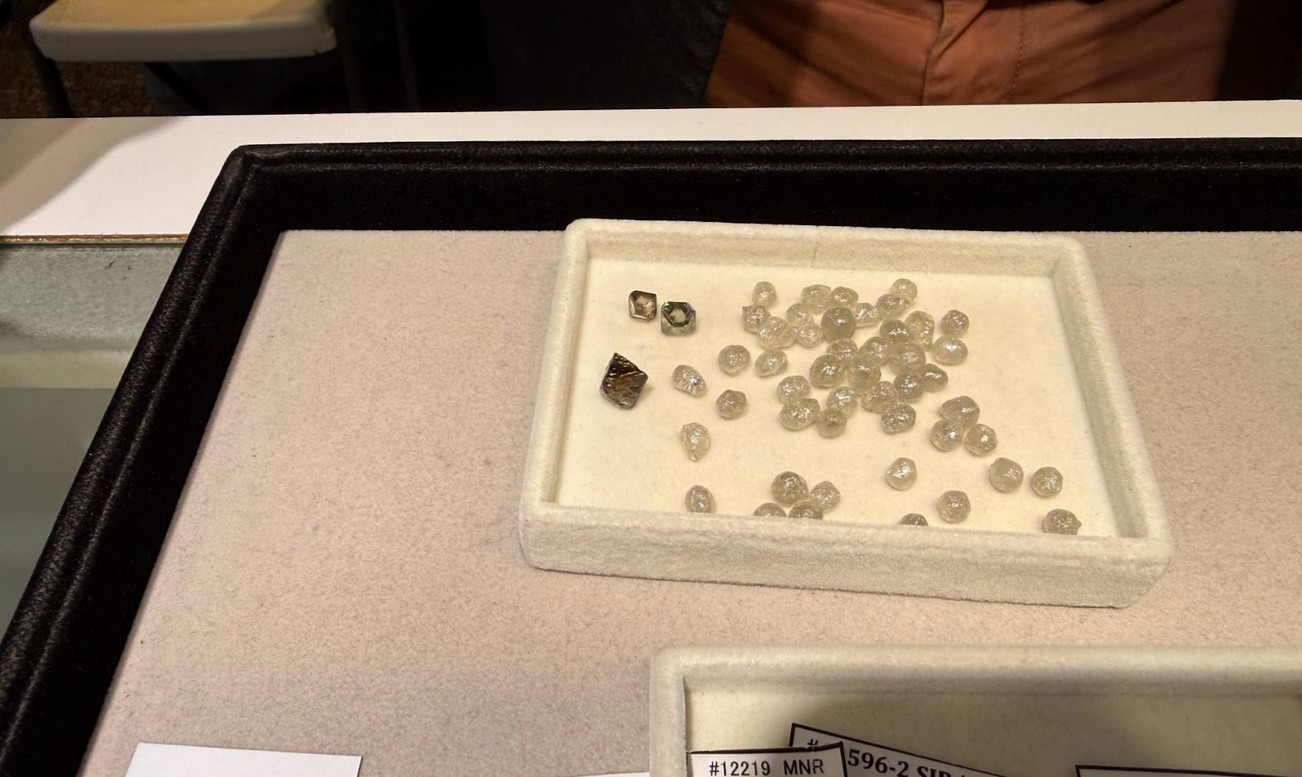
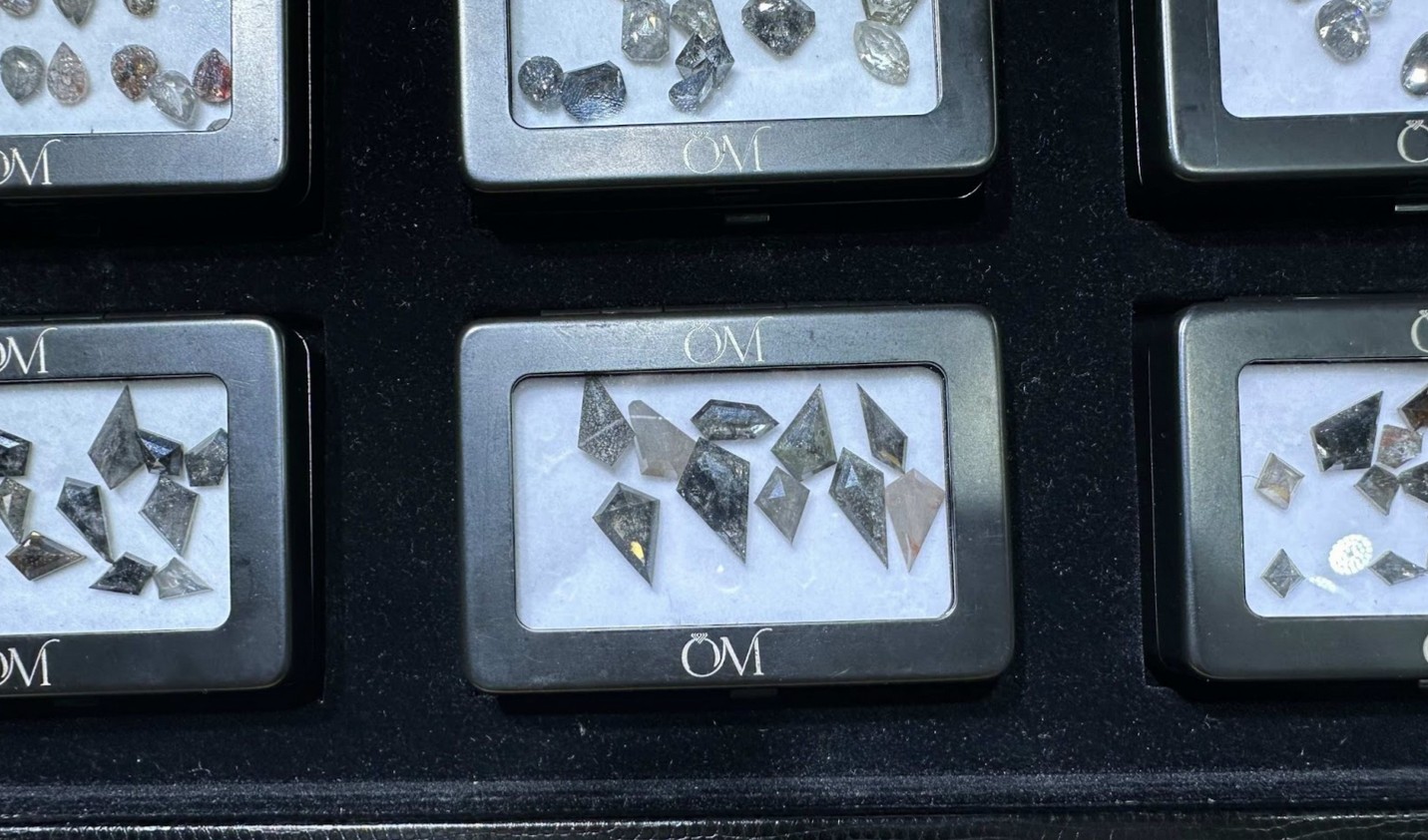
On their own, unconverted graphite inclusions are quite common. An exaggerated example is salt-and-pepper diamonds. These gems are filled with specks of graphite and other inclusions, and buyers have come to value them for their one-of-a-kind uniqueness, which cannot be replicated in a diamond-growing laboratory.
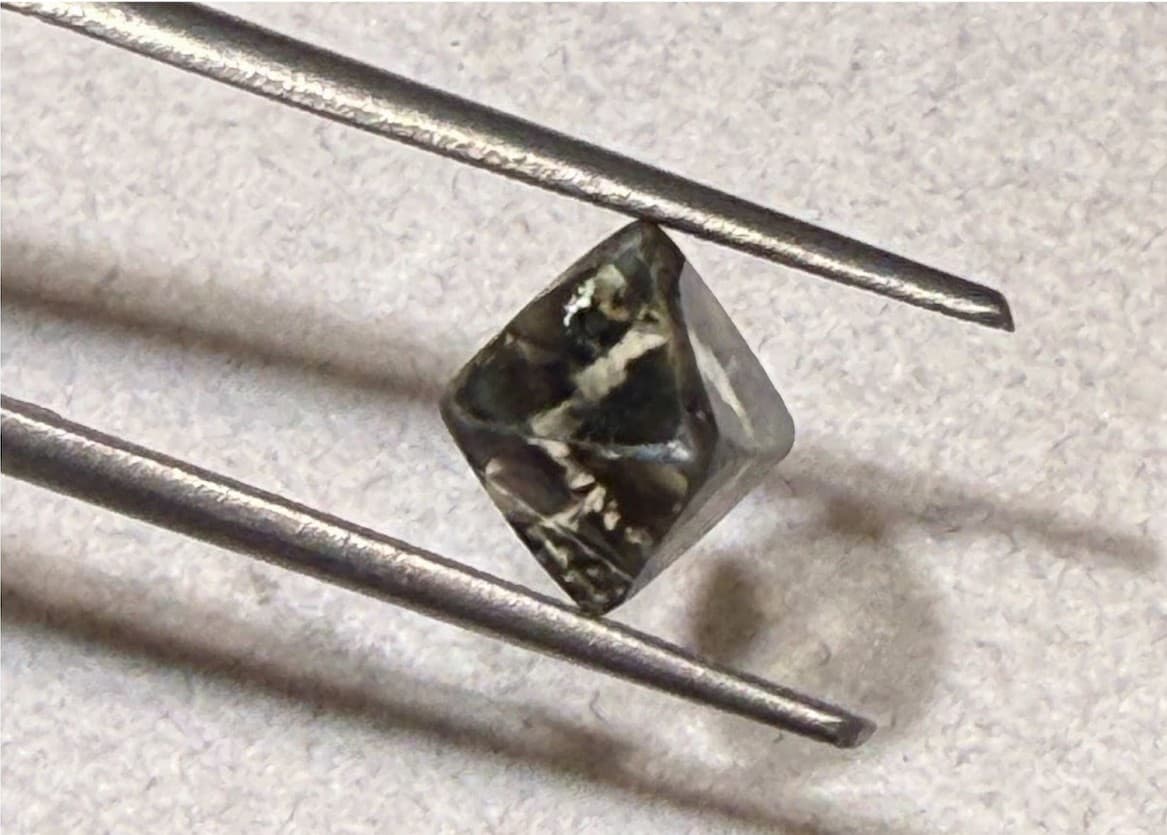
What makes Dynamic International's collection of asteroid diamonds so exceptional is the fact that the distribution of graphite is not random, as you see in salt-and-pepper diamonds. Rather, the inclusions are perfectly aligned along the symmetrical growth planes of the gems.
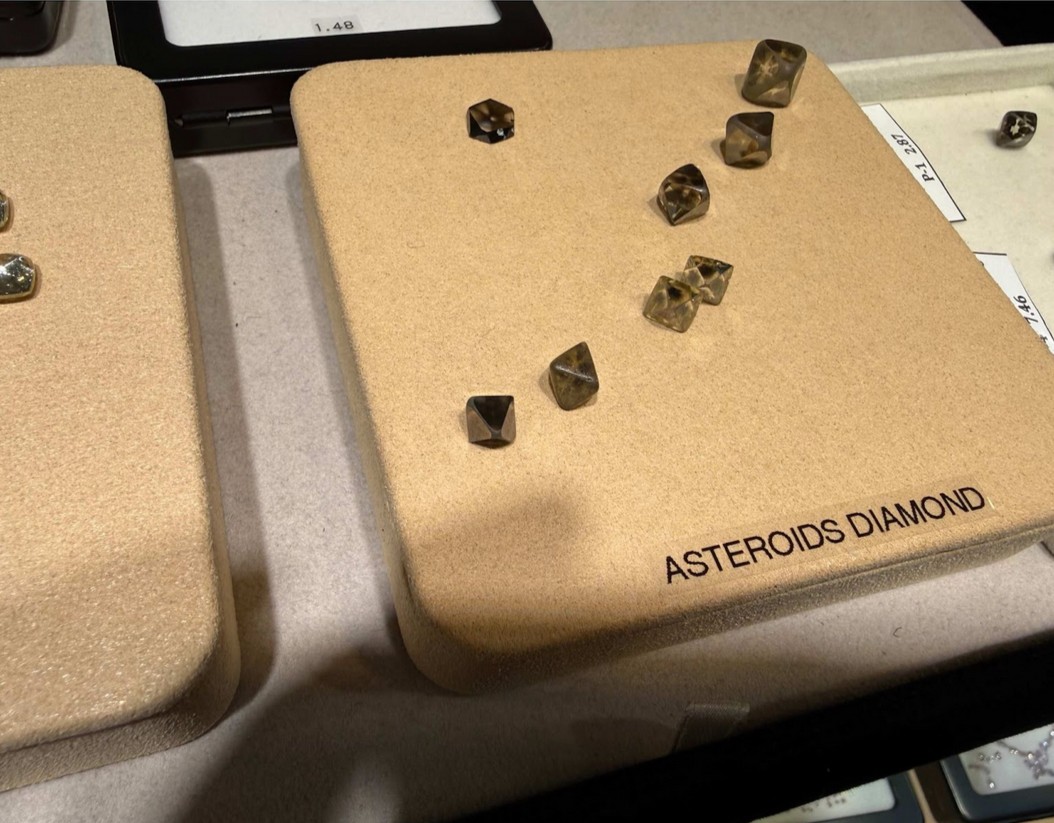
Part of Dynamic International's collection of asteroid diamonds. The flat diamond at the top left of the display is called a "macle," which is a twinned crystal that formed when part of the expanding crystal grew in a different orientation. You can see that its graphite clouds are still perfectly aligned with the growth plane. Photo by Emily Frontiere.
Sales executive for Dynamic International, Ram Malpani, explained that the gems in this exceptional collection were mined in South Africa and Zimbabwe.
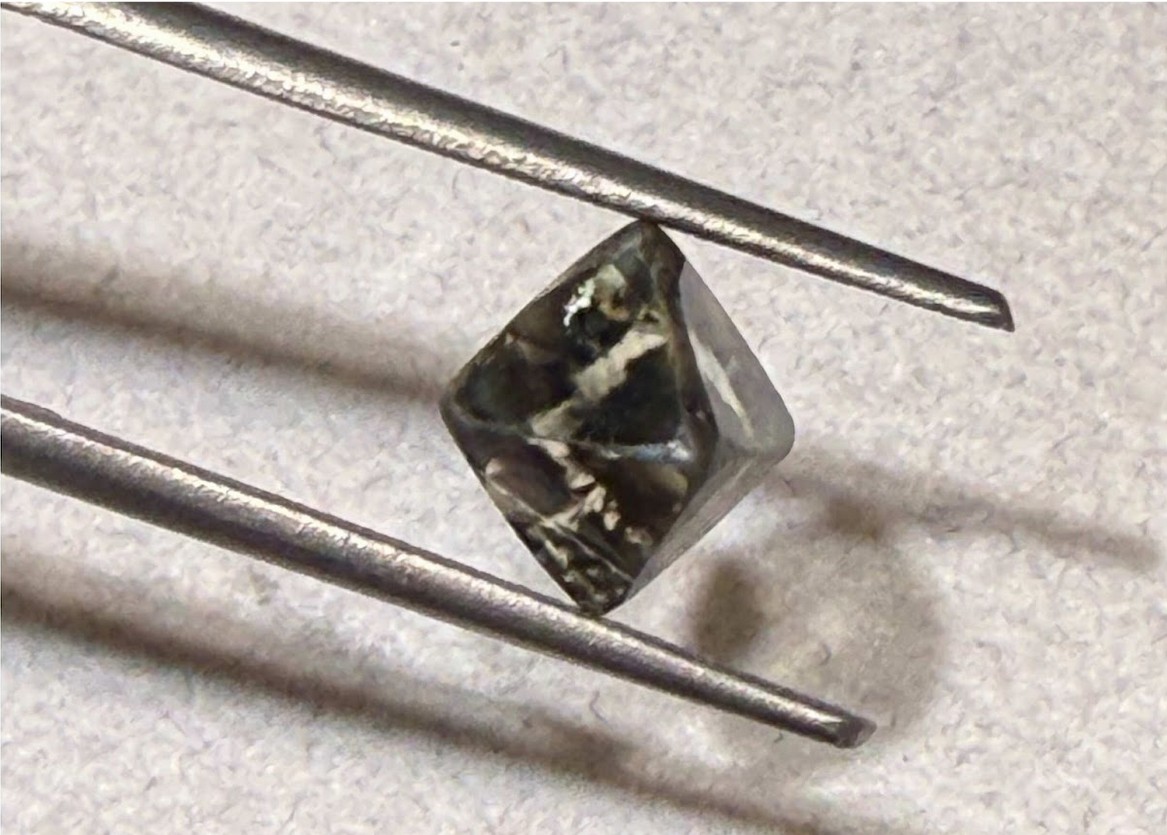
He singled out one gem, which he said is considered lower quality because the gem is overly dark and the pattern of the inclusions is not precise. However, Malpani quickly added that, while this particular gem may not best represent asteroid diamonds, it is still an extraordinary gemstone.
Malpani then selected another of his asteroid diamonds and explained that its quality is outstanding. The body of this diamond is perfectly clear, allowing you to admire the remarkable graphite inclusions.
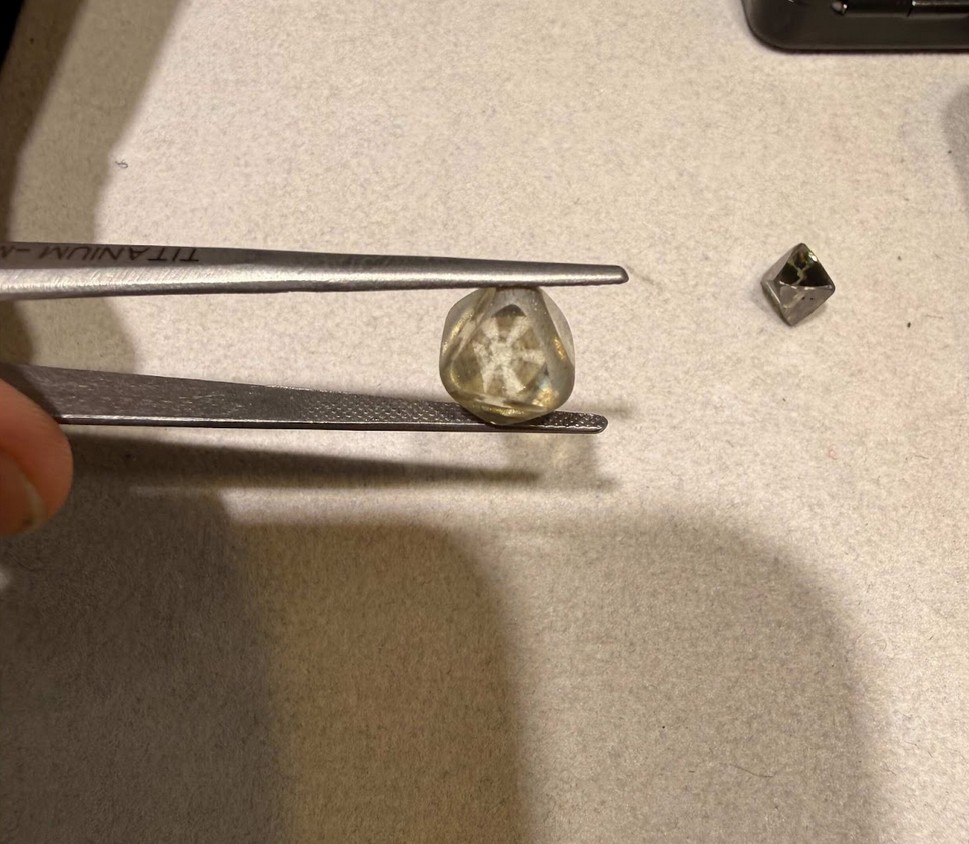
Looking at this perfect example of an asteroid diamond, you may think that the surface has been polished to allow you to see inside the gem. You would be wrong. Malpani proudly said that the collection of raw crystals has not been processed in any way. Industry professionals have a term for well-formed octahedral diamonds with good transparency and clean edges - they are called "glassies".
To demonstrate that Dynamic International's asteroid diamonds have not been polished, Malpani selected another dark diamond with well-placed inclusions which happened to have more weathering on its surface, resulting in a frosted appearance.
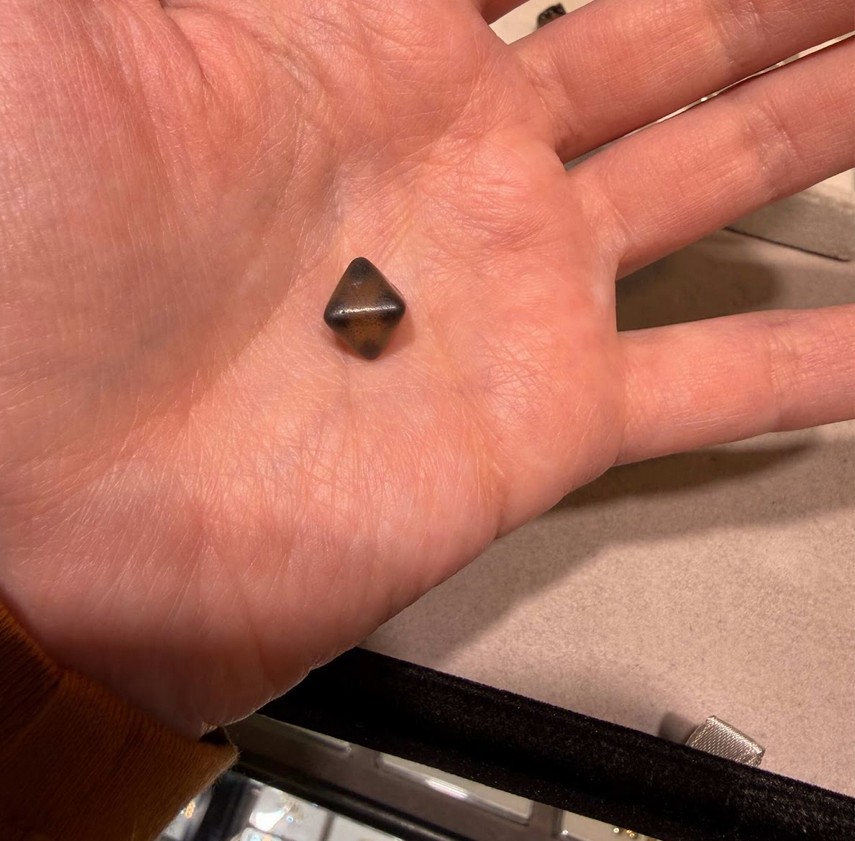
The "weathering" that has scarred the surface of this diamond happened after it formed. As for what caused it, we will never know for sure, but there are a few options. First, it may have had a rough journey to the surface. Once it ascended, it is also possible that the gem rubbed against other diamonds and/or rocks near it, marring its outer skin.
Malpani said that the Dynamic International will not facet or even polish the diamonds in this special collection. Moreover, he expects that buyers of asteroid diamonds will keep the gems as intact specimens. Some natural treasures are too rare and beautiful to be messed with by human hands.



When you join the IGS community, you get trusted diamond & gemstone information when you need it.
As a reporter who covers gem shows, I am often asked, "What do you write about? Don't you just see the same kinds of gems and jewelry every year?" Well, I can tell you that it most certainly is not "the same old things" every time.
The gems and jewelry world is a fantastically dynamic place. Not only are new gemstone deposits discovered, but global politics also influence what type of inventory is available, skilled lapidaries create true works of art, new sizes and colors of cultured pearls are debuted, artists unveil fresh designs, and more!
Under correct and stable growing conditions, diamonds often develop in an octahedral shape, which is basically two four-sided pyramids with their bases attached. This shape is present from the start, with tiny octahedral diamonds expanding outward into bigger octahedra. Diamonds do this because they are part of the cubic crystal system, also known as the isometric crystal system, where their carbon atoms become locked together in a symmetrical and balanced orientation.
When the environmental conditions of diamond nurseries are ideal, you get perfect octahedral shapes and complete carbon conversion, meaning all soft, darkly colored carbon in its graphite form gets squeezed into diamond. Yet, perfection and stability are rarely attained in nature. Many diamonds are exposed to changing conditions as they grow, which affects both their shape and clarity.
On their own, unconverted graphite inclusions are quite common. An exaggerated example is salt-and-pepper diamonds. These gems are filled with specks of graphite and other inclusions, and buyers have come to value them for their one-of-a-kind uniqueness, which cannot be replicated in a diamond-growing laboratory.
What makes Dynamic International's collection of asteroid diamonds so exceptional is the fact that the distribution of graphite is not random, as you see in salt-and-pepper diamonds. Rather, the inclusions are perfectly aligned along the symmetrical growth planes of the gems.
Part of Dynamic International's collection of asteroid diamonds. The flat diamond at the top left of the display is called a "macle," which is a twinned crystal that formed when part of the expanding crystal grew in a different orientation. You can see that its graphite clouds are still perfectly aligned with the growth plane. Photo by Emily Frontiere.
Sales executive for Dynamic International, Ram Malpani, explained that the gems in this exceptional collection were mined in South Africa and Zimbabwe.
He singled out one gem, which he said is considered lower quality because the gem is overly dark and the pattern of the inclusions is not precise. However, Malpani quickly added that, while this particular gem may not best represent asteroid diamonds, it is still an extraordinary gemstone.
Malpani then selected another of his asteroid diamonds and explained that its quality is outstanding. The body of this diamond is perfectly clear, allowing you to admire the remarkable graphite inclusions.
Looking at this perfect example of an asteroid diamond, you may think that the surface has been polished to allow you to see inside the gem. You would be wrong. Malpani proudly said that the collection of raw crystals has not been processed in any way. Industry professionals have a term for well-formed octahedral diamonds with good transparency and clean edges - they are called "glassies".
To demonstrate that Dynamic International's asteroid diamonds have not been polished, Malpani selected another dark diamond with well-placed inclusions which happened to have more weathering on its surface, resulting in a frosted appearance.
The "weathering" that has scarred the surface of this diamond happened after it formed. As for what caused it, we will never know for sure, but there are a few options. First, it may have had a rough journey to the surface. Once it ascended, it is also possible that the gem rubbed against other diamonds and/or rocks near it, marring its outer skin.
Malpani said that the Dynamic International will not facet or even polish the diamonds in this special collection. Moreover, he expects that buyers of asteroid diamonds will keep the gems as intact specimens. Some natural treasures are too rare and beautiful to be messed with by human hands.