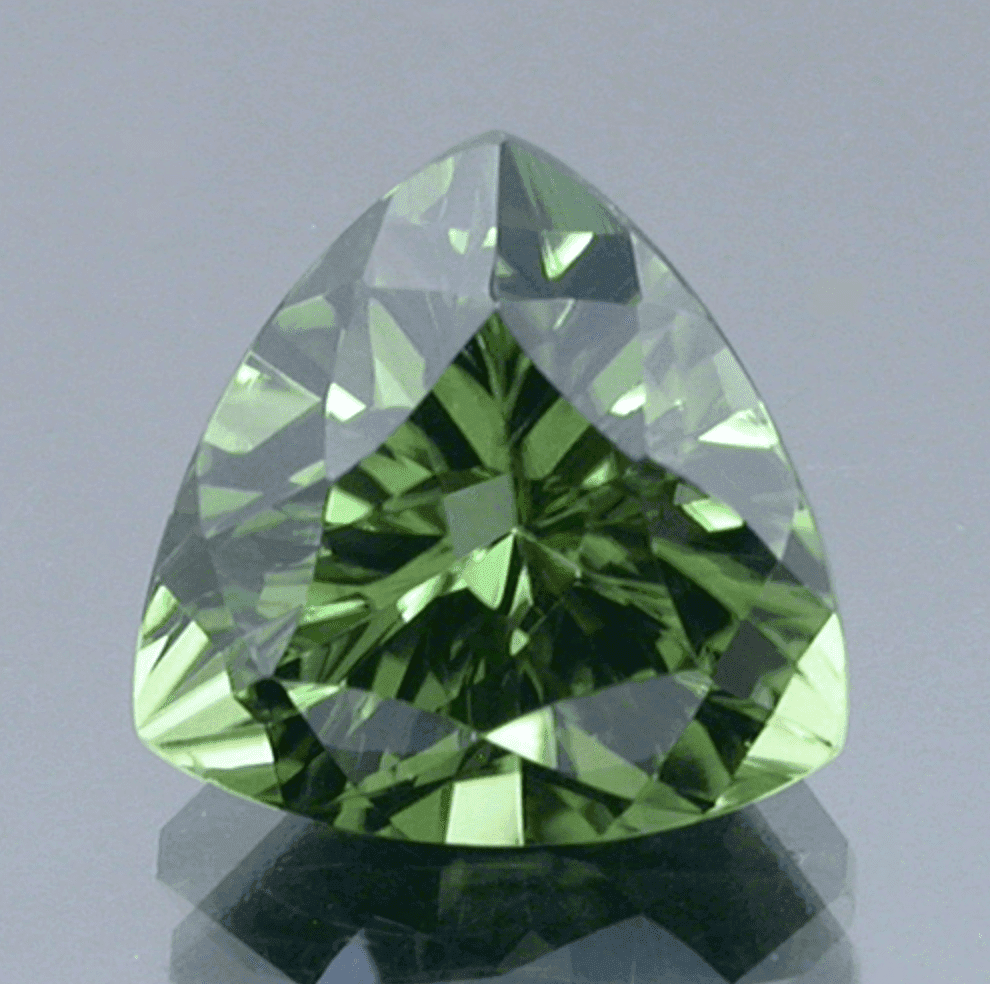
Gems with odd symmetry designs include popular trillions as well as unusual 7-sided stones. Learn the limitations and possibilities of these cuts.
4 Minute Read
For the sake of clarity, I prefer to use the words symmetry instead of "rotational angles" and angle instead of "slope."
Some odd-numbered indices are just odd. That means no even symmetries are possible on them. For example, Ultra Tec makes a 77 index that's solely for odd symmetry. Only 7- and 11-symmetry are possible with this index. A long time ago, many people, including myself, made designs for this index, too.
Some indexes, like the 80 and the 120, can be used for either even or odd symmetry designs. Both of these indexes are very common, and so are gemstone designs created for them.
Gem cutters use some odd symmetries daily, such as 1-symmetry, trillions, and pentagons. Others are rarely used, such as 7, 9 11, 13, etc.
The only practical odd symmetries are 1, 3, and 5. In any faceting book, you'll find many gemstone designs based on these. So, why are 7, 9, 11, and 13 symmetries used so infrequently?
Let's look at an example.
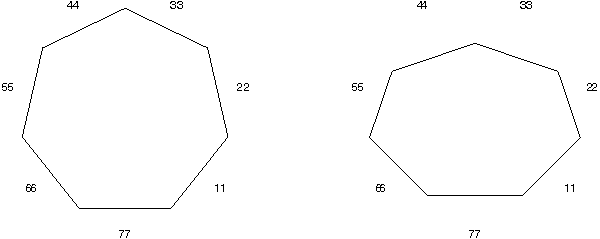
As you can see, the 77 index and seven-sided shape/outline on the left will work fine in a round shape. However, round design options are slim, since seven is a prime number (divisible only by one and itself). Thus, splitting off facet placements is quite limited. There's no way to get a lot of design outlines and tiers for facets. (If you ever try to get a rectangle or oval out of a 7- or 9-symmetry, you'll see what I mean).
The outline on the right is scaled to L/W=1.33. As you can see, a 77 index will certainly not work in any traditional sense for ovals, squares, trillions, rectangles, etc., because of the odd number of facets.
Here's another example.
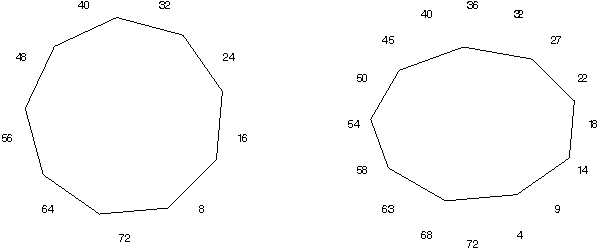
Again, notice the odd number of facets and unevenly shaped outline. A 9-symmetry will work for a round design but is just uneven if scaled. Without some fancy designing, a 9-symmetry just won't work for any other shape but round. Nine isn't a prime number but it's still not easily divisible. There are no real options for facets and tiers.
Odd symmetries like 7, 9, 11, and 13 don't see common use for the following reasons:
Some people have claimed professional gemstone cutters and designers don't use odd symmetry because there's a "profit motive" to promote 96 index designs. This is nonsense. Simply put, what sells are designs that have universal appeal and quality performance. A quality design is a quality design. It doesn't matter with what index or symmetry it's created. If odd symmetry designs or indexes had broad appeal or performed well optically, professional cutters would undoubtedly use them. In fact, trillions are an odd symmetry and are promoted heavily and cut frequently by both professionals and hobbyists. Why? Because they sell and perform well.
That being said, there are indexes (32, 64, 80, 96, and 120) that lend themselves to gemstone designing more than others. Some shapes naturally work better for gemstones and are more pleasing to the eye. Mathematically, these indexes offer many possible variations.
Does that mean odd symmetry designs like 7 and 9 just don't perform or are good for nothing? Not at all. Odd symmetries (except 1, 3, and 5) are limited but they can be used for rounds, unusual shapes, or novelty designs. They can often make nice gemstones. Some odd symmetry designs perform as well as, and in a few cases better than, even symmetry designs. Notwithstanding these possibilities, the mathematical and physical limitations of odd symmetries mean designers and jewelers don't commonly use them.
Odd symmetries are nothing new. A lot of people have been there and done that, including me. If you like odd symmetry designs, by all means, have fun.


When you join the IGS community, you get trusted diamond & gemstone information when you need it.
For the sake of clarity, I prefer to use the words symmetry instead of "rotational angles" and angle instead of "slope."
Some odd-numbered indices are just odd. That means no even symmetries are possible on them. For example, makes a 77 index that's solely for odd symmetry. Only 7- and 11-symmetry are possible with this index. A long time ago, many people, including myself, made designs for this index, too.
Some indexes, like the 80 and the 120, can be used for either even or odd symmetry designs. Both of these indexes are very common, and so are gemstone designs created for them.
Gem cutters use some odd symmetries daily, such as 1-symmetry, trillions, and pentagons. Others are rarely used, such as 7, 9 11, 13, etc.
The only practical odd symmetries are 1, 3, and 5. In any faceting book, you'll find many gemstone designs based on these. So, why are 7, 9, 11, and 13 symmetries used so infrequently?
Let's look at an example.
As you can see, the 77 index and seven-sided shape/outline on the left will work fine in a round shape. However, round design options are slim, since seven is a prime number (divisible only by one and itself). Thus, splitting off facet placements is quite limited. There's no way to get a lot of design outlines and tiers for facets. (If you ever try to get a rectangle or oval out of a 7- or 9-symmetry, you'll see what I mean).
The outline on the right is scaled to L/W=1.33. As you can see, a 77 index will certainly not work in any traditional sense for ovals, squares, trillions, rectangles, etc., because of the odd number of facets.
Here's another example.
Again, notice the odd number of facets and unevenly shaped outline. A 9-symmetry will work for a round design but is just uneven if scaled. Without some fancy designing, a 9-symmetry just won't work for any other shape but round. Nine isn't a prime number but it's still not easily divisible. There are no real options for facets and tiers.
Odd symmetries like 7, 9, 11, and 13 don't see common use for the following reasons:
Some people have claimed professional gemstone cutters and designers don't use odd symmetry because there's a "profit motive" to promote 96 index designs. This is nonsense. Simply put, what sells are designs that have universal appeal and quality performance. A quality design is a quality design. It doesn't matter with what index or symmetry it's created. If odd symmetry designs or indexes had broad appeal or performed well optically, professional cutters would undoubtedly use them. In fact, trillions are an odd symmetry and are promoted heavily and cut frequently by both professionals and hobbyists. Why? Because they sell and perform well.
That being said, there are indexes (32, 64, 80, 96, and 120) that lend themselves to gemstone designing more than others. Some shapes naturally work better for gemstones and are more pleasing to the eye. Mathematically, these indexes offer many possible variations.
Does that mean odd symmetry designs like 7 and 9 just don't perform or are good for nothing? Not at all. Odd symmetries (except 1, 3, and 5) are limited but they can be used for rounds, unusual shapes, or novelty designs. They can often make nice gemstones. Some odd symmetry designs perform as well as, and in a few cases better than, even symmetry designs. Notwithstanding these possibilities, the mathematical and physical limitations of odd symmetries mean designers and jewelers don't commonly use them.
Odd symmetries are nothing new. A lot of people have been there and done that, including me. If you like odd symmetry designs, by all means, have fun.