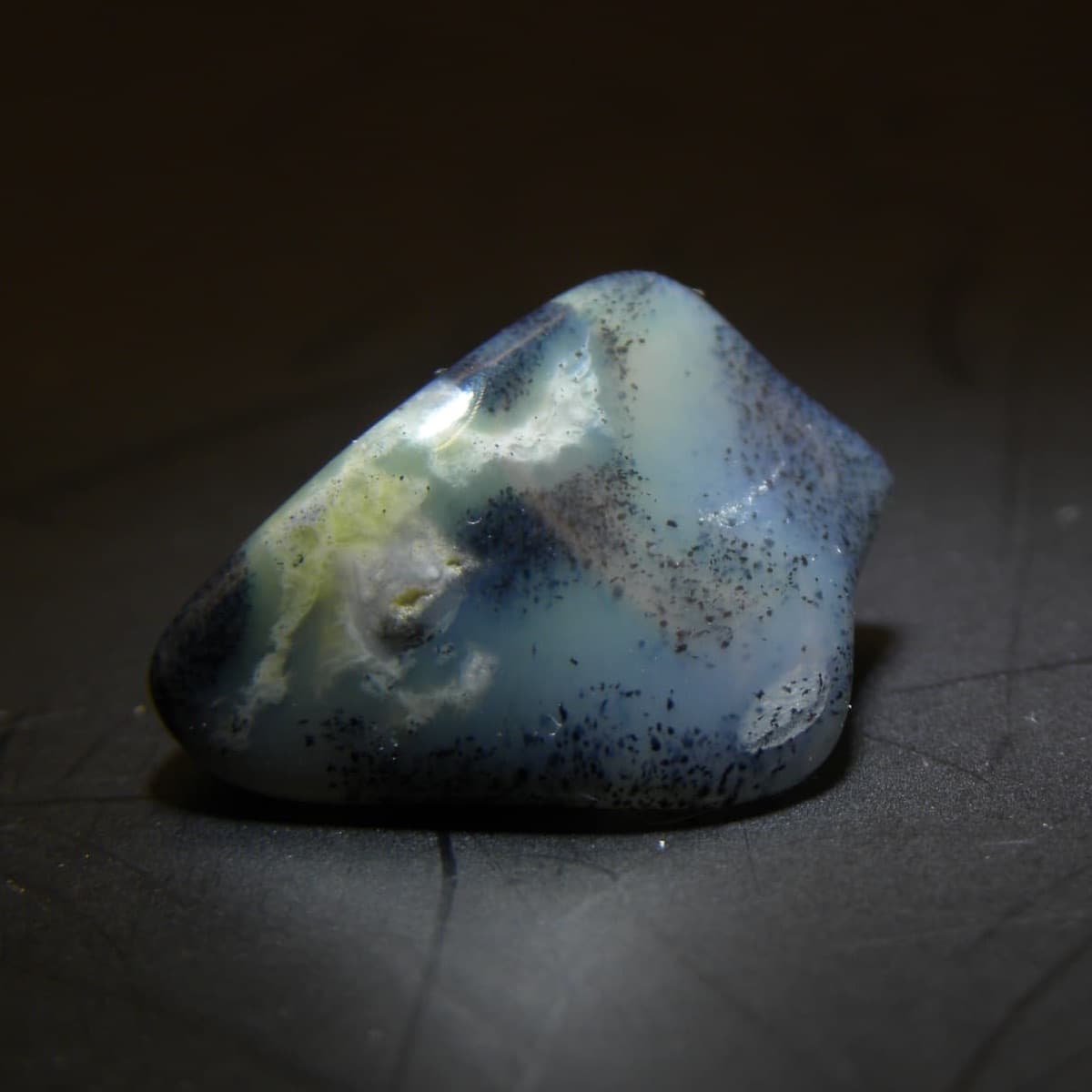
Gemstone identification requires a good reference library and some basic gemology tools. Before you go shopping, learn more about what you'll need.
13 Minute Read
| Tool | Vendors | Estimated Price |
| Microscope | Accu-Scope® Gem Scope 3052-GEM Microscope | $399.95 |
| Loupe | 10X Gesswein® 20.5mm Hex Triplet Loupes - Black | $21.95 |
| Tweezers | D-Master Soft Tip Tweezers | $29.95 |
| Scale | GEMORO® Platinum XP500 Scale (Capacity: 500g) | $29.95 |
| Spectroscope | Handheld Durable Small Diffraction Spectroscope 55mm | $26.90 |
| Refractometer | Ade Advanced Optics GL500 Gem Refractometer | $99.99 |
| Calipers | 4" Electronic Digital Pocket Caliper | $36.05 |
| Diamond tester | Diamond Tech Pro Diamond Tester | $105.95 |
Before you start buying instruments and setting up your gem lab, you need to invest in good reference materials to make sense of what the instruments will tell you. You'll find all the information you need for the International Gem Society (IGS) professional gemologist certification course in the Learning Center. However, you may want to add other resources to your library.
The Color Encyclopedia of Gemstones by Dr. Joel Arem lists approximately 3,000 natural minerals and synthetic materials that have been cut into gems. Dr. Arem has generously allowed the IGS to reprint much of the information from his book in our Gemstone Listings. Where we have done so, he's indicated as a source. You can find copies of this out-of-print book for sale on Amazon. (You can also download the second edition of this work in sections as free PDFs here).
Another excellent reference is Gemstones of the World by Walter Schumann. This book is an easier read than Arem's work and has more information on peripheral subjects like gem sources. Its fifth edition was published in 2013.
Two other noteworthy reference books are available from the Gemological Institute of America (GIA). First, the Gem Reference Guide is similar to the Color Encyclopedia of Gemstones. In some ways, it's easier to read and use than Arem's work. However, it only deals with a hundred or so stones that are "most likely" to show up in jewelry. Second, the GIA's Handbook of Gem Identification describes in detail how to use many gemology tools and gives step-by-step instructions on separating the species. This is unquestionably one of the best books ever written on gem identification.
Gems: Their Sources, Descriptions, and Identification by Robert Webster and B.W. Anderson is an outstanding reference work based on traditional methods of gem identification.
Once you have your reference library, start assembling your lab equipment.
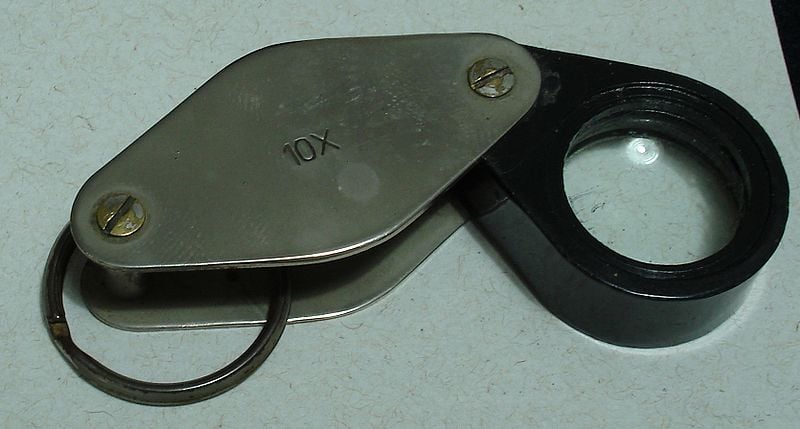
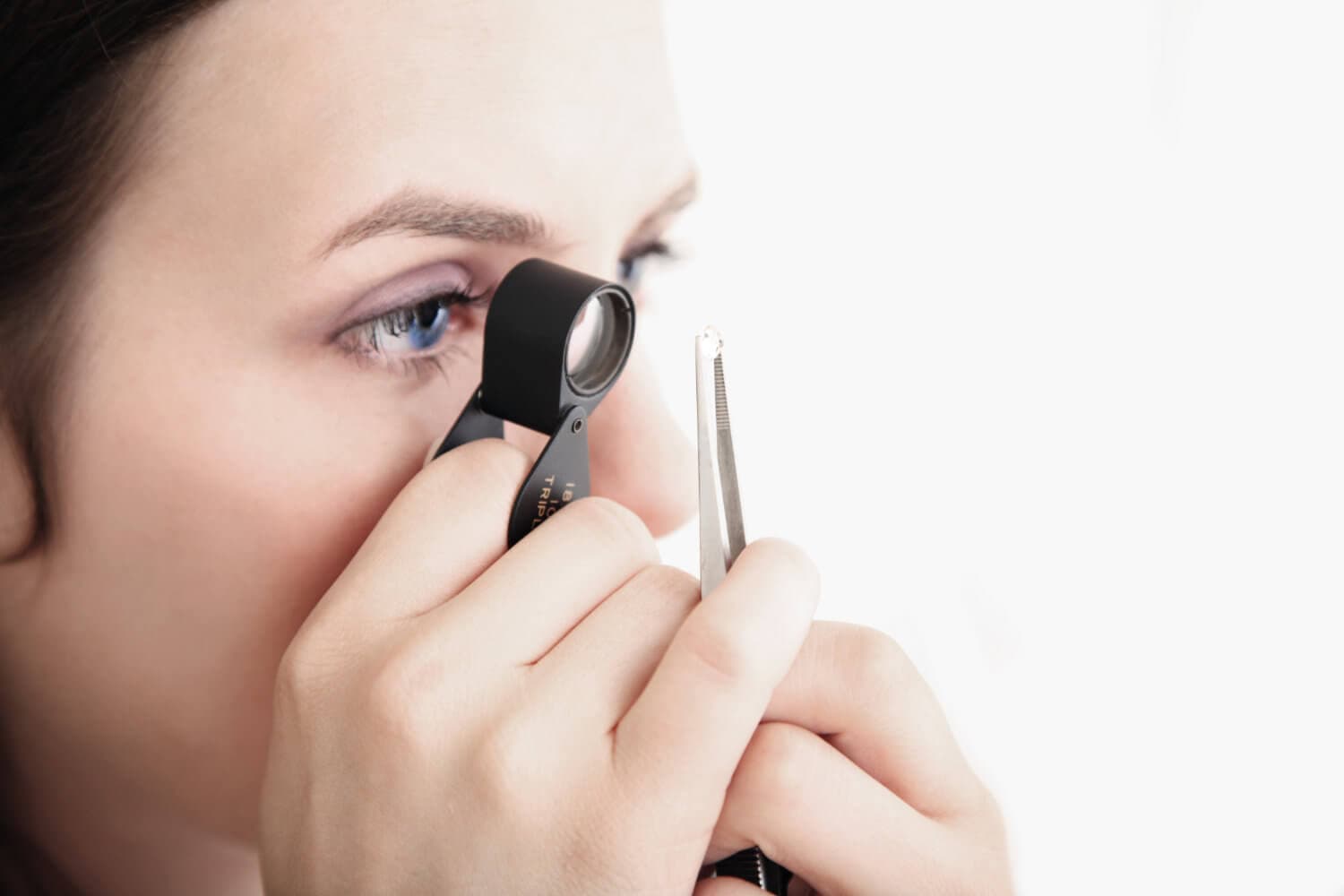
You'll need magnification. Start with a good quality 10x (ten power) loupe. Some economy loupes on the market range from mediocre to very good quality. The best you can get, and the standard for diamond grading, is a color corrected triplet loupe. Triplet means it has three lenses, so there's no distortion near the edges. Color corrected refers to a coating on the lenses, so the color you see is accurate.
Read our article on loupes for more information.
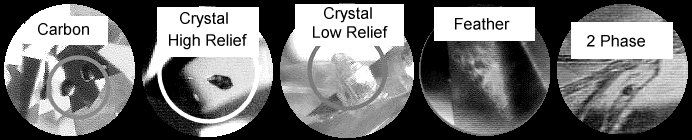
You'll also need a microscope for studying inclusions. This is often the only way to separate natural gems from their synthetic counterparts. While the loupe is more portable, the microscope is easier on the eyes and offers higher magnification. A gem microscope has special features that aren't available on most microscopes, so be sure the microscopes you're considering are appropriate for studying gemstones. A minimum 40x stereo microscope is needed for gemstone identification, but, of course, more power is helpful. You'll be able to see more inclusions and greater detail under higher magnification. Higher power will sometimes mean the difference between making an identification or not.
As a general rule, purchase the highest quality instruments you can afford. With microscopes, however, you can make a compromise for your budget's sake without a significant sacrifice in quality. The bottom line is that the information gathered from a microscope has more to do with the skill of the operator than the quality of the optics.
Read our article on the microscope for more information.
Measuring the refractive index (RI) of your gems will be a high priority. You can do this with a microscope, but a refractometer is the best tool. Besides measuring the RI, a refractometer will give you the birefringence and optic sign of a gemstone.
In North America, the primary supplier of refractometers is the GIA. In Europe, the primary supplier is Krüss Instruments. Of course, used refractometers are occasionally available on eBay.
Read our three-part guide to using a refractometer for more information.
Another gem lab necessity is a means to measure specific gravity (SG). There are two methods for doing this. A balance beam scale can be used, provided one pan can be submerged in water. (That's usually easy to arrange). The other method is to use a set of "heavy liquids." This is a collection of liquids with predetermined SGs. You determine the specific gravity of a gem by submersing it in the liquids and observing whether it floats or sinks.
Heavy liquids have some disadvantages. They are toxic and flammable, so you must exercise care when using and storing them. Sometimes it's difficult to wash off the gem. Furthermore, your readings will always be estimates with heavy liquids. If you have an accurate scale, you can get a much more precise reading. There will be occasions when this is important, as a small fraction can sometimes confirm or eliminate a possible identification.
Read our five-part series on specific gravity testing procedures for more information.

Next on the list is one of the most inexpensive gemology tools. The dichroscope is a small, hand-held instrument that separates the colors in dichroic materials. Its essential elements are two small pieces of polarizing material, oriented at 90º to each other, plus magnification.
With a little thought and skill, you can actually make one yourself.
Read our article on the using a dichroscope for more information.
Equally important (and just a little more expensive) is a polariscope. It's used in conjunction with a loupe or a strainless (not stainless) sphere, which is a glass sphere with no strain lines in it. These are used to determine if a material is singly or doubly refractive and to ascertain its optic sign. The polariscope will also show strain and twinning, which will occasionally help to distinguish between natural and synthetic materials. (If you can't ascertain the optic sign with a polariscope, use a refractometer).
Polariscopes can be made at home or purchased. The primary requirements are an underneath light source and two pieces of polarizing material that are separated enough to hold a gem between them. One piece of polarizing material can be stationary, but the other needs to be rotated in place.
Read our three-part guide to using a polariscope for more information.

If you're serious about gemology and gem identification, you'll need a spectroscope to study a gem's absorption spectrum.
There are essentially two different kinds of instruments, diffraction grating and prism. They both do equally well, but the scale is more elongated in the prism style.
If you're relying on images in a reference book to help you determine what you're seeing, make sure they show views from your kind of spectroscope. Otherwise, the comparisons get very confusing.
Another important feature is a calibrated scale. Many people learn to use a spectroscope without a scale and make their determinations strictly by the colors. This ability depends on your eyesight and experience.
Until you've looked at enough gems, making an accurate assessment in this manner will be difficult. Thus, a spectroscope with a calibrated scale is preferable for beginners. However, a calibrated scale increases the price tremendously, so you'll need to consider this when budgeting for equipment.
Other factors that add to the price of a spectroscope include lighting and a stand. You need both a bright light source and a means to hold the gem, the spectroscope itself, and the light source steady while you're taking your readings. If these are all built-in, the spectroscope will be easier to use but also more expensive. If you're handy with DIY, you can create these elements and save some money.
There are inexpensive diffraction grating spectroscopes on the market. However, these are the most difficult to use. You must find a way to hold them very still in relationship to the gem and the light. To further complicate this, you focus a diffraction grating spectroscope by moving it closer and further from the gem. Since the display is much darker than a prism spectroscope, lighting is a particular consideration. (See our review of the GL SpectroLite).
The spectroscope is one of the last gemology tools you'll need to add to your lab. If you have a tight budget, this instrument will take the most consideration. Prices can run up to a thousand dollars for top-of-the-line instruments with all the accessories. Get the best instrument you can afford, then make your compromises on the lighting and stand.
Read our article on the spectroscope and our spectroscope guide for more information.
The above instruments represent the major, "must-have"s of a gem lab. Of course, you'll also need a bunch of other odds and ends, such as:
In addition to these miscellaneous items, there are other pieces of equipment worth mentioning.
There's an instrument called a "jeweler's eye" or reflectometer that measures luster. It was designed for traveling professionals who need portable instruments, not beginners.
If your work requires you to identify small stones in settings, a diamond tester is a necessity. Small, dirty, low-quality diamonds are impossible to distinguish with the naked eye.
Read our article on diamond testers and other diamond grading tools for more information.
Hardness sets or points, pencil-like things with ends made of varying materials, are a standard part of the mineralogist's toolkit. They're used to determine the hardness of a substance. These are also useful gemology tools if you're going to identify gemstone rough. However, never use these on finished gems. Hardness points will leave a permanent scratch and may cause a gem to break. If you're testing rough, make sure you test a small area that's separate from the cuttable portion, because stress on cleavage planes can cause the stone to split.
Read our article on scratch testing for more information.
Streak testing is a mineralogical procedure for detecting coloring agents. All it requires is a small piece of unglazed ceramic tile. Like scratch testing, this is a destructive test. Never do this to a finished gem. If you're testing rough, the same cautions as scratch testing apply. Use a small sample of gem material that has been separated from the whole.
Read our article on streak testing for more information.
A Chelsea filter is a very handy tool. Originally used to separate real emerald gems from lookalikes, it's been called an emerald filter, too. However, some emeralds get their coloring from vanadium instead of chromium, so it doesn't work in all cases.
Now, gemologists use it primarily to determine if a material gets its color from chromium. If it does, the stone will appear pink or red through the filter. If not, you'll see something else. This is important because gems like chrome pyrope and chrome tourmaline have a different value structure than their counterparts. While you can also make this determination with a spectroscope, a Chelsea filter is the easiest way to distinguish these gems.
For more information, read our article on color filters.
Your lighting needs careful consideration. Standard lights will suit most of your needs, but you'll need something that is flexible and easily moved into useful positions. A flexible arm light, or even a good quality flashlight, will be very helpful. Some of your gemology tools and instruments will have built-in specialty lights. You may need to create or provide your own speciality lights for others.
Keep in mind that incandescent and fluorescent light will give you different colors in some gems. If at all possible, use incandescent or natural sunlight from a window as your primary light source. If your lab has fluorescent lighting already installed in the ceiling, you'll need to turn it off or shield it at times.
One of your most useful light sources is a window with indirect light, since filtered sunlight is the standard for color comparison. Also, don't make the mistake of thinking you can rely on daylight equivalent lights for color change comparisons. They work well in many cases but not well in others. More than one gemologist has been embarrassed by relying on artificial lights.
Learn more about artificial lighting and gemology.
While not absolutely necessary, ultraviolet light (UV) is sometimes helpful in making an identification. You'll need both long and shortwave UV for testing. A low-powered light is sufficient but will need to be mounted in a box that doesn't allow any other light to enter.
Read our article on UV light and gemstone identification for more information.
While all this information about gemology tools may seem a bit daunting, it's meant to be a comprehensive list of the tools you may need as you get more involved in the gem world.
All a beginner needs to get started is access to the IGS website, a pair of tweezers, and a loupe. These simple tools will take you a long way in the study of gems.
Test your knowledge of the gemology tools discussed in this article. Click the link at the end of the quiz for the answers.
Gemology is best described as studying
A. Gemstone color, hardness, and clarity
B. Gem origins
C. The physical and optical properties that make gems unique
Your loupe should have a magnification of
A. 5x
B. 10x
C. 15x
A triplet loupe is preferred because
A. It has three apertures that can be combined for greatest magnification
B. You can view three stones at one time
C. It has three lenses that eliminate distortion near the edges
Color corrected in a loupe means
A. It will match your favorite shirt
B. The loupe contains a special lens to filter out distorted wavelengths of light
C. A special coating on the lens will ensure you see accurate color
A gem microscope has these advantages over the loupe:
A. It's easier on the eyes
B. It'll impress your customers (and your credit card company)
C. Its greater magnification lets you study inclusions in detail
D. All of the above
A gem microscope should have a minimum magnification of
A. 30x
B. 40x
C. 60x
Besides RI, you can use the refractometer to measure
A. Birefringence
B. Optic sign
C. A and B
D None of the above
Heavy liquids can only give an estimate of a gem's specific gravity.
A. True
B. False
A dichroscope is a small hand held instrument used to
A. Measure the dichros of a material
B. Separate the colors in dichroic material using two small pieces of polarizing material set at 45°
C. Separate the colors in dichroic material using two small pieces of polarizing material set at 90°
A polariscope is used with a strainless sphere to determine
A. If material is doubly refractive
B. A material's optic sign
C. Strain and twinning in a material
D. All of the above
There are essentially two different kinds of spectroscopes.
A. True
B. False
A spectroscope with a calibrated scale isn't recommended for beginners.
A. True
B. False
A jeweler's eye is
A. The look a jeweler gives well-heeled customers
B. The ability to distinguish gems from experience
C. An instrument used to measure gem luster
Hardness points are safe to use on finished gemstones.
A. True
B. False
Streak testing uses
A. Unglazed ceramic tile
B. A brick
C. Any hard, coarse material
D. None of the above
Both long and shortwave ultraviolet light are useful for gem identification.
A. True
B. False
If you haven't already, sign up for our Gemology Tools Mini-Course.




When you join the IGS community, you get trusted diamond & gemstone information when you need it.
| Tool | Vendors | Estimated Price |
| Microscope | Accu-Scope® Gem Scope 3052-GEM Microscope | $399.95 |
| Loupe | 10X Gesswein® 20.5mm Hex Triplet Loupes - Black | $21.95 |
| Tweezers | D-Master Soft Tip Tweezers | $29.95 |
| Scale | GEMORO® Platinum XP500 Scale (Capacity: 500g) | $29.95 |
| Spectroscope |
| Handheld Durable Small Diffraction Spectroscope 55mm |
| $26.90 |
| Refractometer | Ade Advanced Optics GL500 Gem Refractometer | $99.99 |
| Calipers | 4" Electronic Digital Pocket Caliper | $36.05 |
| Diamond tester | Diamond Tech Pro Diamond Tester | $105.95 |
Before you start buying instruments and setting up your gem lab, you need to invest in good reference materials to make sense of what the instruments will tell you. You'll find all the information you need for the International Gem Society (IGS) professional gemologist certification course in the Learning Center. However, you may want to add other resources to your library.
The Color Encyclopedia of Gemstones by Dr. Joel Arem lists approximately 3,000 natural minerals and synthetic materials that have been cut into gems. Dr. Arem has generously allowed the IGS to reprint much of the information from his book in our Gemstone Listings. Where we have done so, he's indicated as a source. You can find copies of this out-of-print book for sale on Amazon. (You can also download the second edition of this work in sections as free PDFs here).
Another excellent reference is Gemstones of the World by Walter Schumann. This book is an easier read than Arem's work and has more information on peripheral subjects like gem sources. Its fifth edition was published in 2013.
Two other noteworthy reference books are available from the Gemological Institute of America (GIA). First, the Gem Reference Guide is similar to the Color Encyclopedia of Gemstones. In some ways, it's easier to read and use than Arem's work. However, it only deals with a hundred or so stones that are "most likely" to show up in jewelry. Second, the GIA's Handbook of Gem Identification describes in detail how to use many gemology tools and gives step-by-step instructions on separating the species. This is unquestionably one of the best books ever written on gem identification.
Gems: Their Sources, Descriptions, and Identification by Robert Webster and B.W. Anderson is an outstanding reference work based on traditional methods of gem identification.
Once you have your reference library, start assembling your lab equipment.
You'll need magnification. Start with a good quality 10x (ten power) loupe. Some economy loupes on the market range from mediocre to very good quality. The best you can get, and the standard for diamond grading, is a color corrected triplet loupe. Triplet means it has three lenses, so there's no distortion near the edges. Color corrected refers to a coating on the lenses, so the color you see is accurate.
Read our article on loupes for more information.
You'll also need a microscope for studying inclusions. This is often the only way to separate natural gems from their synthetic counterparts. While the loupe is more portable, the microscope is easier on the eyes and offers higher magnification. A gem microscope has special features that aren't available on most microscopes, so be sure the microscopes you're considering are appropriate for studying gemstones. A minimum 40x stereo microscope is needed for gemstone identification, but, of course, more power is helpful. You'll be able to see more inclusions and greater detail under higher magnification. Higher power will sometimes mean the difference between making an identification or not.
As a general rule, purchase the highest quality instruments you can afford. With microscopes, however, you can make a compromise for your budget's sake without a significant sacrifice in quality. The bottom line is that the information gathered from a microscope has more to do with the skill of the operator than the quality of the optics.
Read our article on the microscope for more information.
Measuring the refractive index (RI) of your gems will be a high priority. You can do this with a microscope, but a refractometer is the best tool. Besides measuring the RI, a refractometer will give you the birefringence and optic sign of a gemstone.
In North America, the primary supplier of refractometers is the GIA. In Europe, the primary supplier is Krüss Instruments. Of course, used refractometers are occasionally available on eBay.
Read our three-part guide to using a refractometer for more information.
Another gem lab necessity is a means to measure specific gravity (SG). There are two methods for doing this. A balance beam scale can be used, provided one pan can be submerged in water. (That's usually easy to arrange). The other method is to use a set of "heavy liquids." This is a collection of liquids with predetermined SGs. You determine the specific gravity of a gem by submersing it in the liquids and observing whether it floats or sinks.
Heavy liquids have some disadvantages. They are toxic and flammable, so you must exercise care when using and storing them. Sometimes it's difficult to wash off the gem. Furthermore, your readings will always be estimates with heavy liquids. If you have an accurate scale, you can get a much more precise reading. There will be occasions when this is important, as a small fraction can sometimes confirm or eliminate a possible identification.
Read our five-part series on specific gravity testing procedures for more information.
Next on the list is one of the most inexpensive gemology tools. The dichroscope is a small, hand-held instrument that separates the colors in dichroic materials. Its essential elements are two small pieces of polarizing material, oriented at 90º to each other, plus magnification.
With a little thought and skill, you can actually make one yourself.
Read our article on the using a dichroscope for more information.
Equally important (and just a little more expensive) is a polariscope. It's used in conjunction with a loupe or a strainless (not stainless) sphere, which is a glass sphere with no strain lines in it. These are used to determine if a material is singly or doubly refractive and to ascertain its optic sign. The polariscope will also show strain and twinning, which will occasionally help to distinguish between natural and synthetic materials. (If you can't ascertain the optic sign with a polariscope, use a refractometer).
Polariscopes can be made at home or purchased. The primary requirements are an underneath light source and two pieces of polarizing material that are separated enough to hold a gem between them. One piece of polarizing material can be stationary, but the other needs to be rotated in place.
Read our three-part guide to using a polariscope for more information.
If you're serious about gemology and gem identification, you'll need a spectroscope to study a gem's absorption spectrum.
There are essentially two different kinds of instruments, diffraction grating and prism. They both do equally well, but the scale is more elongated in the prism style.
If you're relying on images in a reference book to help you determine what you're seeing, make sure they show views from your kind of spectroscope. Otherwise, the comparisons get very confusing.
Another important feature is a calibrated scale. Many people learn to use a spectroscope without a scale and make their determinations strictly by the colors. This ability depends on your eyesight and experience.
Until you've looked at enough gems, making an accurate assessment in this manner will be difficult. Thus, a spectroscope with a calibrated scale is preferable for beginners. However, a calibrated scale increases the price tremendously, so you'll need to consider this when budgeting for equipment.
Other factors that add to the price of a spectroscope include lighting and a stand. You need both a bright light source and a means to hold the gem, the spectroscope itself, and the light source steady while you're taking your readings. If these are all built-in, the spectroscope will be easier to use but also more expensive. If you're handy with DIY, you can create these elements and save some money.
There are inexpensive diffraction grating spectroscopes on the market. However, these are the most difficult to use. You must find a way to hold them very still in relationship to the gem and the light. To further complicate this, you focus a diffraction grating spectroscope by moving it closer and further from the gem. Since the display is much darker than a prism spectroscope, lighting is a particular consideration. (See our review of the GL SpectroLite).
The spectroscope is one of the last gemology tools you'll need to add to your lab. If you have a tight budget, this instrument will take the most consideration. Prices can run up to a thousand dollars for top-of-the-line instruments with all the accessories. Get the best instrument you can afford, then make your compromises on the lighting and stand.
Read our article on the spectroscope and our spectroscope guide for more information.
The above instruments represent the major, "must-have"s of a gem lab. Of course, you'll also need a bunch of other odds and ends, such as:
In addition to these miscellaneous items, there are other pieces of equipment worth mentioning.
There's an instrument called a "jeweler's eye" or reflectometer that measures luster. It was designed for traveling professionals who need portable instruments, not beginners.
If your work requires you to identify small stones in settings, a diamond tester is a necessity. Small, dirty, low-quality diamonds are impossible to distinguish with the naked eye.
Read our article on diamond testers and other diamond grading tools for more information.
Hardness sets or points, pencil-like things with ends made of varying materials, are a standard part of the mineralogist's toolkit. They're used to determine the hardness of a substance. These are also useful gemology tools if you're going to identify gemstone rough. However, never use these on finished gems. Hardness points will leave a permanent scratch and may cause a gem to break. If you're testing rough, make sure you test a small area that's separate from the cuttable portion, because stress on cleavage planes can cause the stone to split.
Read our article on scratch testing for more information.
Streak testing is a mineralogical procedure for detecting coloring agents. All it requires is a small piece of unglazed ceramic tile. Like scratch testing, this is a destructive test. Never do this to a finished gem. If you're testing rough, the same cautions as scratch testing apply. Use a small sample of gem material that has been separated from the whole.
Read our article on streak testing for more information.
A Chelsea filter is a very handy tool. Originally used to separate real emerald gems from lookalikes, it's been called an emerald filter, too. However, some emeralds get their coloring from vanadium instead of chromium, so it doesn't work in all cases.
Now, gemologists use it primarily to determine if a material gets its color from chromium. If it does, the stone will appear pink or red through the filter. If not, you'll see something else. This is important because gems like chrome pyrope and chrome tourmaline have a different value structure than their counterparts. While you can also make this determination with a spectroscope, a Chelsea filter is the easiest way to distinguish these gems.
For more information, read our article on color filters.
Your lighting needs careful consideration. Standard lights will suit most of your needs, but you'll need something that is flexible and easily moved into useful positions. A flexible arm light, or even a good quality flashlight, will be very helpful. Some of your gemology tools and instruments will have built-in specialty lights. You may need to create or provide your own speciality lights for others.
Keep in mind that incandescent and fluorescent light will give you different colors in some gems. If at all possible, use incandescent or natural sunlight from a window as your primary light source. If your lab has fluorescent lighting already installed in the ceiling, you'll need to turn it off or shield it at times.
One of your most useful light sources is a window with indirect light, since filtered sunlight is the standard for color comparison. Also, don't make the mistake of thinking you can rely on daylight equivalent lights for color change comparisons. They work well in many cases but not well in others. More than one gemologist has been embarrassed by relying on artificial lights.
Learn more about artificial lighting and gemology.
While not absolutely necessary, ultraviolet light (UV) is sometimes helpful in making an identification. You'll need both long and shortwave UV for testing. A low-powered light is sufficient but will need to be mounted in a box that doesn't allow any other light to enter.
Read our article on UV light and gemstone identification for more information.
While all this information about gemology tools may seem a bit daunting, it's meant to be a comprehensive list of the tools you may need as you get more involved in the gem world.
All a beginner needs to get started is access to the IGS website, a pair of tweezers, and a loupe. These simple tools will take you a long way in the study of gems.
Test your knowledge of the gemology tools discussed in this article. Click the link at the end of the quiz for the answers.
Gemology is best described as studying
A. Gemstone color, hardness, and clarity
B. Gem origins
C. The physical and optical properties that make gems unique
Your loupe should have a magnification of
A. 5x
B. 10x
C. 15x
A triplet loupe is preferred because
A. It has three apertures that can be combined for greatest magnification
B. You can view three stones at one time
C. It has three lenses that eliminate distortion near the edges
Color corrected in a loupe means
A. It will match your favorite shirt
B. The loupe contains a special lens to filter out distorted wavelengths of light
C. A special coating on the lens will ensure you see accurate color
A gem microscope has these advantages over the loupe:
A. It's easier on the eyes
B. It'll impress your customers (and your credit card company)
C. Its greater magnification lets you study inclusions in detail
D. All of the above
A gem microscope should have a minimum magnification of
A. 30x
B. 40x
C. 60x
Besides RI, you can use the refractometer to measure
A. Birefringence
B. Optic sign
C. A and B
D None of the above
Heavy liquids can only give an estimate of a gem's specific gravity.
A. True
B. False
A dichroscope is a small hand held instrument used to
A. Measure the dichros of a material
B. Separate the colors in dichroic material using two small pieces of polarizing material set at 45°
C. Separate the colors in dichroic material using two small pieces of polarizing material set at 90°
A polariscope is used with a strainless sphere to determine
A. If material is doubly refractive
B. A material's optic sign
C. Strain and twinning in a material
D. All of the above
There are essentially two different kinds of spectroscopes.
A. True
B. False
A spectroscope with a calibrated scale isn't recommended for beginners.
A. True
B. False
A jeweler's eye is
A. The look a jeweler gives well-heeled customers
B. The ability to distinguish gems from experience
C. An instrument used to measure gem luster
Hardness points are safe to use on finished gemstones.
A. True
B. False
Streak testing uses
A. Unglazed ceramic tile
B. A brick
C. Any hard, coarse material
D. None of the above
Both long and shortwave ultraviolet light are useful for gem identification.
A. True
B. False
If you haven't already, sign up for our Gemology Tools Mini-Course.