Impurity Ions and Gemstone Colors
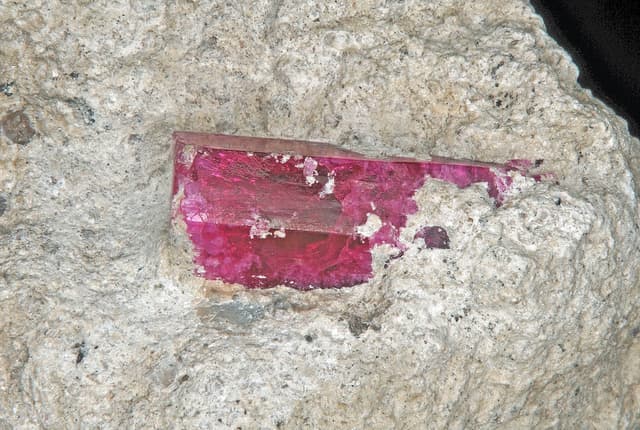
How do gems likes rubies and red beryls get their red color? Learn the role impurity ions play in the coloration of these and other gemstones.
3 Minute Read
The resulting color from an impurity in a mineral depends on the following factors:
- The type of impurity ion.
- The valence state of the impurity ion.
- The concentration of the impurity ion.
- The strength and symmetry of the crystal field on the impurity ion at the site at which it resides in the crystal. (This is determined by mineral type).
To explain this, I’ll use sapphire and ruby as my first gemstone examples. Chromium in corundum causes pink or red coloration.
How Do Impurity Ions Affect Ruby and Sapphire Color?
Just aluminum (Al) and oxygen (O) comprise pure corundum. The chemical formula, Al2O3, gives their relative amounts. Pure corundum doesn’t absorb any light from the far ultraviolet to the mid-infrared range. Thus, it’s absolutely colorless.
Now, chromium is a metal. However, when a chromium atom takes part in making a chemical compound, it loses electrons and becomes an ion. In the case of chromium in aluminum oxide, it loses three electrons, so we say it’s trivalent. It has a valence of +3 (Cr3+).
The trivalent chromium impurity substitutes for the trivalent aluminum of corundum. The addition of the trivalent chromium colors a corundum…
Related Articles
Evolution of the Pigeon’s Blood Ruby Color Grade
Gemstone Physical Properties
Gem Origin Opinions: When Gemology Labs Agree to Disagree on Sapphire Origins
Natural Radiation and Gemstone Color
Latest Articles

800 Years of Mogok: A Celebration in Tenuous Times
What is the Average Gemstone Faceting Yield?
Pyroxmangite Value, Price, and Jewelry Information

How to Identify Emerald Simulants and Synthetics

Never Stop Learning
When you join the IGS community, you get trusted diamond & gemstone information when you need it.