Ruby Specialist Mini Course
Tips to Identify Striae in Synthetic Corundum
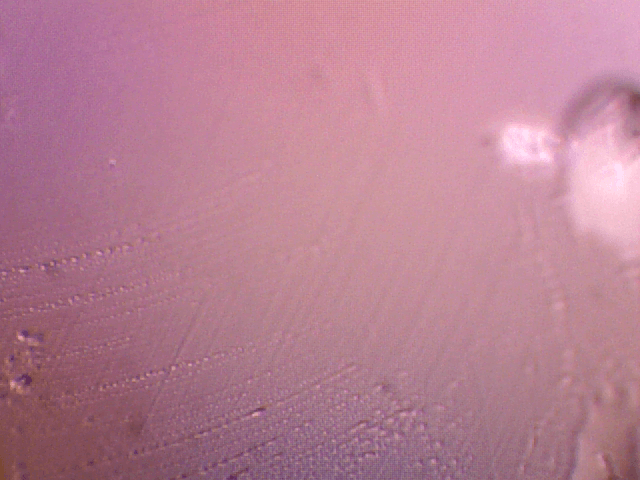
Answer: Curved striae are sure signs that a ruby or sapphire is synthetic. However, seeing these inclusions can be difficult because the curvature of the lines can be very subtle.
Using a Polariscope to Find Curved Striae in Synthetic Ruby or Sapphire
On several occasions, I've noticed I could find the zoning lines of natural corundum (rubies and sapphires) more easily with a polariscope. Sometimes, these lines aren't easily visible under a standard 10X loupe. If you have a polariscope, try it. It may work for the striae in lab-made ruby and sapphire.
If you don't have a polariscope, you can make a cheap one. And don't be afraid of using your loupe between the polarizing lenses.
A polariscope helps you locate the C-axis of a crystal rather easily. If you use a polariscope to locate the C-axis of a synthetic ruby, for example, then at least you'd expect the lines to be curved if you see them while looking down that axis. If you don't look down the C-axis, you may see straight lines that are actually curved. (Especially if you look at them at an angle perpendicular to the C-axis).
Immersion Method
Additionally, Richard Liddicoat recommended immersing a stone in methylene iodide or bromoform in a jar. This makes it easier to view the striae while using a white sheet of paper under the jar as a background.
Sincerely,
Ryan Young (Hobbyist Gemologist/Mineralogist and Enthusiast)
Using Magnification to View Curved Striae
IGS Members can watch this video by Gem Geek for tips on viewing curved striae under a loupe or microscope.
International Gem Society

Never Stop Learning
When you join the IGS community, you get trusted diamond & gemstone information when you need it.