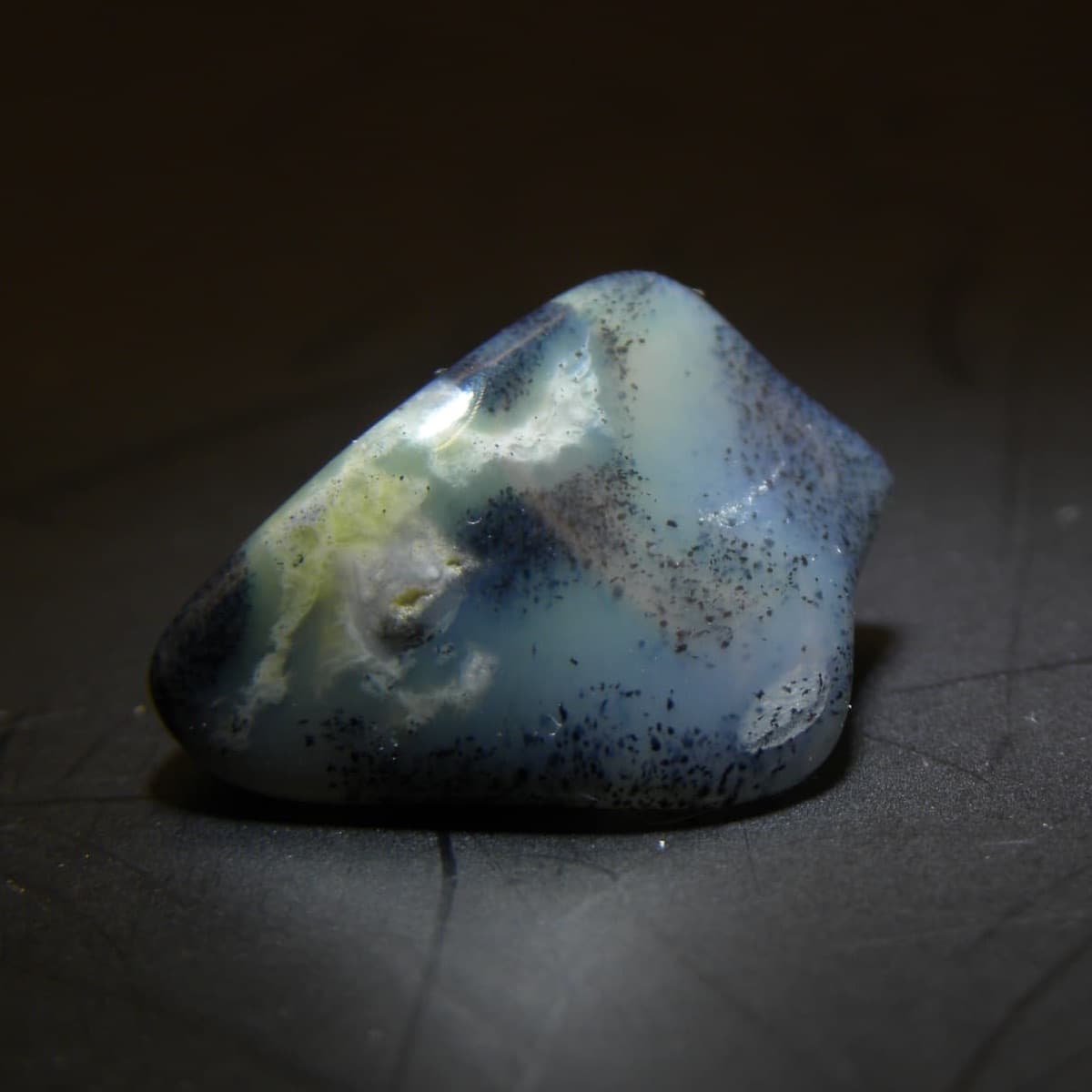
Discover turquoise gemstone value factors, history, colors, treatments, and care. Learn how to identify genuine stones, top mining sources, and durability considerations for jewelry.
11 Minute Read
In this detailed turquoise guide, you'll learn:
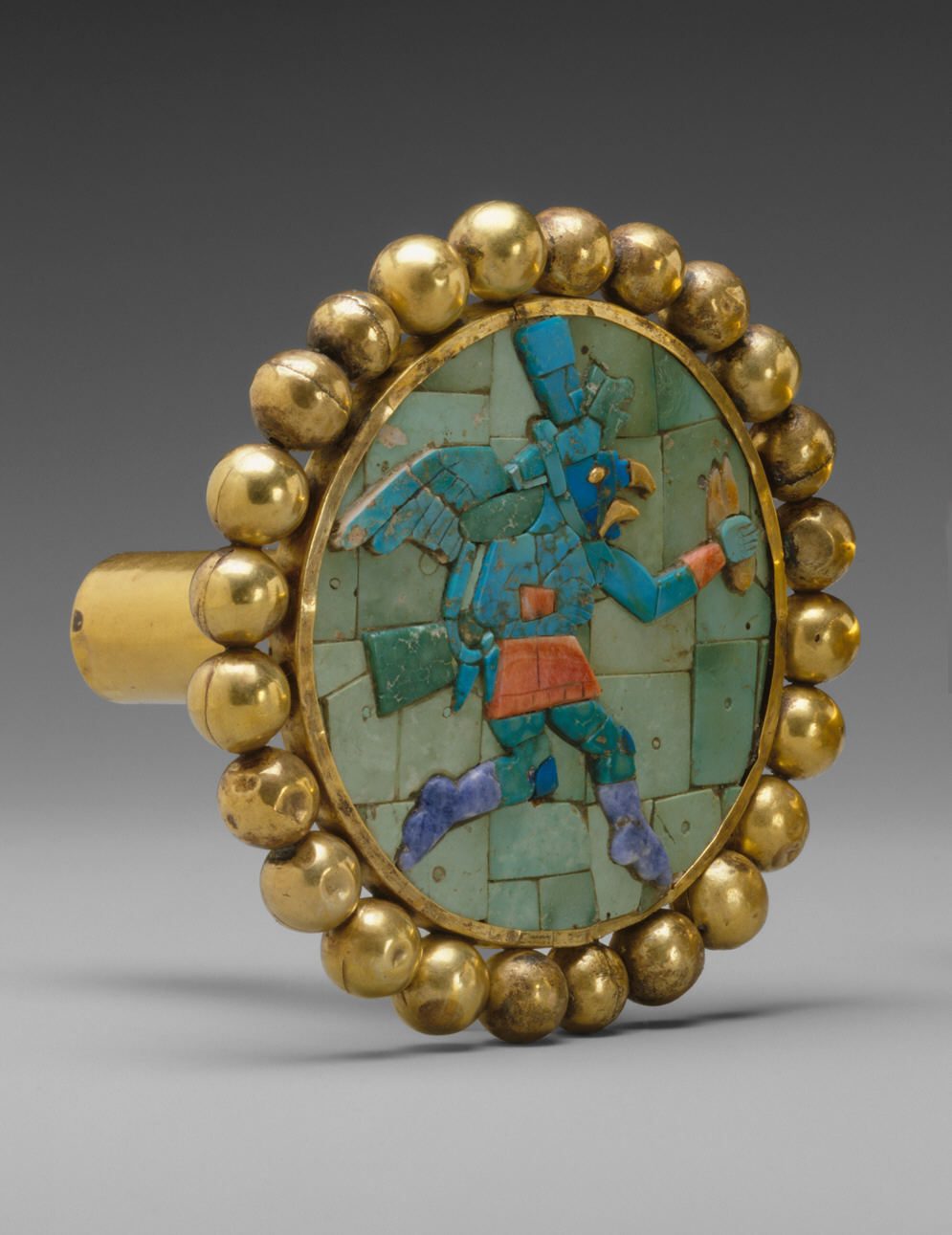
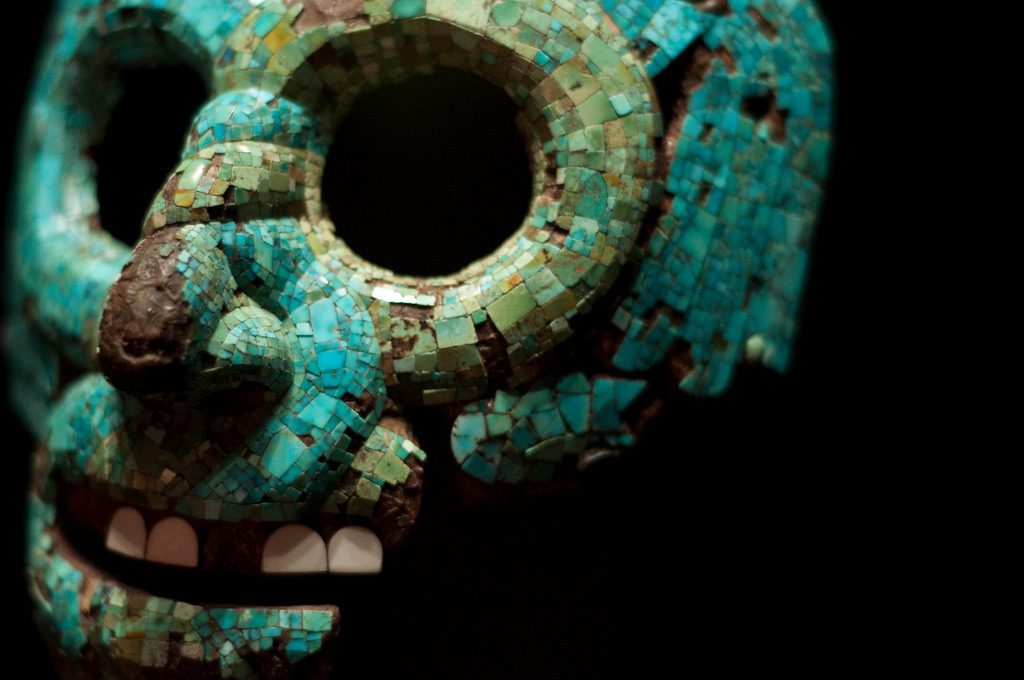
Turquoise has maintained its popularity despite changing fashion trends across millennia. Ancient Egyptians mined it and crafted into jewelry and ceremonial objects as early as 3,000 BCE. Chinese and Ancient American cultures later incorporated turquoise into their artistic traditions. Persia (Iran) introduced Medieval Europe to this captivating gemstone. The stone has inspired numerous legends and folkloric beliefs across diverse cultures.
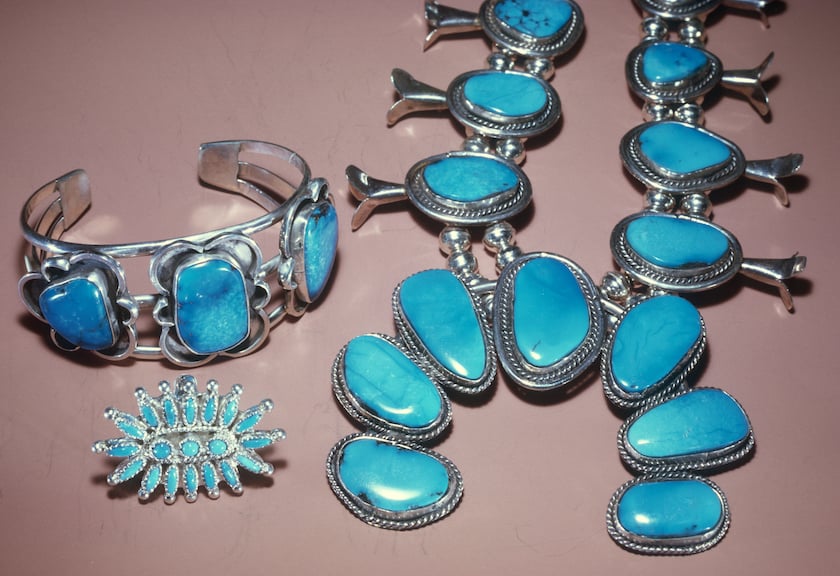
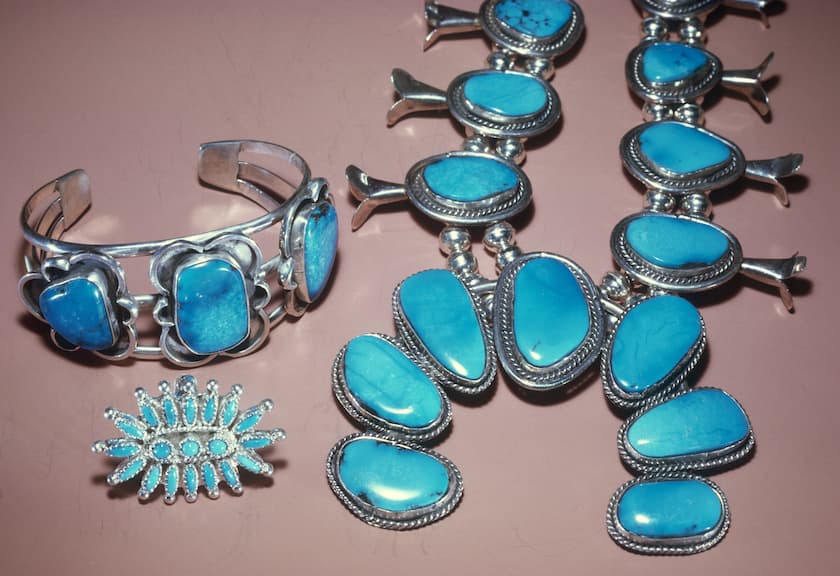
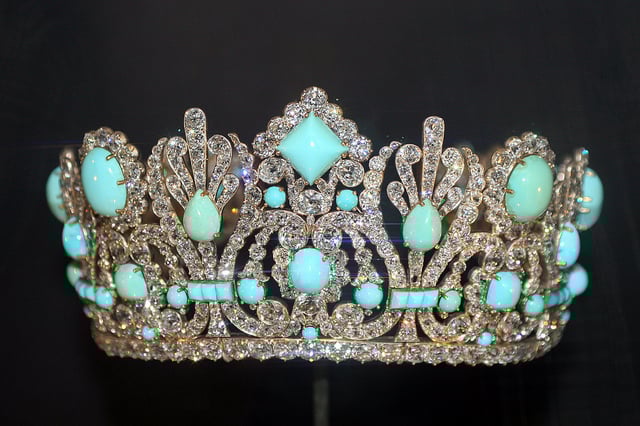
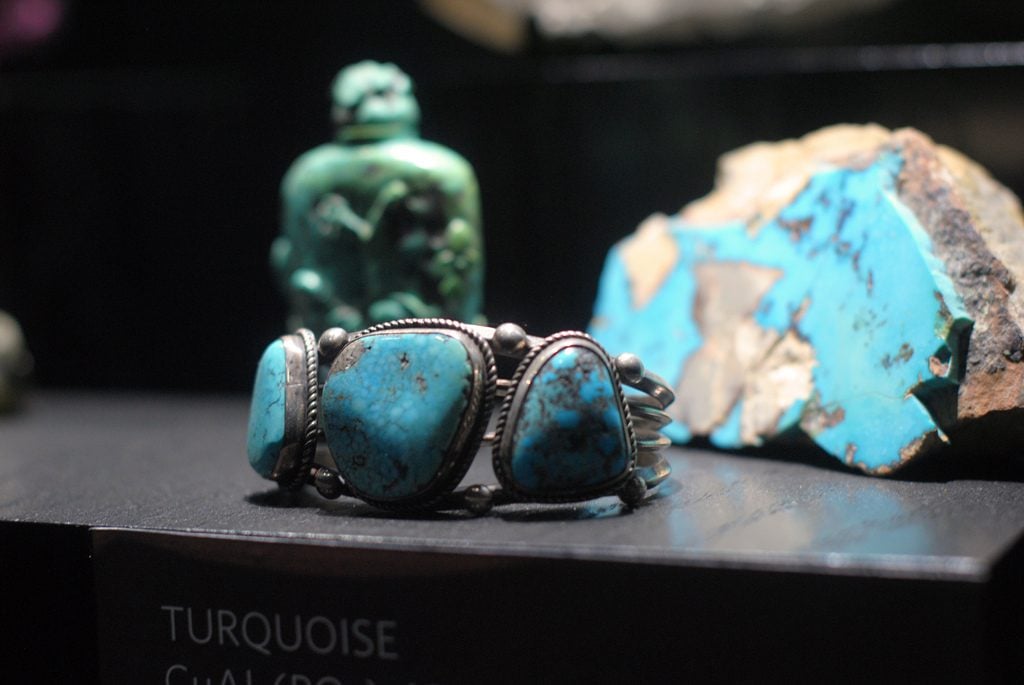
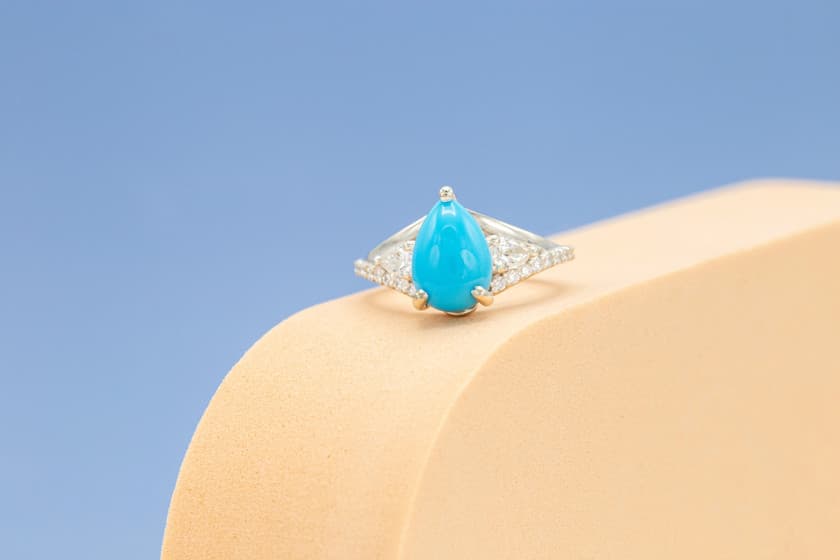
While the United States traditionally sets turquoise in silver, Middle Eastern and Iranian jewelers historically preferred gold settings, sometimes with diamonds.
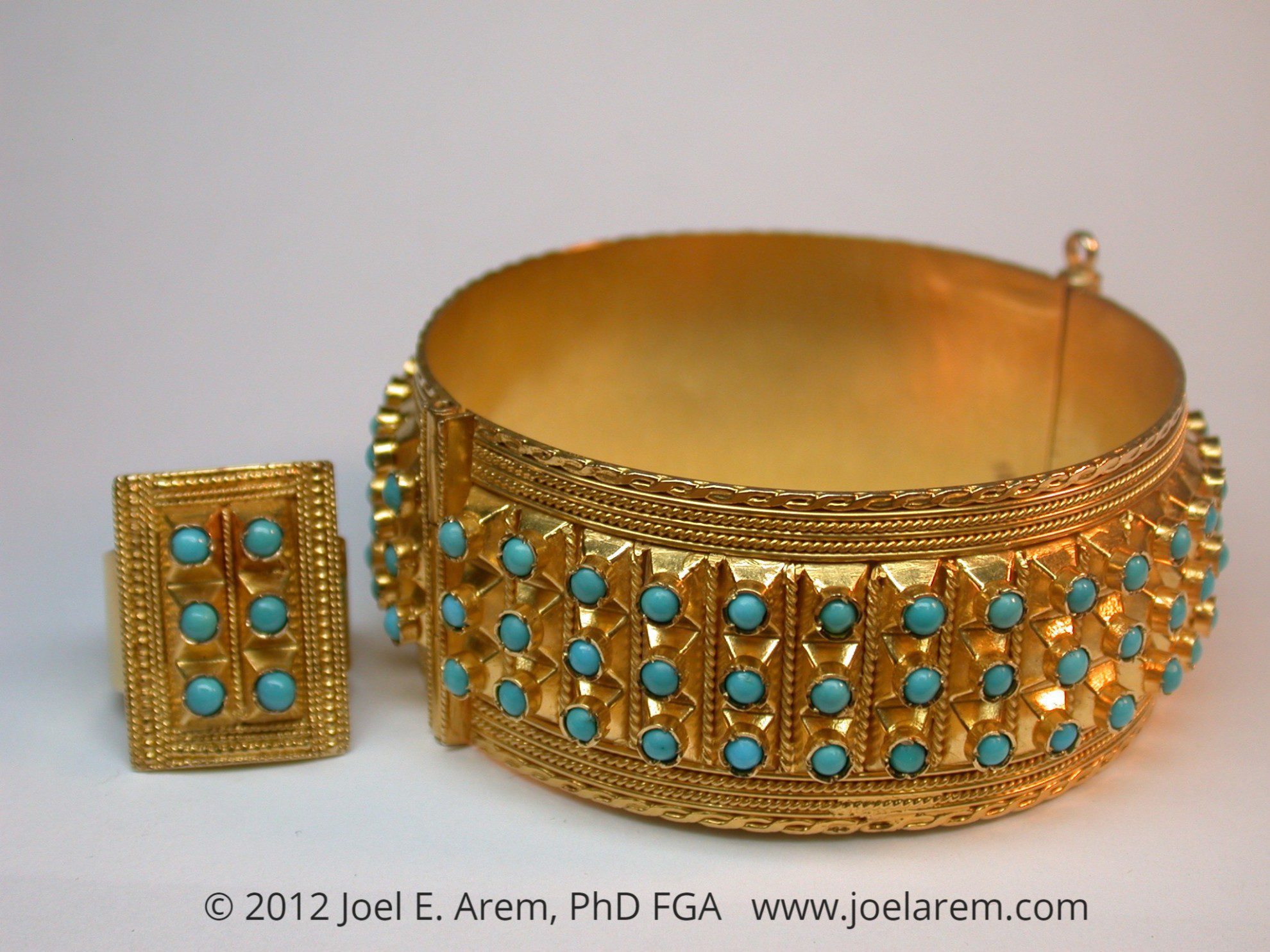
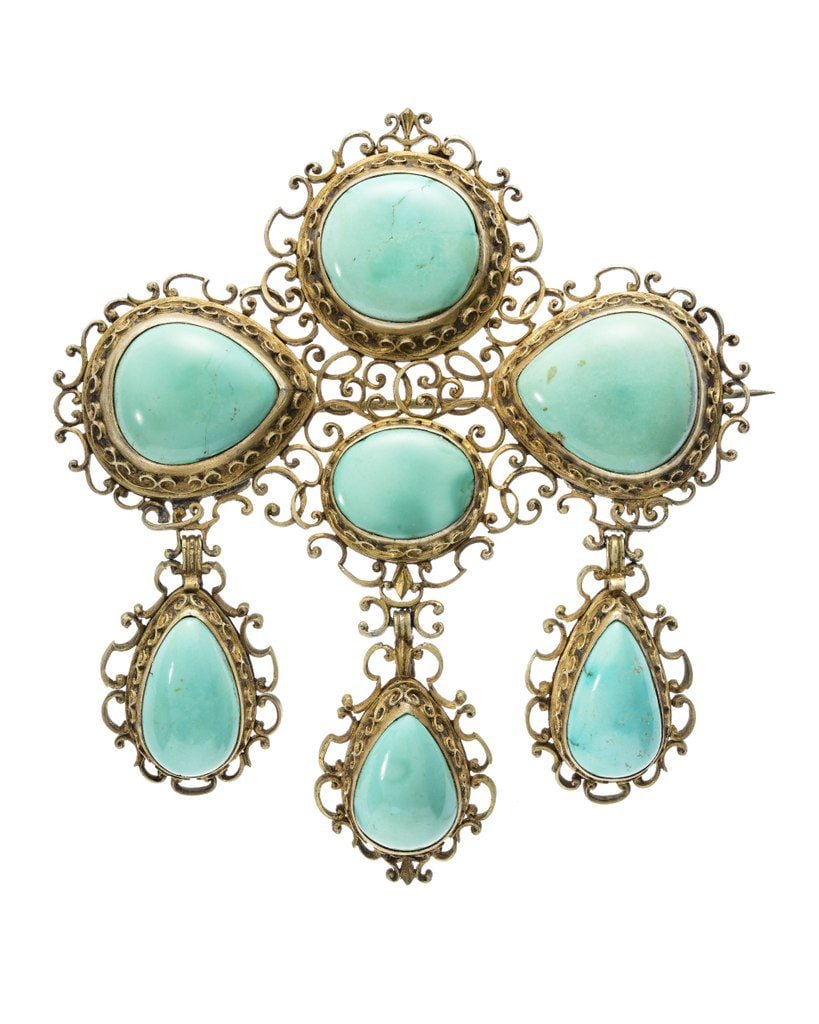
During the Victorian Era, turquoise gained immense popularity, typically set in gold. Today's jewelry designers increasingly follow Persian and Victorian traditions by setting turquoise in gold.
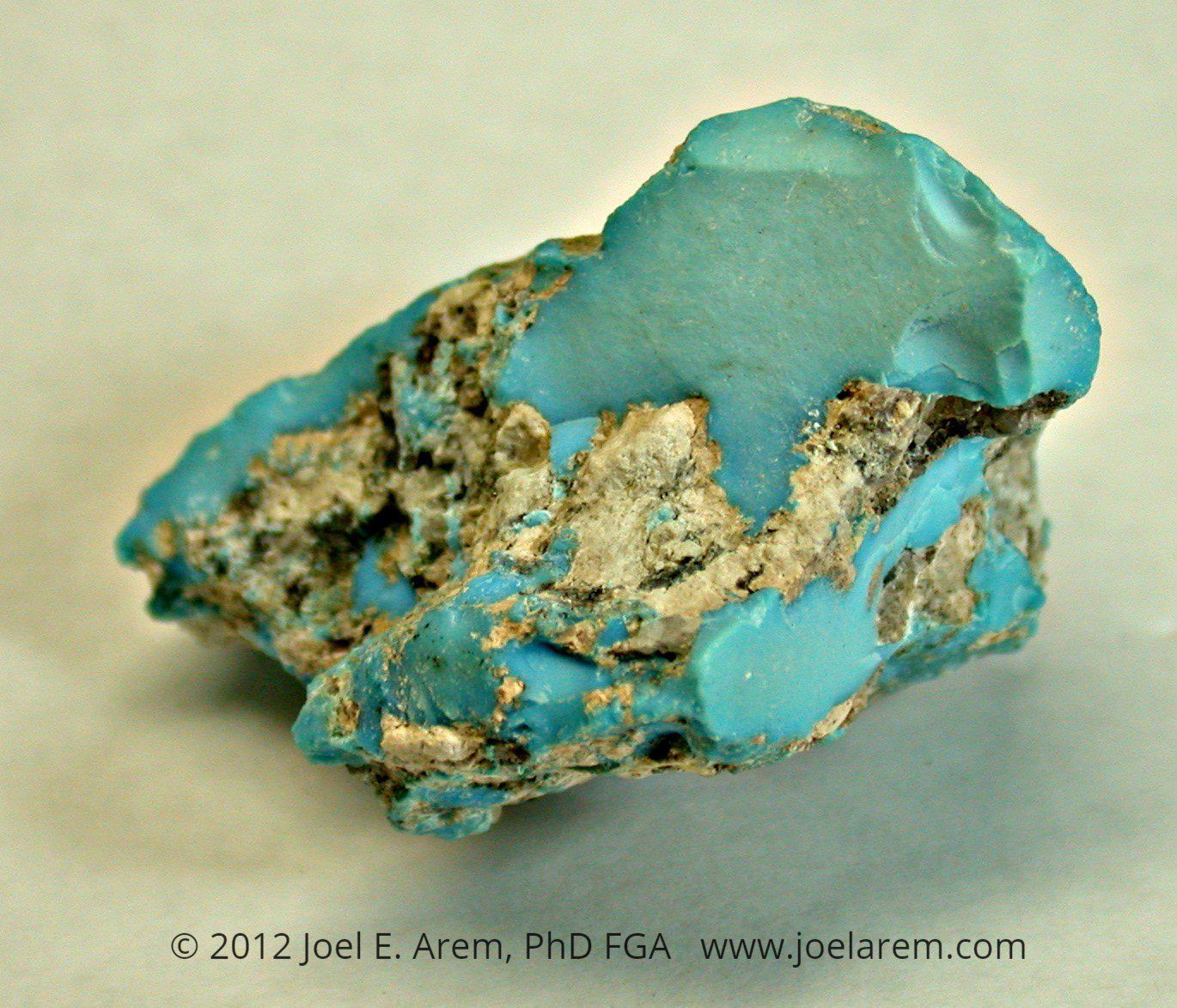
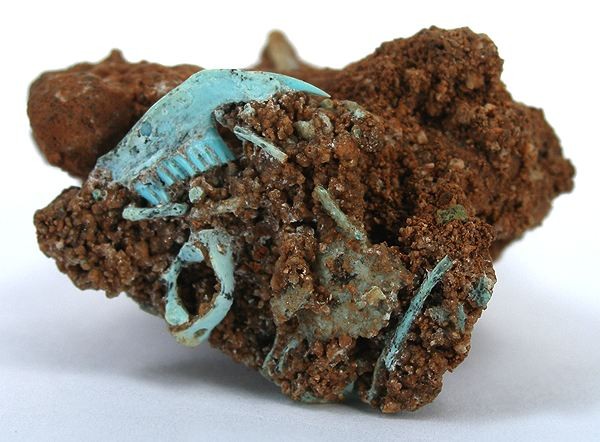
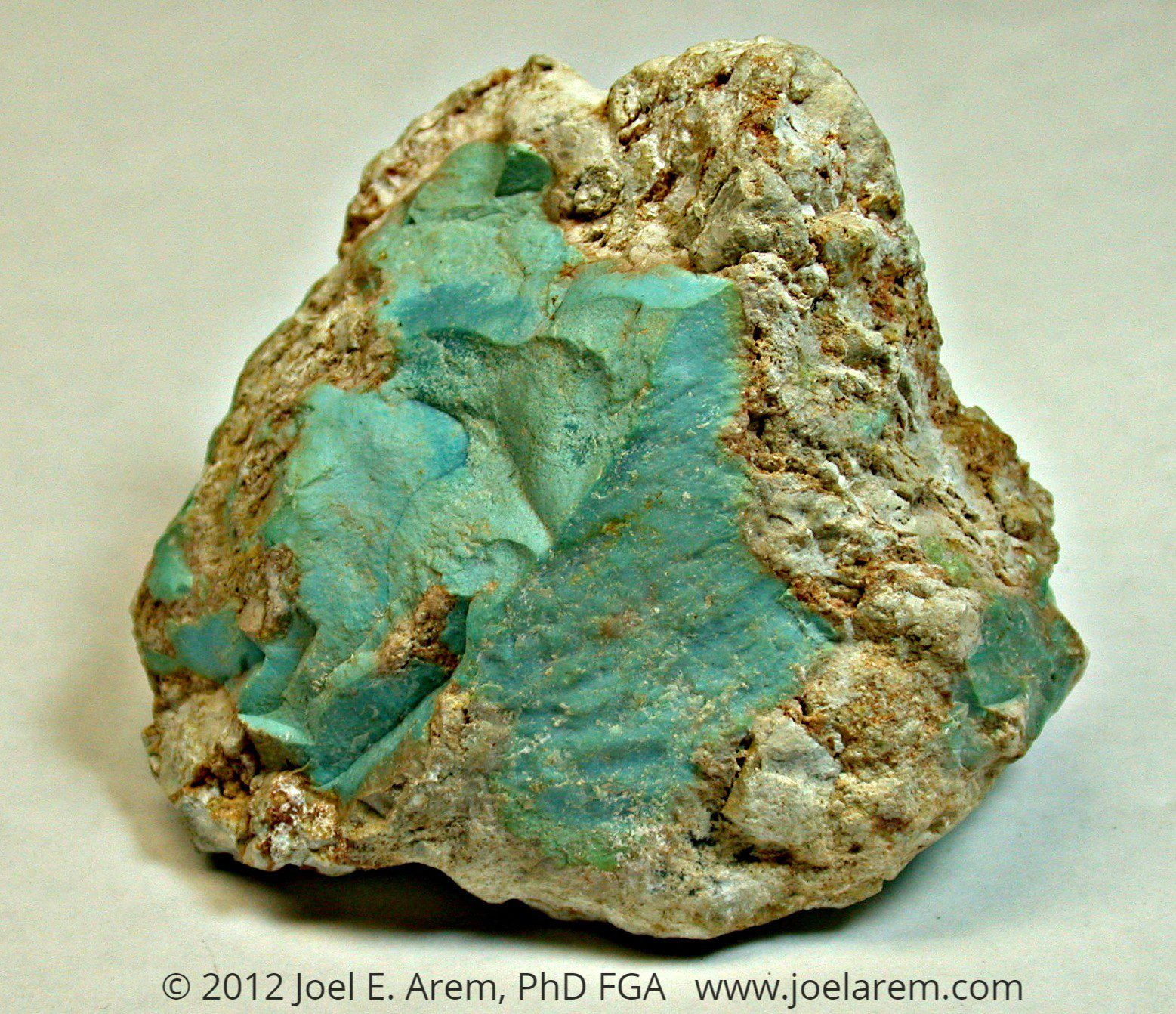
Chemically, turquoise is a hydrated copper/aluminum phosphate with an aggregate, cryptocrystalline structure. Only Lynch Station, Virginia has produced transparent to translucent turquoise crystals (rare specimens commanding premium prices). More commonly, it appears as opaque deposits in nodules, veins within host rocks, or shallow crusts on rock surfaces.
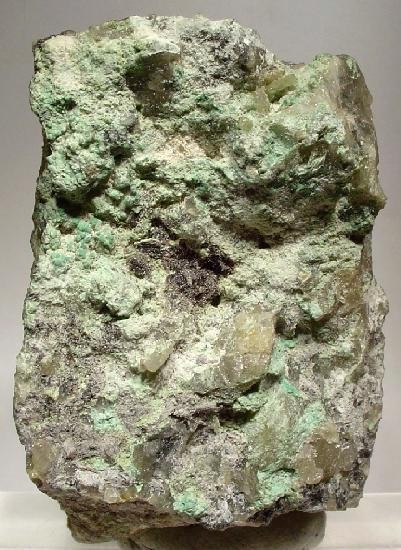
Several minerals relate to turquoise. Faustite, the zinc analogue, displays intense yellow-green color with density in the turquoise range. Turquoise can form in series with chalcosiderite and planerite. Malachite and chrysocolla sometimes grow alongside turquoise.
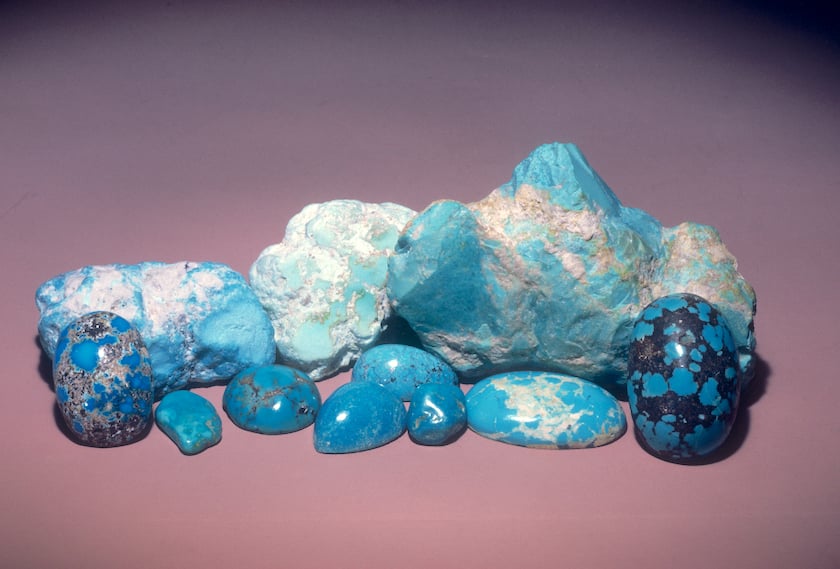
Turquoise colors range from blue to blue-green to yellowish green depending on the elements present. Copper forms part of turquoise's chemical structure, contributing blue coloration. Chromium and vanadium traces add green tints. Iron traces introduce yellow hues. Rare blue-violet specimens contain strontium impurities.
US mines typically produce slightly greenish-blue to green gems due to high iron and vanadium content. The most admired turquoise displays fine robin's egg or celestial blue coloration with no visible matrix, often called "Persian Blue," indicating minimal vanadium and no iron presence. Iran continues producing this variety, though Arizona's Sleeping Beauty Mine has yielded similar stones.
While turquoise makes beautiful jewelry, it has some physical limitations. With proper cutting, treatment, and care, however, turquoise jewelry becomes a wonderful addition to any collection.
It is relatively fragile, porous, and vulnerable to heat/chemical damage. Stones average 18-20% water content. When heated (as with a jeweler's torch), water progressively escapes until structural integrity breaks down at 400°C.
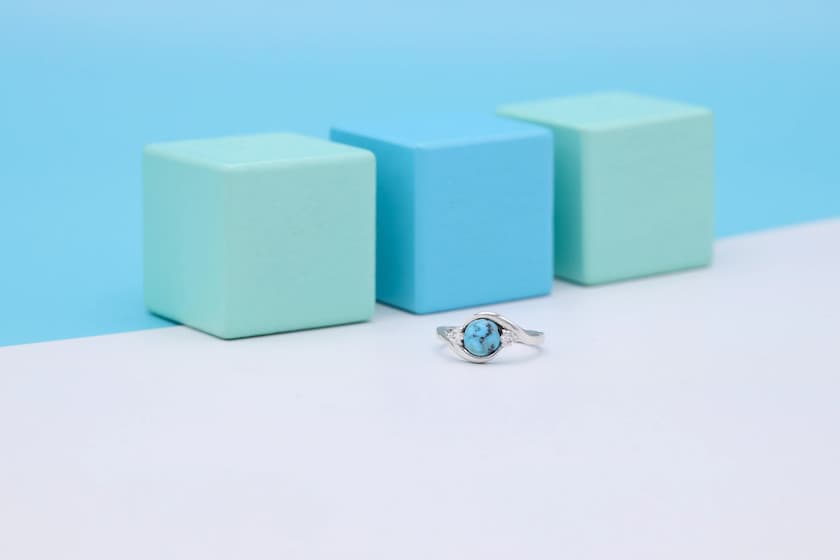
Due to these properties, reserve turquoise jewelry for occasional wear. Protect pieces from heat, chemicals, and physical impacts by using protective settings, especially for rings.
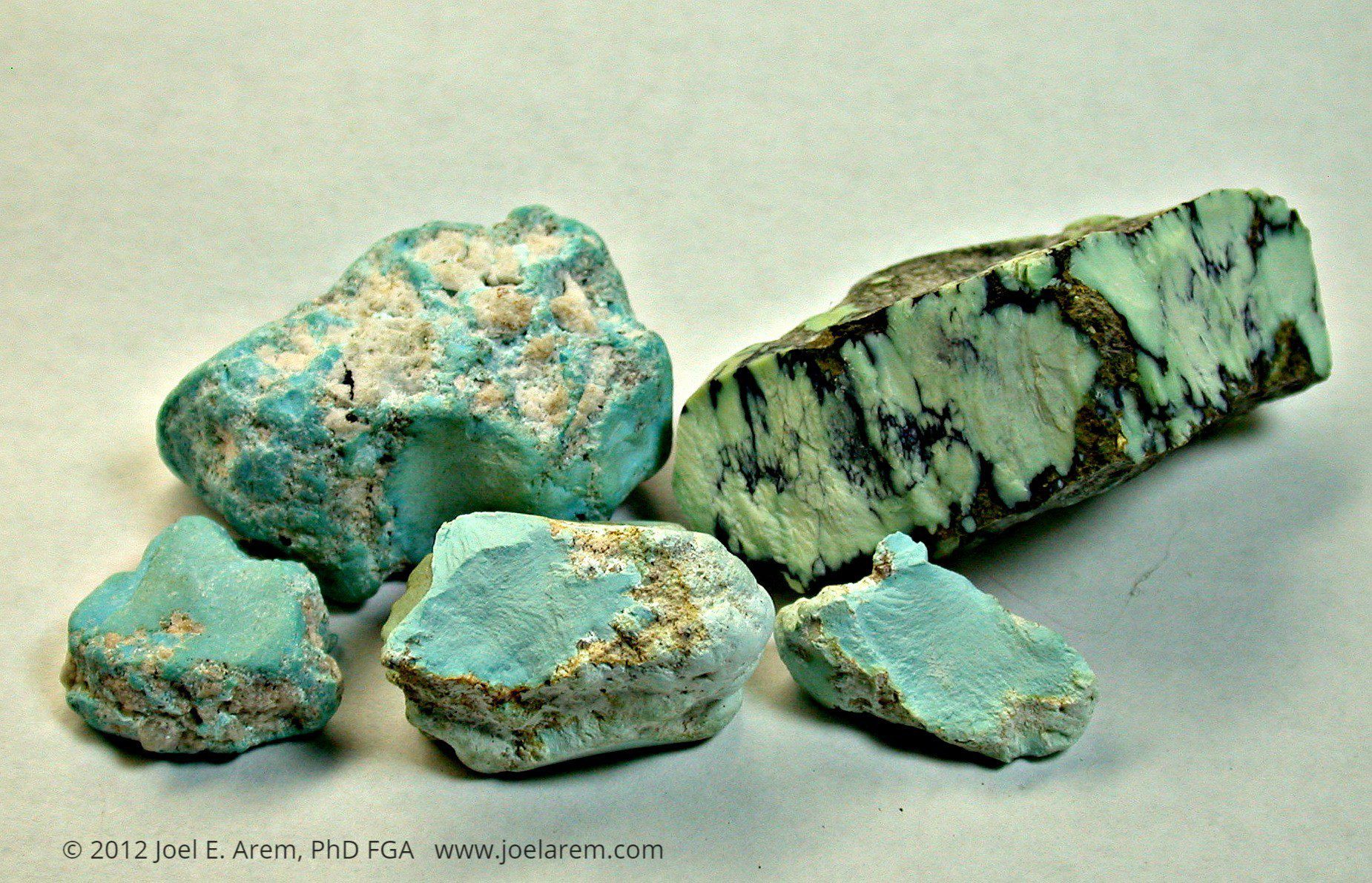
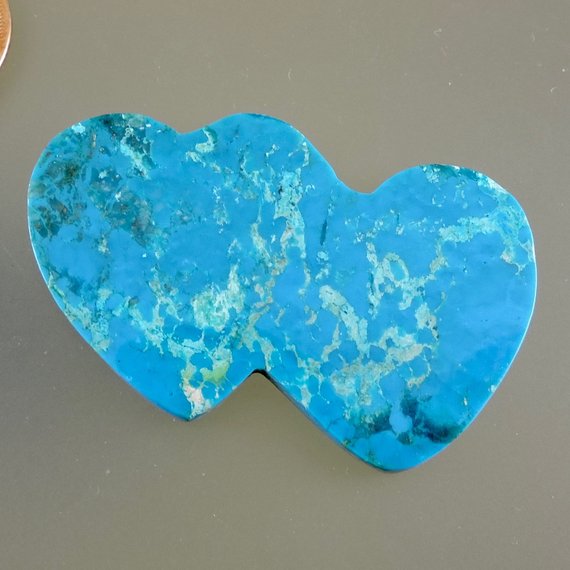
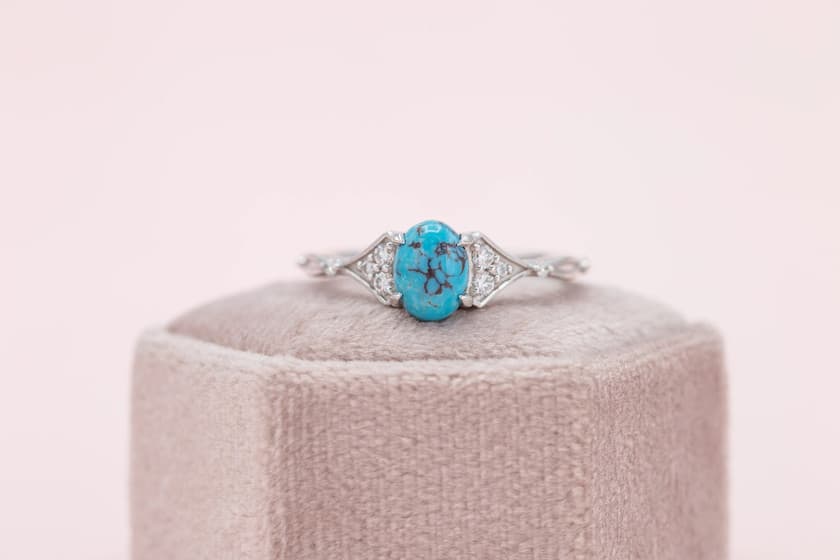
Most turquoise rough contains matrix—patches or veins of host rock such as chalcedony, opal, brown limonite, black chert, or white kaolinite. Lapidaries often include this brownish or black matrix in cuts to provide color contrast and patterns.
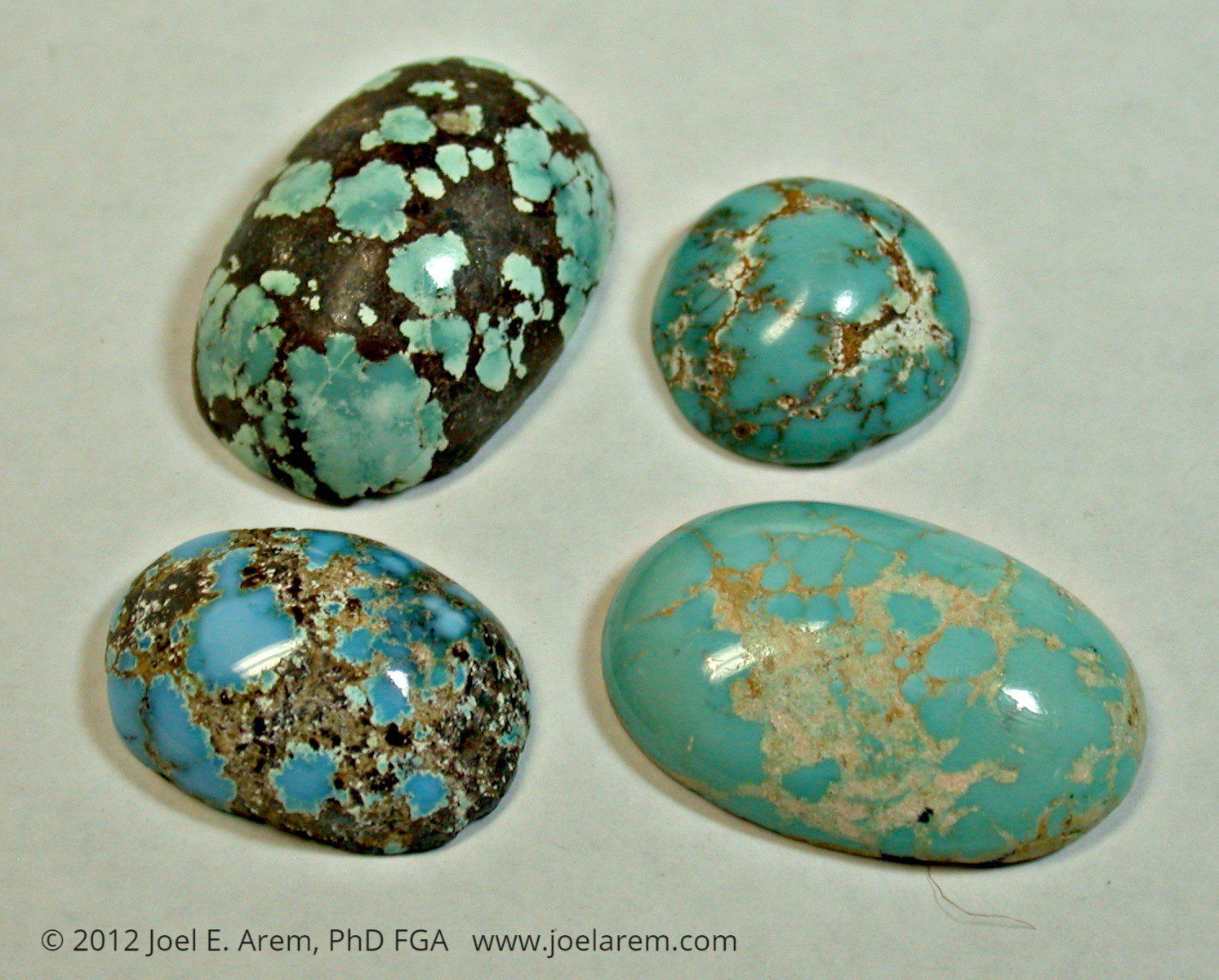
Matrix significantly affects color appearance and overall aesthetics, stone toughness and durability, and workability and polishability. Generally, higher silicate mineral content increases hardness and decreases porosity. Conversely, higher clay mineral content creates softer, more porous stones.
The spectrum ranges from minimally porous pieces with hardness 5.5-6 that take bright polish to soft, chalky specimens with hardness 3, so porous they require stabilization for use.
Turquoise can have a distinctive absorption spectrum, with lines at 4600 (vague) and 4320. These are usually seen in light reflected from the stone's surface.
The specific gravity (SG) of stones from different sources varies. While there is some overlap, some of the measurements at the extreme ends can help identify sources.
When assessing turquoise value, jewelers and collectors primarily consider color evenness and saturation. A stone's ability to take a good polish without stabilization also significantly impacts its worth.
Generally, darker blue shades command higher prices than lighter tones. Less green tint in blue colors increases value considerably. Spiderweb turquoise, veined with black matrix in crocheted lace-like patterns, enjoys premium pricing. Matrix patterns attract dedicated collectors who value different variations.
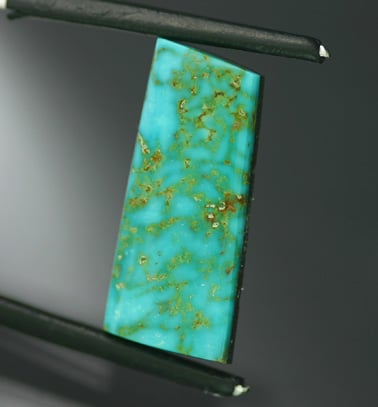
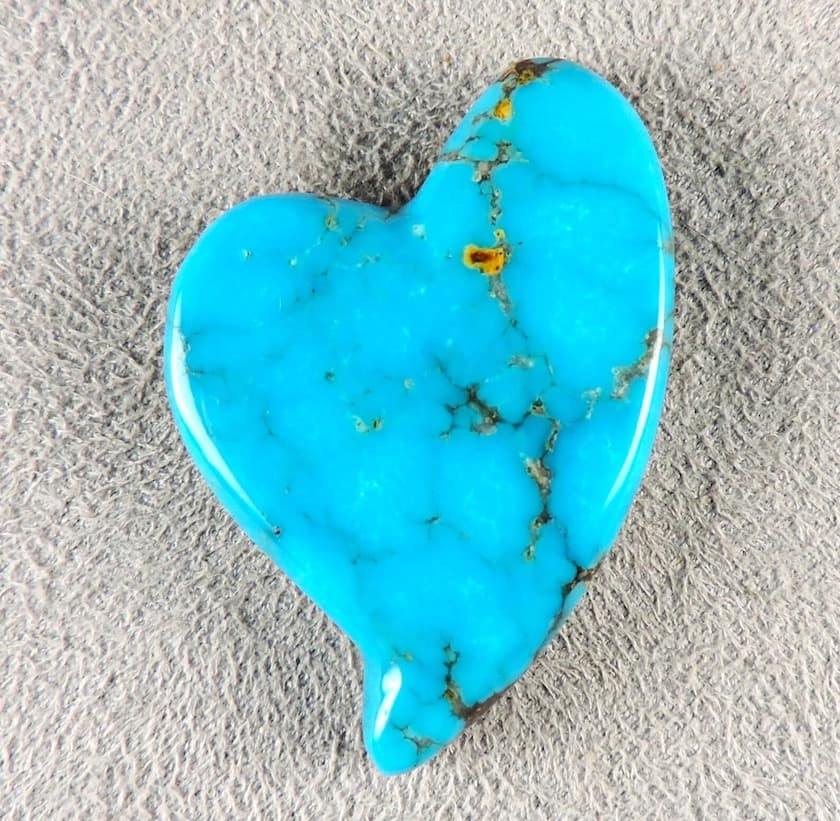
High-grade turquoise typically becomes cabochons, carvings, and inlay, while lower grades appear as polished or natural "nugget-style" beads.
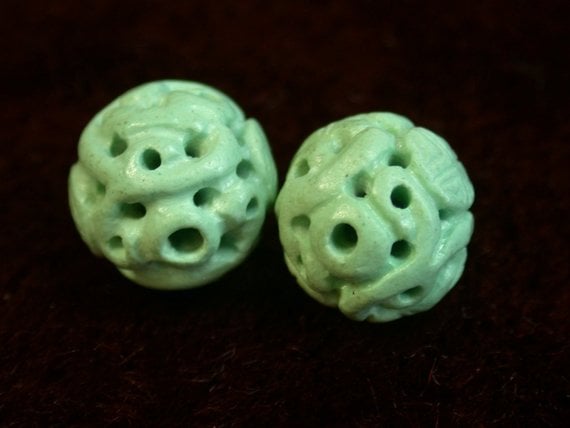
Turquoise enjoys a passionate collector market with enthusiasts favoring different colors, matrix variations, and mine sources. These preferences create interesting market dynamics that affect pricing, as detailed in our turquoise appraisals article.
No gem collection feels complete without several turquoise specimens, and no jewelry collection should lack at least one piece featuring this beloved December birthstone (also the birthstone for those born on Saturday). For more information on value factors, consult our buying guide.
Synthetic turquoise exists, with or without matrix. The Pierre Gilson Company created the most well-known type in 1972, which can resemble the finest Persian grade stones. However, a microscope reveals clear differences. Natural stones display smooth surfaces. Synthetics show tiny blue spheres in a light-colored host medium resembling "cream of wheat."
Many turquoise simulants appear in the marketplace. Non-mineral imitations include plastics, ceramics, and glass, often appearing quite realistic.
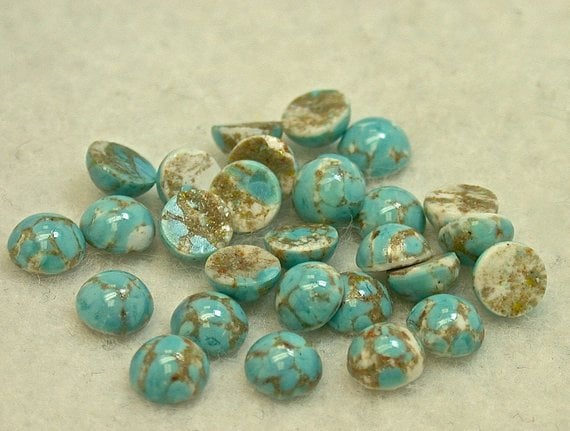
Remember that the color "turquoise" enjoys tremendous popularity. Items marketed as "turquoise beads" or "turquoise jewelry" may contain only turquoise-colored materials rather than genuine pieces. Always ask vendors questions and read descriptions carefully. For example, "Viennese turquoise" merely refers to artificially blue-tinted argillaceous earth. Learn more about materials sold under false or misleading gemstone names.
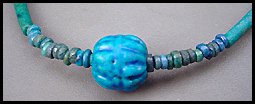
Natural stones sometimes mistaken for turquoise include Variscite, which can resemble green turquoise, and sometimes forms with turquoise in "variquoise" rocks. Prosopite, especially Mexican material with its light-blue color, serves as another potential simulant.
Most turquoise on today's market has received some treatment or enhancement. Pale specimens commonly undergo extensive treatments to improve their color. Fine-grained, compact material that takes good polish remains rare. Even top-grade, otherwise natural stones often receive paraffin wax surface coatings to seal them and enhance polish.
The following enhancement methods appear frequently and prove difficult to detect without specialized knowledge and testing equipment.
All but the highest grades of turquoise may be impregnated or stabilized through pressure infusion with wax, oil, natural resin, or epoxy resin.
Small, porous pieces sometimes get pressed together with resin binder to create stabilized mosaics. These pressings aren't always obvious to casual observers.
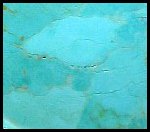
An electro-chemical proprietary enhancement process called the Zachery Treatment has been promoted as an alternative to traditional stabilization that improves both durability and color evenness.
Turquoise itself rarely receives dyed treatments, though dyes sometimes enhance impregnation fillers.
More commonly, other materials receive dye treatments to simulate turquoise. Howlite, with its white and grey-veined appearance, readily accepts dye. Blue-dyed howlite frequently enters the market, sometimes without proper disclosure. Vendors occasionally sell natural howlite as "white turquoise"—a misleading term since no such thing exists.
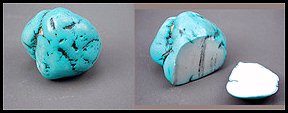
Dyed magnesite can also resemble turquoise. In recent years, this material has gained popularity as a simulant. If properly disclosed, this is acceptable. If not, again, buyer beware.
Beware of so-called "yellow turquoise" imported from China as well. Some stones do indeed have a natural light yellow-green color. However, vendors offer some very bright sunshine or butter-yellow dyed pieces without much effort to discriminate them from the non-dyed material.
A mixture of ground natural turquoise and plastic or other materials, reconstituted turquoise is cheap, easy to cut, and readily available. Although this material does contain natural turquoise, there is some debate over whether this material counts as a synthetic, a hybrid gem, or a simulant.
Please note: hot point and dye testing are destructive tests. Conduct them only as a last resort for identification.
Turquoise usually occurs in arid regions, where ground water percolates through aluminous rock in the vicinity of copper deposits. Like azurite, malachite, and opal, it's a secondary mineral that forms through the interaction of pre-existing minerals and their solutions. The majority of today's commerce in turquoise comes primarily from North America and China.
Some connoisseurs may be able to tell the actual mine of origin of many cut gemstones because of distinctive nuances in color and matrix. The variation in these characteristics is enormous.
The US deposits are almost exclusively limited to the southwest states, with some notable exceptions. (Turquoise is the official state gemstone of Arizona, Nevada, and New Mexico).
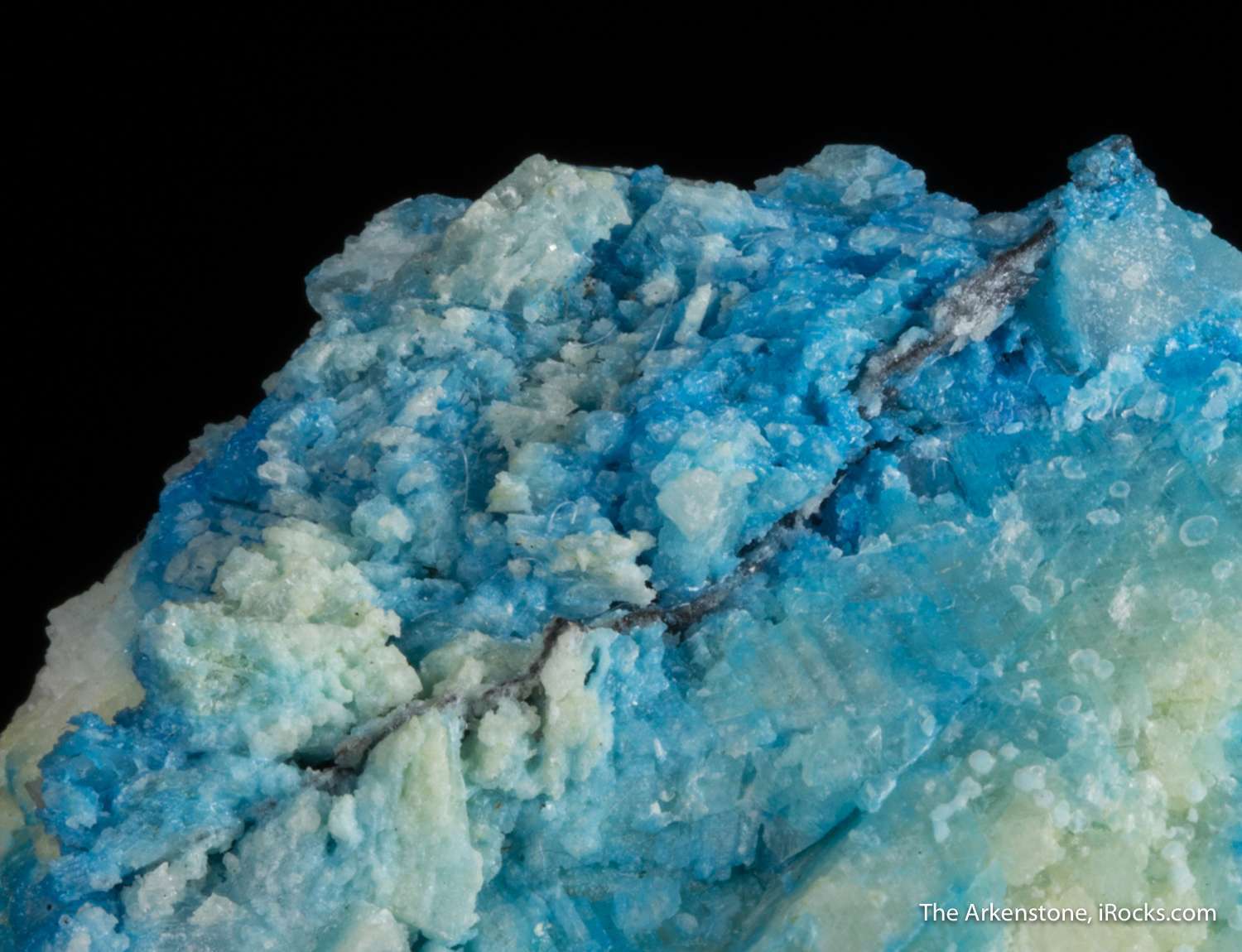
Lynch Station represents the only well-known occurrence of turquoise crystals, typically producing microscopic specimens. Occasionally, larger specimens tempt gem cutters, resulting in very tiny faceted gems (under one carat).
Nevada is home to more mines than Arizona, California, Colorado, and New Mexico put together.
The better known localities include the following:
Other notable mines in Nevada: Papoose, Zuni, Montezuma, Crow Springs, Carlin, Red Mountain, and Godber.
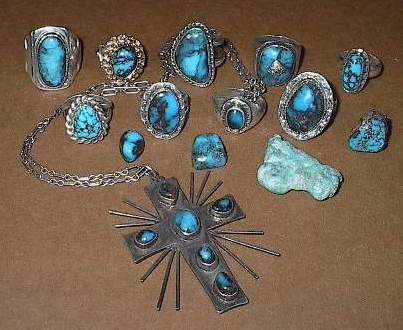
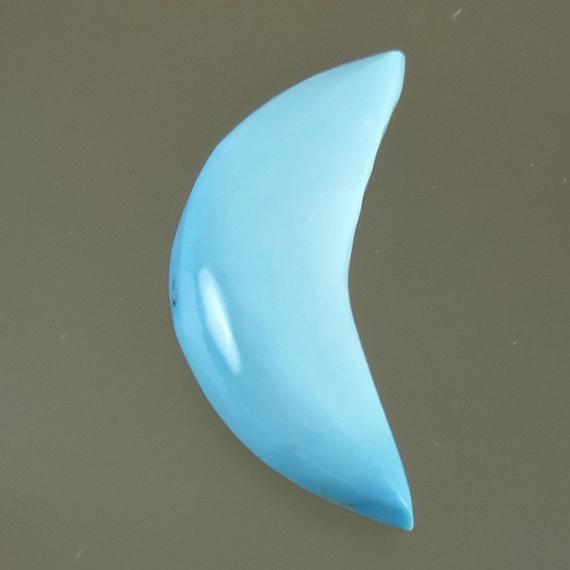
Historically, Persia (Iran) produced the finest material, and considerable production continues from this region. Iranian pieces has become almost synonymous with highest quality material.
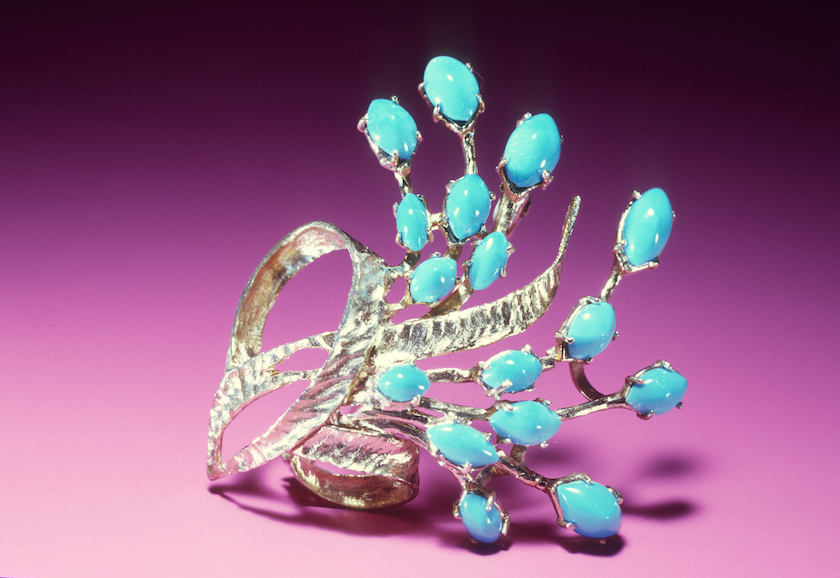
The District of Nishapur, on Ali-mersai Mountain, yields turquoise in porphyry and trachyte rocks, cemented by brown limonite. The color displays lovely uniform sky blue, often intensely saturated, sometimes veined by thin lines of limonitic matrix. These mines have operated for centuries.
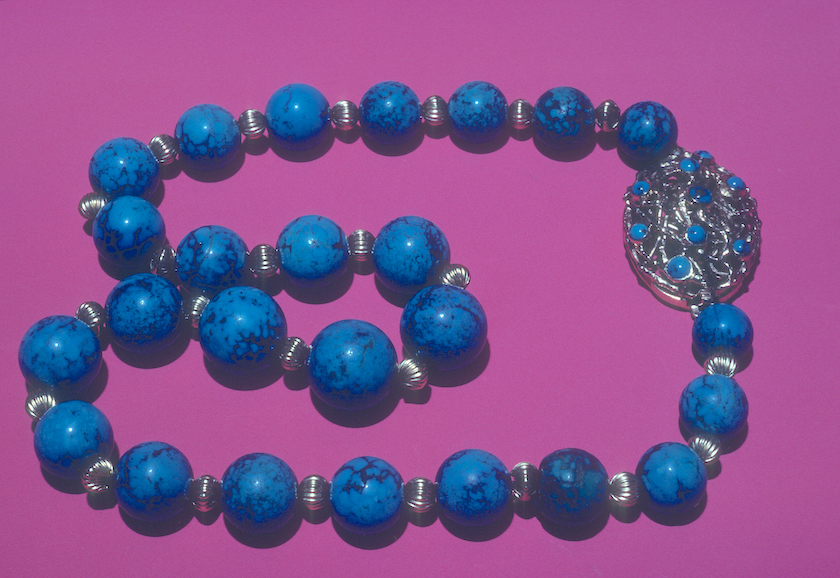
Some mines appear to have operated in ancient times. Archaeological finds dated as early as 1,300 BCE indicate the possibility of a centuries-old exploitation of local deposits.
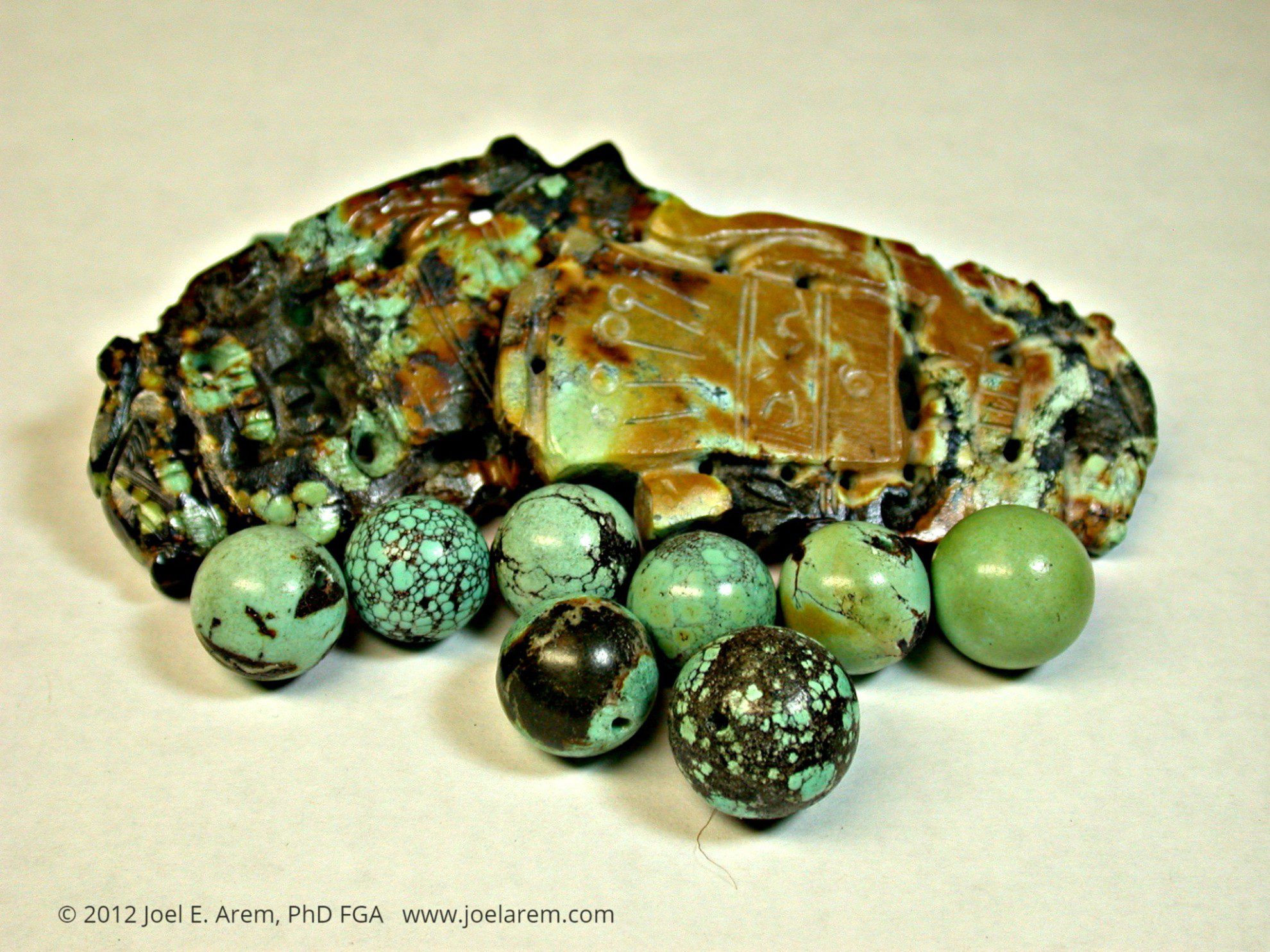
Currently, the Wudang mountain area of northwestern Hubei Province and Shaanxi Province, about 150 km to the northwest, produce fine turquoises. The material occurs as compact nodules, typically up to 8 cm, with much larger masses occasionally found. The color ranges from pale blue to light green. Generally, Chinese stones have softer matrix and are more porous than the material from the American Southwest.
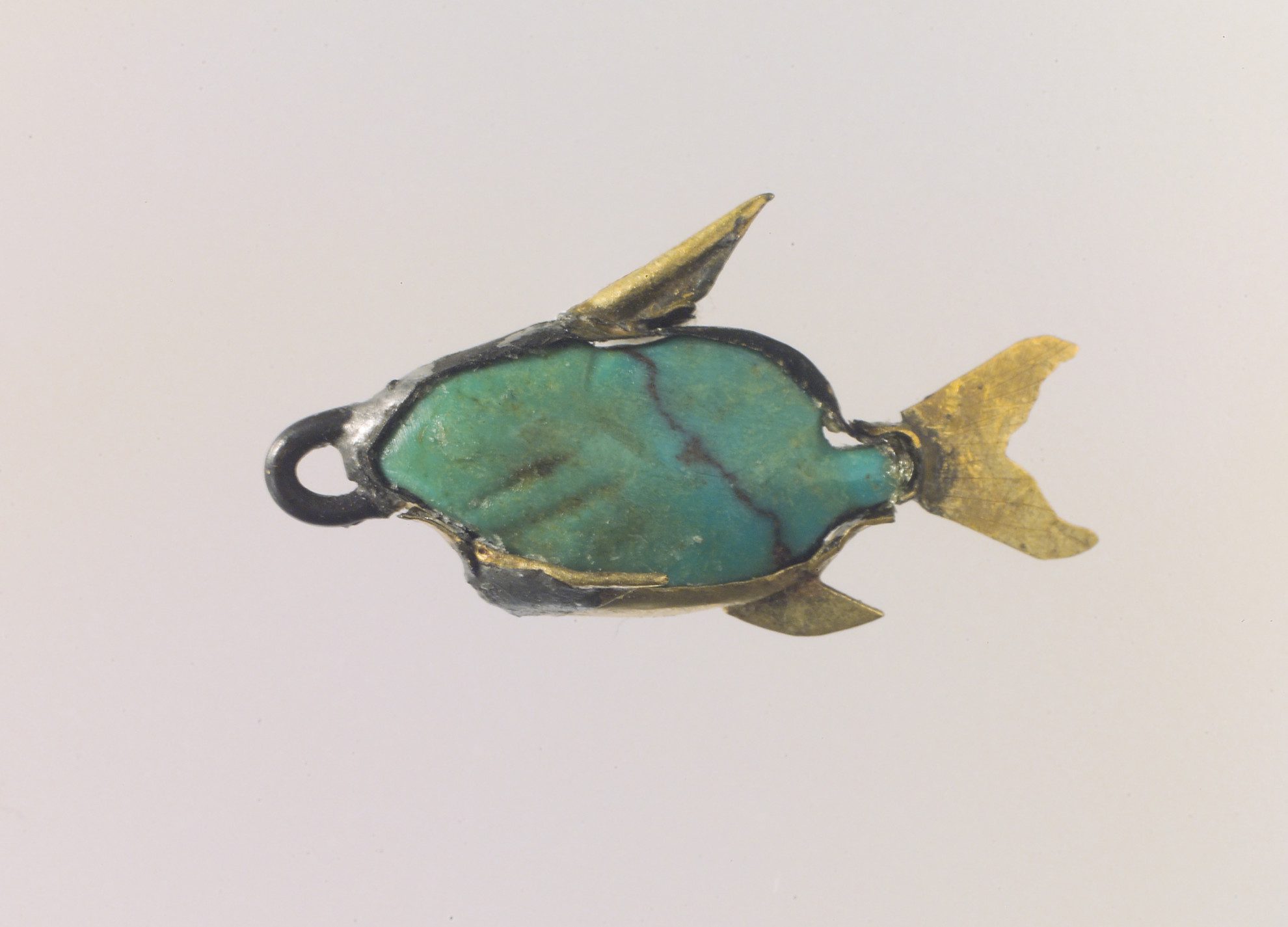
In the Sinai Peninsula, the Serâbît el Khâdim and Maharâh mines produce turquoise. They operated as early as 1,000 BCE, and the material was used to create jewelry for the Pharaohs. The producing area extends along the Suez Gulf, where the material occurs in sandstone. Earth movements have brecciated the gem and matrix. There is considerable limonite present. The color is blue to greenish blue. Some may fade in the sunlight.
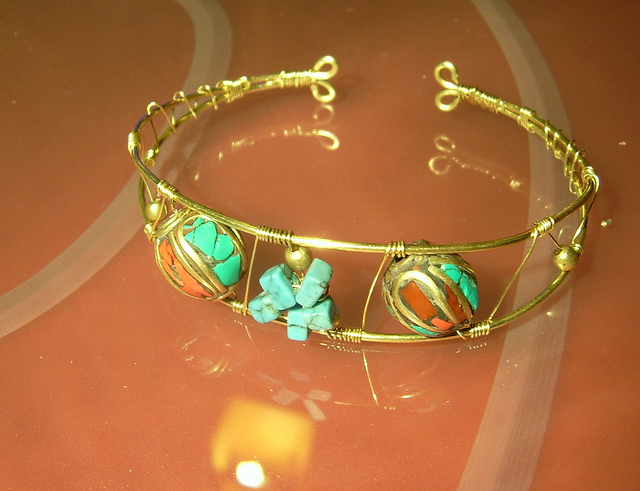
As the national gem of Tibet, turquoise could historically be gathered by hand from ground surface. Today, very little material remains available. Green represents the most prized color in Tibetan tradition.
Australia has yielded dense, compact turquoise of fine color in large deposits. Found in nodules that may reach hundreds of pounds, this material displays solid structure, takes high polish, and shows uniform color. However, it exhibits a slight tendency to shear along planes of weakness. The color resembles Persian (Iranian) variety.
Turquoise requires special care to maintain its beauty. Avoid mechanical cleaning methods such as ultrasonic or steam systems. Never clean this porous gemstone with soap, detergents, or cleaning solutions. Wipe pieces with a damp cloth, then immediately dry them thoroughly. Always wipe jewelry with a damp cloth after wearing to remove skin oils and cosmetic residues.
For more detailed care recommendations, consult our guide for caring for your turquoises and our general guide to gemstone jewelry cleaning.


When you join the IGS community, you get trusted diamond & gemstone information when you need it.
In this detailed turquoise guide, you'll learn:
Turquoise has maintained its popularity despite changing fashion trends across millennia. Ancient Egyptians mined it and crafted into jewelry and ceremonial objects as early as 3,000 BCE. Chinese and Ancient American cultures later incorporated turquoise into their artistic traditions. Persia (Iran) introduced Medieval Europe to this captivating gemstone. The stone has inspired numerous legends and folkloric beliefs across diverse cultures.
While the United States traditionally sets turquoise in silver, Middle Eastern and Iranian jewelers historically preferred gold settings, sometimes with diamonds.
During the Victorian Era, turquoise gained immense popularity, typically set in gold. Today's jewelry designers increasingly follow Persian and Victorian traditions by setting turquoise in gold.
Chemically, turquoise is a hydrated copper/aluminum phosphate with an aggregate, cryptocrystalline structure. Only Lynch Station, Virginia has produced transparent to translucent turquoise crystals (rare specimens commanding premium prices). More commonly, it appears as opaque deposits in nodules, veins within host rocks, or shallow crusts on rock surfaces.
Several minerals relate to turquoise. Faustite, the zinc analogue, displays intense yellow-green color with density in the turquoise range. Turquoise can form in series with chalcosiderite and planerite. Malachite and chrysocolla sometimes grow alongside turquoise.
Turquoise colors range from blue to blue-green to yellowish green depending on the elements present. Copper forms part of turquoise's chemical structure, contributing blue coloration. Chromium and vanadium traces add green tints. Iron traces introduce yellow hues. Rare blue-violet specimens contain strontium impurities.
US mines typically produce slightly greenish-blue to green gems due to high iron and vanadium content. The most admired turquoise displays fine robin's egg or celestial blue coloration with no visible matrix, often called "Persian Blue," indicating minimal vanadium and no iron presence. Iran continues producing this variety, though Arizona's Sleeping Beauty Mine has yielded similar stones.
While turquoise makes beautiful jewelry, it has some physical limitations. With proper cutting, treatment, and care, however, turquoise jewelry becomes a wonderful addition to any collection.
It is relatively fragile, porous, and vulnerable to heat/chemical damage. Stones average 18-20% water content. When heated (as with a jeweler's torch), water progressively escapes until structural integrity breaks down at 400°C.
Due to these properties, reserve turquoise jewelry for occasional wear. Protect pieces from heat, chemicals, and physical impacts by using protective settings, especially for rings.
Most turquoise rough contains matrix—patches or veins of host rock such as chalcedony, opal, brown limonite, black chert, or white kaolinite. Lapidaries often include this brownish or black matrix in cuts to provide color contrast and patterns.
Matrix significantly affects color appearance and overall aesthetics, stone toughness and durability, and workability and polishability. Generally, higher silicate mineral content increases hardness and decreases porosity. Conversely, higher clay mineral content creates softer, more porous stones.
The spectrum ranges from minimally porous pieces with hardness 5.5-6 that take bright polish to soft, chalky specimens with hardness 3, so porous they require stabilization for use.
Turquoise can have a distinctive absorption spectrum, with lines at 4600 (vague) and 4320. These are usually seen in light reflected from the stone's surface.
The specific gravity (SG) of stones from different sources varies. While there is some overlap, some of the measurements at the extreme ends can help identify sources.
When assessing turquoise value, jewelers and collectors primarily consider color evenness and saturation. A stone's ability to take a good polish without stabilization also significantly impacts its worth.
Generally, darker blue shades command higher prices than lighter tones. Less green tint in blue colors increases value considerably. Spiderweb turquoise, veined with black matrix in crocheted lace-like patterns, enjoys premium pricing. Matrix patterns attract dedicated collectors who value different variations.
High-grade turquoise typically becomes cabochons, carvings, and inlay, while lower grades appear as polished or natural "nugget-style" beads.
Turquoise enjoys a passionate collector market with enthusiasts favoring different colors, matrix variations, and mine sources. These preferences create interesting market dynamics that affect pricing, as detailed in our turquoise appraisals article.
No gem collection feels complete without several turquoise specimens, and no jewelry collection should lack at least one piece featuring this beloved December birthstone (also the birthstone for those born on Saturday). For more information on value factors, consult our buying guide.
Synthetic turquoise exists, with or without matrix. The Pierre Gilson Company created the most well-known type in 1972, which can resemble the finest Persian grade stones. However, a microscope reveals clear differences. Natural stones display smooth surfaces. Synthetics show tiny blue spheres in a light-colored host medium resembling "cream of wheat."
Many turquoise simulants appear in the marketplace. Non-mineral imitations include plastics, ceramics, and glass, often appearing quite realistic.
Remember that the color "turquoise" enjoys tremendous popularity. Items marketed as "turquoise beads" or "turquoise jewelry" may contain only turquoise-colored materials rather than genuine pieces. Always ask vendors questions and read descriptions carefully. For example, "Viennese turquoise" merely refers to artificially blue-tinted argillaceous earth. Learn more about materials sold under false or misleading gemstone names.
Natural stones sometimes mistaken for turquoise include Variscite, which can resemble green turquoise, and sometimes forms with turquoise in "variquoise" rocks. Prosopite, especially Mexican material with its light-blue color, serves as another potential simulant.
Most turquoise on today's market has received some treatment or enhancement. Pale specimens commonly undergo extensive treatments to improve their color. Fine-grained, compact material that takes good polish remains rare. Even top-grade, otherwise natural stones often receive paraffin wax surface coatings to seal them and enhance polish.
The following enhancement methods appear frequently and prove difficult to detect without specialized knowledge and testing equipment.
All but the highest grades of turquoise may be impregnated or stabilized through pressure infusion with wax, oil, natural resin, or epoxy resin.
Small, porous pieces sometimes get pressed together with resin binder to create stabilized mosaics. These pressings aren't always obvious to casual observers.
An electro-chemical proprietary enhancement process called the Zachery Treatment has been promoted as an alternative to traditional stabilization that improves both durability and color evenness.
Turquoise itself rarely receives dyed treatments, though dyes sometimes enhance impregnation fillers.
More commonly, other materials receive dye treatments to simulate turquoise. Howlite, with its white and grey-veined appearance, readily accepts dye. Blue-dyed howlite frequently enters the market, sometimes without proper disclosure. Vendors occasionally sell natural howlite as "white turquoise"—a misleading term since no such thing exists.
Dyed magnesite can also resemble turquoise. In recent years, this material has gained popularity as a simulant. If properly disclosed, this is acceptable. If not, again, buyer beware.
Beware of so-called "yellow turquoise" imported from China as well. Some stones do indeed have a natural light yellow-green color. However, vendors offer some very bright sunshine or butter-yellow dyed pieces without much effort to discriminate them from the non-dyed material.
A mixture of ground natural turquoise and plastic or other materials, reconstituted turquoise is cheap, easy to cut, and readily available. Although this material does contain natural turquoise, there is some debate over whether this material counts as a synthetic, a hybrid gem, or a simulant.
Please note: hot point and dye testing are destructive tests. Conduct them only as a last resort for identification.
Turquoise usually occurs in arid regions, where ground water percolates through aluminous rock in the vicinity of copper deposits. Like azurite, malachite, and opal, it's a secondary mineral that forms through the interaction of pre-existing minerals and their solutions. The majority of today's commerce in turquoise comes primarily from North America and China.
Some connoisseurs may be able to tell the actual mine of origin of many cut gemstones because of distinctive nuances in color and matrix. The variation in these characteristics is enormous.
The US deposits are almost exclusively limited to the southwest states, with some notable exceptions. (Turquoise is the official state gemstone of Arizona, Nevada, and New Mexico).
Lynch Station represents the only well-known occurrence of turquoise crystals, typically producing microscopic specimens. Occasionally, larger specimens tempt gem cutters, resulting in very tiny faceted gems (under one carat).
Nevada is home to more mines than Arizona, California, Colorado, and New Mexico put together.
The better known localities include the following:
Other notable mines in Nevada: Papoose, Zuni, Montezuma, Crow Springs, Carlin, Red Mountain, and Godber.
Historically, Persia (Iran) produced the finest material, and considerable production continues from this region. Iranian pieces has become almost synonymous with highest quality material.
The District of Nishapur, on Ali-mersai Mountain, yields turquoise in porphyry and trachyte rocks, cemented by brown limonite. The color displays lovely uniform sky blue, often intensely saturated, sometimes veined by thin lines of limonitic matrix. These mines have operated for centuries.
Some mines appear to have operated in ancient times. Archaeological finds dated as early as 1,300 BCE indicate the possibility of a centuries-old exploitation of local deposits.
Currently, the Wudang mountain area of northwestern Hubei Province and Shaanxi Province, about 150 km to the northwest, produce fine turquoises. The material occurs as compact nodules, typically up to 8 cm, with much larger masses occasionally found. The color ranges from pale blue to light green. Generally, Chinese stones have softer matrix and are more porous than the material from the American Southwest.
In the Sinai Peninsula, the Serâbît el Khâdim and Maharâh mines produce turquoise. They operated as early as 1,000 BCE, and the material was used to create jewelry for the Pharaohs. The producing area extends along the Suez Gulf, where the material occurs in sandstone. Earth movements have brecciated the gem and matrix. There is considerable limonite present. The color is blue to greenish blue. Some may fade in the sunlight.
As the national gem of Tibet, turquoise could historically be gathered by hand from ground surface. Today, very little material remains available. Green represents the most prized color in Tibetan tradition.
Australia has yielded dense, compact turquoise of fine color in large deposits. Found in nodules that may reach hundreds of pounds, this material displays solid structure, takes high polish, and shows uniform color. However, it exhibits a slight tendency to shear along planes of weakness. The color resembles Persian (Iranian) variety.
Turquoise requires special care to maintain its beauty. Avoid mechanical cleaning methods such as ultrasonic or steam systems. Never clean this porous gemstone with soap, detergents, or cleaning solutions. Wipe pieces with a damp cloth, then immediately dry them thoroughly. Always wipe jewelry with a damp cloth after wearing to remove skin oils and cosmetic residues.
For more detailed care recommendations, consult our guide for caring for your turquoises and our general guide to gemstone jewelry cleaning.


Turquoise has captivated humans for over five millennia with its striking blue to blue-green colors. This comprehensive guide explores everything you need to know about this beloved gemstone that serves as the traditional December birthstone and features prominently in both contemporary designer jewelry and Native American craftsmanship.