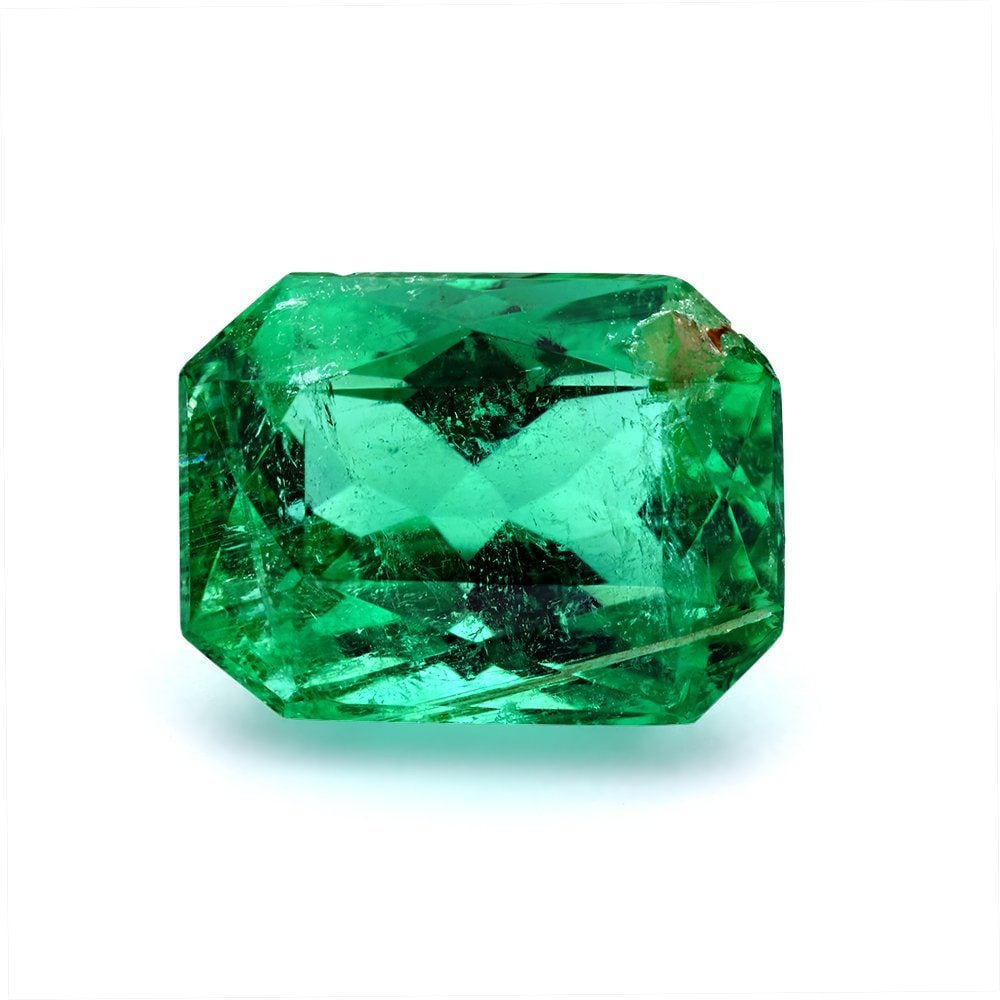
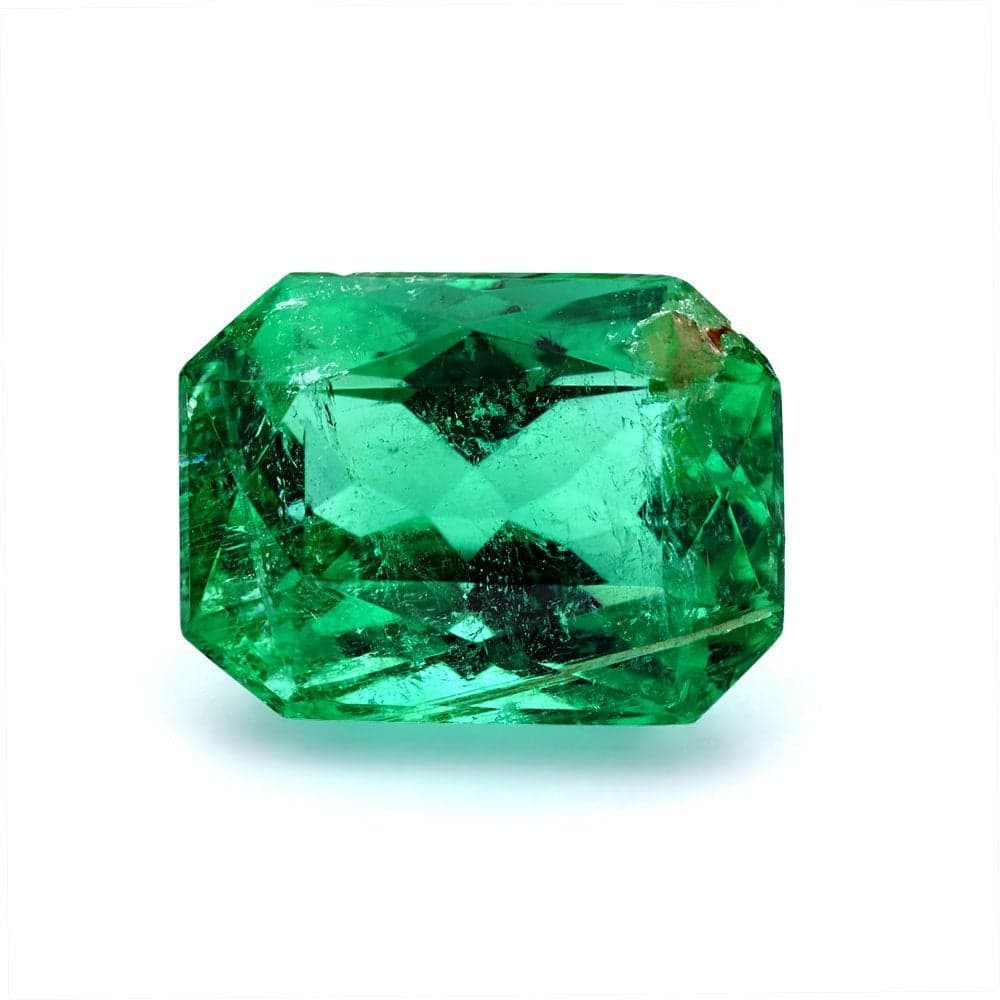
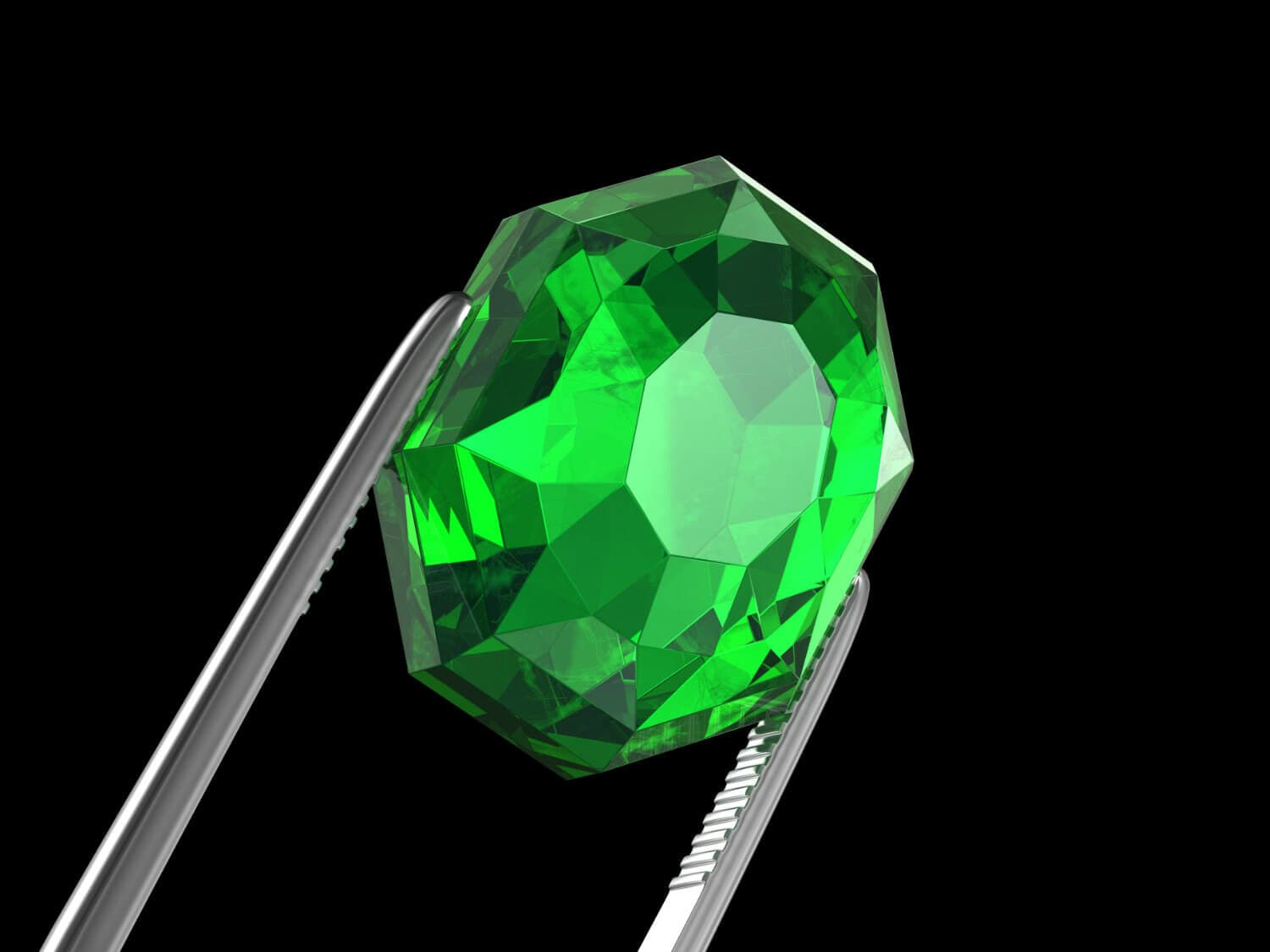
Emerald has been synonymous with the color green since ancient times. A fine emerald is a truly breathtaking sight, and this member of the beryl family deserves its placement among the traditional “Big Four” gems along with diamond, ruby, and sapphire.
14 Minute Read

Emeralds have fascinated people since ancient times. Not surprisingly, cultures from all over the world have developed a rich folklore around emeralds, and stories of famous emeralds have captivated people for centuries. Emerald is also the birthstone for May as well as the 20th and 35th wedding anniversary stone.

Emerald is a medium or darker green to blue-green beryl gemstone, in which the green color is derived from impurities of chromium (Cr), vanadium (V), or a combination of both. Before 1963, the definition of emerald was limited to beryls with chromium impurities, but the discovery in Brazil of a large deposit of beryl stones colored green by vanadium led to modification. According to the modern definition, the purity and saturation of the green color of a beryl is what defines an emerald.
Varying amounts of iron (Fe) will affect the color as well. More iron atoms increase the bluish tones.

In a situation similar to the division between pink sapphire and ruby, some chromium colored stones of light to medium-light green color are sometimes sold as emeralds though they could be considered green beryls. Emeralds should have a medium to dark primary green hue. (Editor's note: Some gemologists, including Dr. Joel Arem, define emerald strictly as beryl that contains chromium and consider beryls colored green because of vanadium to be simply green beryls).
Geological conditions in Colombia produced exactly the slightly bluish-green shade and strong saturation that make stones from that locale the epitome of the variety.
Emeralds from the Muzo and Chivor mines in Colombia can be distinguished in a general way. Muzo material is yellowish green, whereas that from Chivor is blue-green. (It sometimes takes a trained eye to see the distinction in color, however).

Emeralds from Zambia may also display an unusual blue tone, with blue-green/yellow green pleochroism, due to their high iron content (0.73%). Zambian crystals may be intensely color zoned, with near colorless cores and dark green rims, almost like watermelon tourmaline.

Recently discovered emeralds from Itabira, Minas Gerais, Brazil, rival the best Colombian stones in quality. They are typically light bluish green down the c-axis.
The center of world emerald mining is in South America, with Colombia and Brazil as major producers.
The Egyptian mines that supplied Cleopatra's passion have long since been played out. However, today the African continent is second only to South America in production, with mines in Zambia, Zimbabwe, Madagascar, and Nigeria. Each of these locales typically produces a certain color, size, and clarity. Since 2016, Ethiopia has also produced some high-quality emeralds with grass green to blue-green colors that don't need oil treatments.

Other notable sources of emeralds include Afghanistan and China.
As for consumers, the United States and Japan together purchase more than 75% of the world's cut emeralds.

The physical and optical properties of emeralds may help gemologists distinguish natural from synthetic stones and even identify the sources of mined stones.
The absorption spectrum of emerald is very distinctive, with fine lines in the red, weak ones in the blue, and broad absorption in the violet; e and o have different characteristics:
Some Zambian emeralds contain Fe and display the spectral lines of aquamarine as well as emerald. Pleochroism in these gems is also distinctive: blue/yellowish-green.
Vanadium-bearing emeralds may show a weak band at 6100.
The luminescence of emerald is very distinctive and can help positively identify an emerald.
Iron in emeralds may quench fluorescence.
See the "Synthetics" section for information on luminescence in lab-created emeralds.


Emeralds on matrix, Muzo mine, Colombia, under normal light and UV LW light. Photos by Géry Parent. Public Domain.
Emeralds can feature many kinds of internal fractures and inclusions. The evocative term jardin, French for "garden," is used to refer to this variety. The types of inclusions in emeralds can help identify their sources. See the tables below.
For inclusions of synthetic emeralds, see the "Synthetics" section below.
| Locality | Occurrence | o | e | Birefringence | SG | Notes |
| Poona | schists | 1.578-1.579 | 1.572 | 0.005-0.007 | 2.69-2.70 | |
| Emmaville | pegmatite | 1.575 | 1.57 | 0.005 | 2.68 |
Inclusions: Biotite (abundantly); actinolite; calcite; some 3-phase inclusions seen, tubes, "daggers," fluorite.
| Locality | Occurrence | o | e | Birefringence | SG | Notes |
| Habachthal | biotite schist | 1.591 | 1.584 | 0.007 | 2.74 | |
| (unspecified) | 1.582 | 1.576 | 0.006 | 2.73 |
Inclusions (Habachthal): Straight, broad-stemmed tremolite rods; biotite, rounded mica plates; tourmaline; epidote; sphene; apatite; rutile.

| Locality | Occurrence | o | e | Birefringence | SG | Notes |
| Bahia | ||||||
| Anagé | 1.584 | 1.576 | 0.008 | 2.80 | ||
| Brumado | 1.579 | 1.573 | 0.005-0.006 | 2.68 | ||
| Carnaiba | mica schist | 1.588 | 1.583 | 0.006-0.007 | 2.72 | |
| Salininha | 1.589 | 1.583 | 0.006 | 2.71 | ||
| Minas Gerais (var.) | 1.578-1.581 | 1.572-1.576 | 0.006-0.009 | 2.71-2.73 | ||
| Goiás (Sta. Terezinha) | in talc and biotite schist | 1.588-1.593 | 1.580-1.586 | 0.007-0.008 | 2.70-2.76 | bluish green |
Inclusions:

| Locality | Occurrence | o | e | Birefringence | SG | Notes |
| Chivor Mine | cracks in dark schist | 1.577-1.579 | 1.570-1.571 | 0.005-0.006 | 2.69 | blue-green |
| Muzo Mine | calcite veins in dark shale | 1.580-1.584 | 1.570-1.578 | 0.005-0.006 | 2.70-2.71 | yellow-green |
| Gachalá Mine | 1.576 | 1.57 | 0.006 | 2.70 | ||
| Borbur Mine | 1.576 | 1.569 | 0.007 | 2.70 | ||
| Trapiche emerald | in biotite | 1.583 | 1.577 | 0.006 | 2.70 |
Inclusions:

| Locality | Occurrence | o | e | Birefringence | SG | Notes |
| poor quality | 1.589 | 1.582 | 0.007 | 2.70 |
| Locality | Occurrence | o | e | Birefringence | SG | Notes |
| Ajmer | 1.595 | 1.585 | 0.007-0.010 | 2.74 | ||
| (unspecified) | in biotite schist | 1.593 | 1.585 | 0.007 | 2.73 |
Inclusions: Oblong cavities parallel to long crystal axis, with gas bubbles; biotite crystals parallel to basal plane; fuchsite, 2-phase inclusions; apatite crystals; groups of negative twin crystals with comma shape.
| Locality | Occurrence | o | e | Birefringence | SG | Notes |
| Ankadilalana Mine | mica schist | 1.589-1.591 | 1.581-1.585 | 0.007 | 2.73 |
| Locality | Occurrence | o | e | Birefringence | SG | Notes |
| Morrua | 1.593 | 1.585 | 0.008 | 2.73 |
| Locality | Occurrence | o | e | Birefringence | SG | Notes |
| Eidsvoll | in granite | 1.590-1.591 | 1.583-1.584 | 0.007 | 2.68-2.76 |
Inclusions: Mossy inclusions; also interconnected tubes that make crystals appear turbid.
| Locality | Occurrence | o | e | Birefringence | SG | Notes |
| Mingora | 1.596 | 1.588 | 0.007 | 2.78 | ||
| Bucha | talc-quartz-carbonate enclosed in ultramafic | 1.6 | 1.59 | 0.010 | - | |
| Swat (general) | in metamorphics | 1.595-1.600 | 1.588-1.593 | 0.007 | 2.75-2.78 |
Inclusions: 2-phase inclusions; thin films; some liquid inclusions, few mineral crystals.

| Locality | Occurrence | o | e | Birefringence | SG | Notes |
| Urals | biotite-chlorite schists | 1.588 | 1.581 | 0.006-0.007 | 2.74 |
Inclusions: Actinolite crystals, singly or in groups, resembling bamboo cane; mica plates.

| Locality | Occurrence | o | e | Birefringence | SG | Notes |
| Transvaal, Gravolotte (Cobra Mine, etc.) | acid pegmatites and contacting schists | 1.593-1.594 | 1.583-1.586 | 0.006-0.007 | 2.75-2.76 |
Inclusions:
| Locality | Occurrence | o | e | Birefringence | SG | Notes |
| Lake Manyara | in pegmatites and mica schists | 1.585 | 1.578-1.580 | 0.005-0.006 | 2.72-2.73 | with alexandrite |
Inclusions: 2-phase and 3-phase inclusions; square-shaped cavities and tubes; actinolite, mica.

| Locality | Occurrence | o | e | Birefringence | SG | Notes |
| North Carolina | in albite matrix | 1.588 | 1.581 | 0.007 | 2.73 | fluoresces in LW-UV |
Inclusions (North Carolina): Quartz crystals sometimes seen.
| Locality | Occurrence | o | e | Birefringence | SG | Notes |
| Miku | in schists | 1.589-1.590 | 1.581-1.582 | 0.007-0.009 | 2.74 | |
| Mufulira | 1.588 | 1.581 | 0.007 | 2.68 | ||
| Kitwe | in schists | 1.586 | 1.58 | 0.006 | 2.79 | |
| Kafubu | 1.602 | 1.592 | 0.010 | 2.77 |
Inclusions: Biotite (black crystals) as small specks or dots; pinpoints, breadcrumb inclusions; also tourmaline (dravite) and magnetite. Material from Kitwe contains: rutile, chrysoberyl, muscovite, apatite, quartz, ilmenite, tourmaline, color zoning, 2-phase inclusions.

| Locality | Occurrence | o | e | Birefringence | SG | Notes |
| Victoria Province | 1.576-1.591 | 1.572-1.585 | 0.004-0.007 | 2.67-2.74 | with alexandrite | |
| Bubera Province | 1.585 | 1.58 | 0.005 | - | not gemmy | |
| Shamva Province | 1.591 | 1.584 | 0.007 | - | not gemmy | |
| Filabusi Province | 1.587-1.594 | 1.583-1.588 | 0.004 | - | ||
| Belinwe Province | 1.593-1.594 | 1.586-1.588 | 0.005-0.007 | - | ||
| Sandawana | 1.590-1.596 | 1.583-1.588 | 0.004-0.006 | 2.74-2.75 |
Occurrence (General): granite pegmatites, cutting schists, also serpentines and fine mica aggregates.
Inclusions: Fine long-curving tremolite needles; also 2-3 phase inclusions, short rods or fine curved fibers; color zoning; garnets; hematite; feldspar; brown mica; negative crystals.


Emerald simulants or imitations often encountered in the marketplace include: glass, yttrium aluminum garnet (YAG), green cubic zirconia (CZ), and assembled triplets of beryl as well as synthetic spinel. Although these pieces may resemble emeralds, their optical and physical properties differ notably from those of emeralds.
Of course, other natural green gemstones may also resemble emeralds and may be misidentified — either accidentally or deliberately — as emeralds. Since emeralds are among the most popular and expensive gemstones in the world, unscrupulous vendors may associate the name "emerald" to other less popular green gems in order to drum up consumer interest, such as calling green fluorite "African emerald" or chrome sphene "Mexican emerald." However, gemologists can usually readily distinguish emeralds from other gemstones.
Read our article on false or misleading gem names for more examples.

Two major processes, the hydrothermal and flux methods, can produce synthetic or lab-created emeralds.
If you've seen and priced synthetic emeralds, you may wonder why they're so costly compared to other synthetics, such as synthetic sapphires. Both the hydrothermal and flux methods of production require costly equipment and are energy intensive. They take a long time to produce emeralds and have a low yield of cuttable gems.
For more information on the history of synthetic gemstones in general as well as the specific development of lab-created emeralds and the particular proprietary process noted below, consult our 5-part synthetic gemstone guide.
For more information on distinguishing synthetic emeralds from natural stones as well as identifying specific manufacturing processes, consult this article on lab-made emeralds.
Synthetic emeralds typically have slightly lower refractive indices (RI) and birefringence than do natural stones.
Most emerald synthetics have the same absorption spectrum as natural emeralds. Gilson type III may have a line at 4270.
| Natural | Flux | Hydrothermal | Lechleitner Overgrowths | |
| Optics | ||||
| o | 1.572-1600 | 1.560-1.563 | 1.566-1.576 | 1.578-1.605 |
| e | 1.570-1.593 | 1.563-1.566 | 1.571-1.576 | 1.570-1.599 |
| Birefringence | 0.005-0.009 | 0.003-0.005 | 0.005-0.007 | 0.005-0.010 |
| Specific Gravity | 2.68-2.78 (usually over 2.69) | 2.65-2.67 | 2.67-2.71 | - |
Flux-grown emerald doesn't show the infrared spectrum characteristics of water in the beryl structure. This spectrum is characteristic only of natural and hydrothermal synthetic emeralds. Flux-grown emeralds typically have relatively low RIs and specific gravity values (SG) and show strong red fluorescence in UV.
Chlorine appears to be a diagnostic trace element found only in hydrothermal synthetics. Other trace elements overlap with natural material and are therefore not diagnostic. Natural emeralds contain Na, Mg, and Fe in significantly higher amounts (more than 0.1%) than synthetic emeralds but contain lower amounts (less than 18%) of silica and alumina.
Chatham stones transmit UV to 2300, whereas natural emeralds are opaque below 3000.
Regency emerald is the material formerly made by Linde, manufactured under license by Vacuum Ventures, Inc. This material is therefore identical with the Linde product.

Some of the first lab-created emeralds on the market weren't convincing because they were so clean. However, the sophistication of today's consumer has led to a trend toward more natural-looking synthetics with inclusions. Although this improves their salability, it makes a little more difficult for gemologists and appraisers to prove natural origin. Fortunately, the types of inclusions in synthetic emeralds can help gemologists verify either a mined or synthetic origin.
Flux grown synthetic emeralds may contain flux, platinum crystals, (metallic) phenakite crystals (colorless and low relief) and show a Venetian blind effect.
| Source | e | o | Birefringence | SG |
| Hydrothermal | ||||
| Lechleitner | ||||
| Overgrowth | 1.571-1.601 | 1.571-1.610 | 0.005-0.010 | 2.68-2.71 |
| Solid | 1.569 | 1.574 | 0.005 | 2.70 |
| Beryl Sandwich | 1.566 | 1.570 | 0.004 | 2.68 |
| Regency (Linde) | 1.566-1.572 | 1.571-1.578 | 0.005-0.006 | 2.67-2.70 |
| Biron | 1.569 | 1.573 | 0.004-0.005 | 2.68-2.71 |
| Crystal Research | 1.571-1.575 | 1.566-1.570 | 0.005 | 2.68 |
| Inamori (Kyocera) | 1.563 | 1.568 | 0.005 | 2.65-2.70 |
| Flux | ||||
| Gilson | 1.558-1.561 | 1.565-1.575 | 0.003-0.005 | 2.65-2.70 |
| Seiko | 1.561 | 1.565 | 0.004 | 2.66 |
| Lenix | 1.562 | 1.566 | 0.004 | 2.62-2.65 |
| Zerfass | 1.555 | 1.561 | 0.006 | 2.66 |
| Russian Synthetics | 1.559 | 1.563 | 0.004 | 2.65 |
| Chatham | 1.56 | 1.565 | 0.003-0.004 | 2.64-2.66 |
Lechleitner emerald has a Cr content of approximately 4-10% (weight), with mean RI varying from 1.576-1.605 as the Cr content increases. In contrast, Linde emerald has a Cr content of 0.3-1.2% and a mean RI of 1.568-1.575. Natural emeralds usually have a maximum Cr content below 2%, but the RI also varies with other impurities.
The properties of Seiko (flux-melt) emeralds are reported as similar to those of other synthetics.

Emerald is considered a "Type III" gemstone, which means these gems are virtually always included to some degree. Because of this designation, a clarity grade of "Very Slightly Included" is the normal range for emeralds. Well over 90% of the emeralds in commerce have been treated to minimize the appearance of the inclusions.
Emerald inclusions pose more than aesthetic considerations, however. Although emeralds, like other beryls, have a high hardness rating, they're more fragile than other beryls. (A high Mohs rating doesn't mean a stone is indestructible. It simply means the stone is more resistant to scratching). Their inclusions reduce their structural integrity, and these inclusions occur because of how emeralds form under the Earth. They're unavoidable. Emerald enthusiasts will simply have to treat these gems gently.
The standard industry practice for enhancing emeralds is oiling. This term refers to the practice of immersing emeralds in a colorless oil or resin. Often this is done using a vacuum chamber to assist penetration. Non-standard treatments go beyond this to using green colored oils and hardened, epoxy-like resins. These treatments dramatically improve the appearance of the gems but necessitate special care in cleaning and setting.
Consumers should learn the pros and cons of emeralds and their treatments before purchasing emerald stones or jewelry.
Emerald is notorious for growing very large. The largest emerald crystal extant weighs 16,020 carats and is from the Muzo Mine in Colombia. (The "Bahia Emerald," discovered in 2001, may take that title). Many museums around the world display fine and large emeralds, both rough and faceted gems, as well as some carvings and tumble-polished stones.
See our article on the world's largest emeralds for more information.

Keep in mind that sometimes the following names are used to refer to emeralds from these specific sources. However, they may also be used as trade names to describe emeralds with particular characteristics, regardless of source. If you're not sure how vendors are using the term, ask them for clarification.
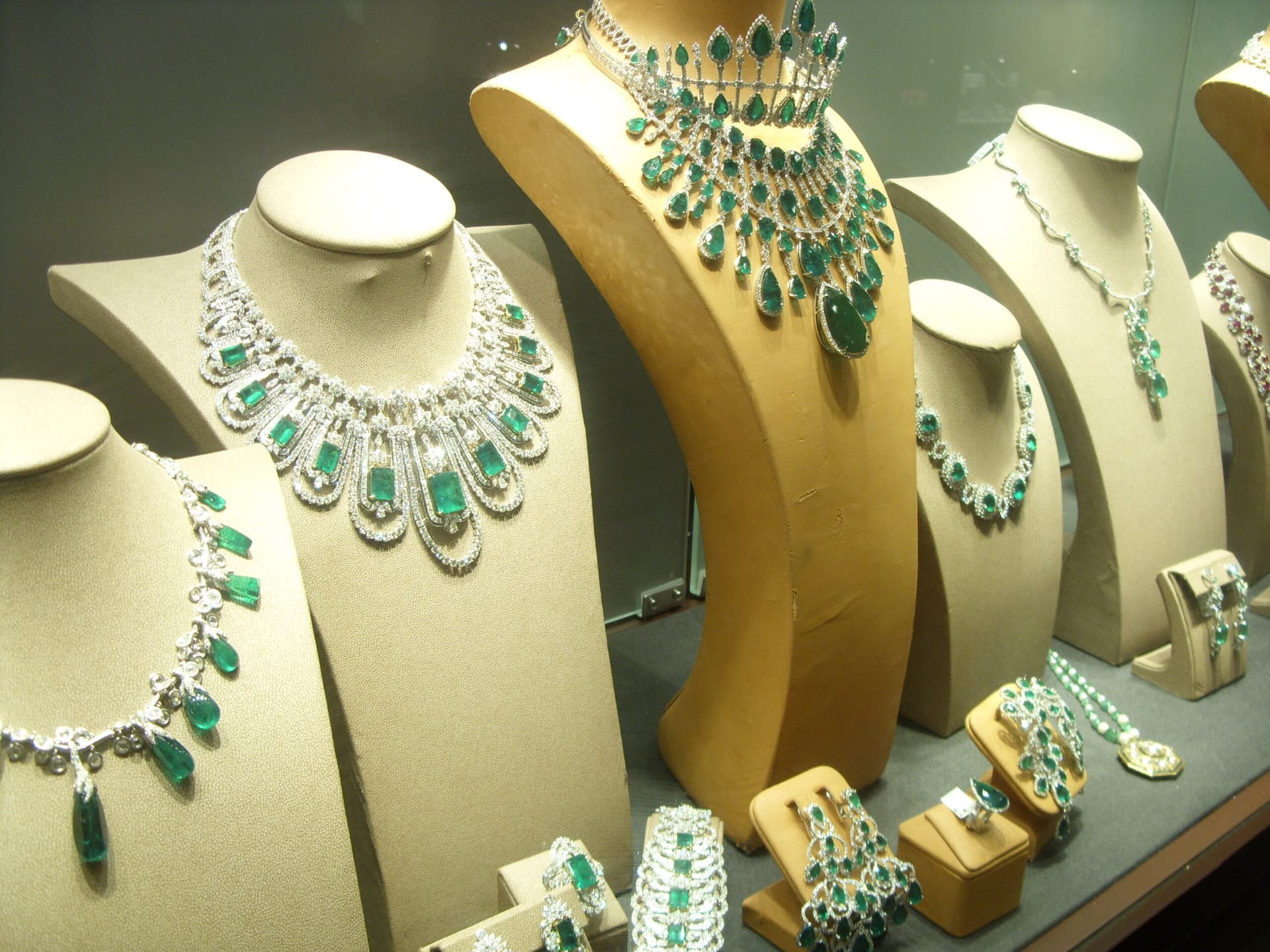
Emerald rings should have protective settings to shield the gem from physical blows. Emeralds also make excellent choices for pendants, brooches, and earrings.
Mechanical cleaning is not recommended for emeralds. In the worst case, ultrasonic, steam, and boiling methods can shatter emeralds. At the very least, these methods will mean you'll have to re-oil your emerald. Use only warm water, detergent, and soft brush for cleaning or take your emeralds to a professional jeweler.
For more recommendations, consult our gemstone jewelry care guide.




When you join the IGS community, you get trusted diamond & gemstone information when you need it.
Emeralds have fascinated people since ancient times. Not surprisingly, cultures from all over the world have developed a rich folklore around emeralds, and stories of famous emeralds have captivated people for centuries. Emerald is also the birthstone for May as well as the 20th and 35th wedding anniversary stone.
Emerald is a medium or darker green to blue-green beryl gemstone, in which the green color is derived from impurities of chromium (Cr), vanadium (V), or a combination of both. Before 1963, the definition of emerald was limited to beryls with chromium impurities, but the discovery in Brazil of a large deposit of beryl stones colored green by vanadium led to modification. According to the modern definition, the purity and saturation of the green color of a beryl is what defines an emerald.
Varying amounts of iron (Fe) will affect the color as well. More iron atoms increase the bluish tones.
In a situation similar to the division between pink sapphire and ruby, some chromium colored stones of light to medium-light green color are sometimes sold as emeralds though they could be considered green beryls. Emeralds should have a medium to dark primary green hue. (Editor's note: Some gemologists, including Dr. Joel Arem, define emerald strictly as beryl that contains chromium and consider beryls colored green because of vanadium to be simply green beryls).
Geological conditions in Colombia produced exactly the slightly bluish-green shade and strong saturation that make stones from that locale the epitome of the variety.
Emeralds from the Muzo and Chivor mines in Colombia can be distinguished in a general way. Muzo material is yellowish green, whereas that from Chivor is blue-green. (It sometimes takes a trained eye to see the distinction in color, however).
Emeralds from Zambia may also display an unusual blue tone, with blue-green/yellow green pleochroism, due to their high iron content (0.73%). Zambian crystals may be intensely color zoned, with near colorless cores and dark green rims, almost like watermelon tourmaline.
Recently discovered emeralds from Itabira, Minas Gerais, Brazil, rival the best Colombian stones in quality. They are typically light bluish green down the c-axis.
The center of world emerald mining is in South America, with Colombia and Brazil as major producers.
The Egyptian mines that supplied Cleopatra's passion have long since been played out. However, today the African continent is second only to South America in production, with mines in Zambia, Zimbabwe, Madagascar, and Nigeria. Each of these locales typically produces a certain color, size, and clarity. Since 2016, Ethiopia has also produced some high-quality emeralds with grass green to blue-green colors that don't need oil treatments.
Other notable sources of emeralds include Afghanistan and China.
As for consumers, the United States and Japan together purchase more than 75% of the world's cut emeralds.
The physical and optical properties of emeralds may help gemologists distinguish natural from synthetic stones and even identify the sources of mined stones.
The absorption spectrum of emerald is very distinctive, with fine lines in the red, weak ones in the blue, and broad absorption in the violet; e and o have different characteristics:
Some Zambian emeralds contain Fe and display the spectral lines of aquamarine as well as emerald. Pleochroism in these gems is also distinctive: blue/yellowish-green.
Vanadium-bearing emeralds may show a weak band at 6100.
The luminescence of emerald is very distinctive and can help positively identify an emerald.
Iron in emeralds may quench fluorescence.
See the "Synthetics" section for information on luminescence in lab-created emeralds.
Emeralds on matrix, Muzo mine, Colombia, under normal light and UV LW light. Photos by Géry Parent. Public Domain.
Emeralds can feature many kinds of internal fractures and inclusions. The evocative term jardin, French for "garden," is used to refer to this variety. The types of inclusions in emeralds can help identify their sources. See the tables below.
For inclusions of synthetic emeralds, see the "Synthetics" section below.
| Locality | Occurrence | o | e | Birefringence | SG | Notes |
| Poona | schists | 1.578-1.579 | 1.572 | 0.005-0.007 | 2.69-2.70 | |
| Emmaville | pegmatite | 1.575 | 1.57 | 0.005 | 2.68 |
Inclusions: Biotite (abundantly); actinolite; calcite; some 3-phase inclusions seen, tubes, "daggers," fluorite.
| Locality | Occurrence | o | e | Birefringence | SG | Notes |
| Habachthal | biotite schist | 1.591 | 1.584 | 0.007 | 2.74 | |
| (unspecified) | 1.582 | 1.576 | 0.006 | 2.73 |
Inclusions (Habachthal): Straight, broad-stemmed tremolite rods; biotite, rounded mica plates; tourmaline; epidote; sphene; apatite; rutile.
| Locality | Occurrence | o | e | Birefringence | SG | Notes |
| Bahia | ||||||
| Anagé | 1.584 | 1.576 | 0.008 | 2.80 | ||
| Brumado | 1.579 | 1.573 | 0.005-0.006 | 2.68 | ||
| Carnaiba | mica schist | 1.588 | 1.583 | 0.006-0.007 | 2.72 | |
| Salininha | 1.589 | 1.583 | 0.006 | 2.71 | ||
| Minas Gerais (var.) | 1.578-1.581 | 1.572-1.576 | 0.006-0.009 | 2.71-2.73 | ||
| Goiás (Sta. Terezinha) | in talc and biotite schist | 1.588-1.593 | 1.580-1.586 | 0.007-0.008 | 2.70-2.76 | bluish green |
Inclusions:
| Locality | Occurrence | o | e | Birefringence | SG | Notes |
| Chivor Mine | cracks in dark schist | 1.577-1.579 | 1.570-1.571 | 0.005-0.006 | 2.69 | blue-green |
| Muzo Mine | calcite veins in dark shale | 1.580-1.584 | 1.570-1.578 | 0.005-0.006 | 2.70-2.71 | yellow-green |
| Gachalá Mine | 1.576 | 1.57 | 0.006 | 2.70 | ||
| Borbur Mine | 1.576 | 1.569 | 0.007 | 2.70 | ||
| Trapiche emerald | in biotite | 1.583 | 1.577 | 0.006 | 2.70 |
Inclusions:
| Locality | Occurrence | o | e | Birefringence | SG | Notes |
| poor quality | 1.589 | 1.582 | 0.007 | 2.70 |
| Locality | Occurrence | o | e | Birefringence | SG | Notes |
| Ajmer | 1.595 | 1.585 | 0.007-0.010 | 2.74 | ||
| (unspecified) | in biotite schist | 1.593 | 1.585 | 0.007 | 2.73 |
Inclusions: Oblong cavities parallel to long crystal axis, with gas bubbles; biotite crystals parallel to basal plane; fuchsite, 2-phase inclusions; apatite crystals; groups of negative twin crystals with comma shape.
| Locality | Occurrence | o | e | Birefringence | SG | Notes |
| Ankadilalana Mine | mica schist | 1.589-1.591 | 1.581-1.585 | 0.007 | 2.73 |
| Locality | Occurrence | o | e | Birefringence | SG | Notes |
| Morrua | 1.593 | 1.585 | 0.008 | 2.73 |
| Locality | Occurrence | o | e | Birefringence | SG | Notes |
| Eidsvoll | in granite | 1.590-1.591 | 1.583-1.584 | 0.007 | 2.68-2.76 |
Inclusions: Mossy inclusions; also interconnected tubes that make crystals appear turbid.
| Locality | Occurrence | o | e | Birefringence | SG | Notes |
| Mingora | 1.596 | 1.588 | 0.007 | 2.78 | ||
| Bucha | talc-quartz-carbonate enclosed in ultramafic | 1.6 | 1.59 | 0.010 | - | |
| Swat (general) | in metamorphics | 1.595-1.600 | 1.588-1.593 | 0.007 | 2.75-2.78 |
Inclusions: 2-phase inclusions; thin films; some liquid inclusions, few mineral crystals.
| Locality | Occurrence | o | e | Birefringence | SG | Notes |
| Urals | biotite-chlorite schists | 1.588 | 1.581 | 0.006-0.007 | 2.74 |
Inclusions: Actinolite crystals, singly or in groups, resembling bamboo cane; mica plates.
| Locality | Occurrence | o | e | Birefringence | SG | Notes |
| Transvaal, Gravolotte (Cobra Mine, etc.) | acid pegmatites and contacting schists | 1.593-1.594 | 1.583-1.586 | 0.006-0.007 | 2.75-2.76 |
Inclusions:
| Locality | Occurrence | o | e | Birefringence | SG | Notes |
| Lake Manyara | in pegmatites and mica schists | 1.585 | 1.578-1.580 | 0.005-0.006 | 2.72-2.73 | with alexandrite |
Inclusions: 2-phase and 3-phase inclusions; square-shaped cavities and tubes; actinolite, mica.
| Locality | Occurrence | o | e | Birefringence | SG | Notes |
| North Carolina | in albite matrix | 1.588 | 1.581 | 0.007 | 2.73 | fluoresces in LW-UV |
Inclusions (North Carolina): Quartz crystals sometimes seen.
| Locality | Occurrence | o | e | Birefringence | SG | Notes |
| Miku | in schists | 1.589-1.590 | 1.581-1.582 | 0.007-0.009 | 2.74 | |
| Mufulira | 1.588 | 1.581 | 0.007 | 2.68 | ||
| Kitwe | in schists | 1.586 | 1.58 | 0.006 | 2.79 | |
| Kafubu | 1.602 | 1.592 | 0.010 | 2.77 |
Inclusions: Biotite (black crystals) as small specks or dots; pinpoints, breadcrumb inclusions; also tourmaline (dravite) and magnetite. Material from Kitwe contains: rutile, chrysoberyl, muscovite, apatite, quartz, ilmenite, tourmaline, color zoning, 2-phase inclusions.
| Locality | Occurrence | o | e | Birefringence | SG | Notes |
| Victoria Province | 1.576-1.591 | 1.572-1.585 | 0.004-0.007 | 2.67-2.74 | with alexandrite | |
| Bubera Province | 1.585 | 1.58 | 0.005 | - | not gemmy | |
| Shamva Province | 1.591 | 1.584 | 0.007 | - | not gemmy | |
| Filabusi Province | 1.587-1.594 | 1.583-1.588 | 0.004 | - | ||
| Belinwe Province | 1.593-1.594 | 1.586-1.588 | 0.005-0.007 | - | ||
| Sandawana | 1.590-1.596 | 1.583-1.588 | 0.004-0.006 | 2.74-2.75 |
Occurrence (General): granite pegmatites, cutting schists, also serpentines and fine mica aggregates.
Inclusions: Fine long-curving tremolite needles; also 2-3 phase inclusions, short rods or fine curved fibers; color zoning; garnets; hematite; feldspar; brown mica; negative crystals.
Emerald simulants or imitations often encountered in the marketplace include: glass, yttrium aluminum garnet (YAG), green cubic zirconia (CZ), and assembled triplets of beryl as well as synthetic spinel. Although these pieces may resemble emeralds, their optical and physical properties differ notably from those of emeralds.
Of course, other natural green gemstones may also resemble emeralds and may be misidentified — either accidentally or deliberately — as emeralds. Since emeralds are among the most popular and expensive gemstones in the world, unscrupulous vendors may associate the name "emerald" to other less popular green gems in order to drum up consumer interest, such as calling green fluorite "African emerald" or chrome sphene "Mexican emerald." However, gemologists can usually readily distinguish emeralds from other gemstones.
Read our article on false or misleading gem names for more examples.
Two major processes, the hydrothermal and flux methods, can produce synthetic or lab-created emeralds.
If you've seen and priced synthetic emeralds, you may wonder why they're so costly compared to other synthetics, such as synthetic sapphires. Both the hydrothermal and flux methods of production require costly equipment and are energy intensive. They take a long time to produce emeralds and have a low yield of cuttable gems.
For more information on the history of synthetic gemstones in general as well as the specific development of lab-created emeralds and the particular proprietary process noted below, consult our 5-part synthetic gemstone guide.
For more information on distinguishing synthetic emeralds from natural stones as well as identifying specific manufacturing processes, consult this article on lab-made emeralds.
Synthetic emeralds typically have slightly lower refractive indices (RI) and birefringence than do natural stones.
Most emerald synthetics have the same absorption spectrum as natural emeralds. Gilson type III may have a line at 4270.
| Natural | Flux | Hydrothermal | Lechleitner Overgrowths | |
| Optics | ||||
| o | 1.572-1600 | 1.560-1.563 | 1.566-1.576 | 1.578-1.605 |
| e | 1.570-1.593 | 1.563-1.566 | 1.571-1.576 | 1.570-1.599 |
| Birefringence | 0.005-0.009 | 0.003-0.005 | 0.005-0.007 | 0.005-0.010 |
| Specific Gravity | 2.68-2.78 (usually over 2.69) | 2.65-2.67 | 2.67-2.71 | - |
Flux-grown emerald doesn't show the infrared spectrum characteristics of water in the beryl structure. This spectrum is characteristic only of natural and hydrothermal synthetic emeralds. Flux-grown emeralds typically have relatively low RIs and specific gravity values (SG) and show strong red fluorescence in UV.
Chlorine appears to be a diagnostic trace element found only in hydrothermal synthetics. Other trace elements overlap with natural material and are therefore not diagnostic. Natural emeralds contain Na, Mg, and Fe in significantly higher amounts (more than 0.1%) than synthetic emeralds but contain lower amounts (less than 18%) of silica and alumina.
Chatham stones transmit UV to 2300, whereas natural emeralds are opaque below 3000.
Regency emerald is the material formerly made by Linde, manufactured under license by Vacuum Ventures, Inc. This material is therefore identical with the Linde product.
Some of the first lab-created emeralds on the market weren't convincing because they were so clean. However, the sophistication of today's consumer has led to a trend toward more natural-looking synthetics with inclusions. Although this improves their salability, it makes a little more difficult for gemologists and appraisers to prove natural origin. Fortunately, the types of inclusions in synthetic emeralds can help gemologists verify either a mined or synthetic origin.
Flux grown synthetic emeralds may contain flux, platinum crystals, (metallic) phenakite crystals (colorless and low relief) and show a Venetian blind effect.
| Source | e | o | Birefringence | SG |
| Hydrothermal | ||||
| Lechleitner | ||||
| Overgrowth | 1.571-1.601 | 1.571-1.610 | 0.005-0.010 | 2.68-2.71 |
| Solid | 1.569 | 1.574 | 0.005 | 2.70 |
| Beryl Sandwich | 1.566 | 1.570 | 0.004 | 2.68 |
| Regency (Linde) | 1.566-1.572 | 1.571-1.578 | 0.005-0.006 | 2.67-2.70 |
| Biron | 1.569 | 1.573 | 0.004-0.005 | 2.68-2.71 |
| Crystal Research | 1.571-1.575 | 1.566-1.570 | 0.005 | 2.68 |
| Inamori (Kyocera) | 1.563 | 1.568 | 0.005 | 2.65-2.70 |
| Flux | ||||
| Gilson | 1.558-1.561 | 1.565-1.575 | 0.003-0.005 | 2.65-2.70 |
| Seiko | 1.561 | 1.565 | 0.004 | 2.66 |
| Lenix | 1.562 | 1.566 | 0.004 | 2.62-2.65 |
| Zerfass | 1.555 | 1.561 | 0.006 | 2.66 |
| Russian Synthetics |
Lechleitner emerald has a Cr content of approximately 4-10% (weight), with mean RI varying from 1.576-1.605 as the Cr content increases. In contrast, Linde emerald has a Cr content of 0.3-1.2% and a mean RI of 1.568-1.575. Natural emeralds usually have a maximum Cr content below 2%, but the RI also varies with other impurities.
The properties of Seiko (flux-melt) emeralds are reported as similar to those of other synthetics.
Emerald is considered a "Type III" gemstone, which means these gems are virtually always included to some degree. Because of this designation, a clarity grade of "Very Slightly Included" is the normal range for emeralds. Well over 90% of the emeralds in commerce have been treated to minimize the appearance of the inclusions.
Emerald inclusions pose more than aesthetic considerations, however. Although emeralds, like other beryls, have a high hardness rating, they're more fragile than other beryls. (A high Mohs rating doesn't mean a stone is indestructible. It simply means the stone is more resistant to scratching). Their inclusions reduce their structural integrity, and these inclusions occur because of how emeralds form under the Earth. They're unavoidable. Emerald enthusiasts will simply have to treat these gems gently.
The standard industry practice for enhancing emeralds is oiling. This term refers to the practice of immersing emeralds in a colorless oil or resin. Often this is done using a vacuum chamber to assist penetration. Non-standard treatments go beyond this to using green colored oils and hardened, epoxy-like resins. These treatments dramatically improve the appearance of the gems but necessitate special care in cleaning and setting.
Consumers should learn the pros and cons of emeralds and their treatments before purchasing emerald stones or jewelry.
Emerald is notorious for growing very large. The largest emerald crystal extant weighs 16,020 carats and is from the Muzo Mine in Colombia. (The "Bahia Emerald," discovered in 2001, may take that title). Many museums around the world display fine and large emeralds, both rough and faceted gems, as well as some carvings and tumble-polished stones.
See our article on the world's largest emeralds for more information.
Keep in mind that sometimes the following names are used to refer to emeralds from these specific sources. However, they may also be used as trade names to describe emeralds with particular characteristics, regardless of source. If you're not sure how vendors are using the term, ask them for clarification.
Emerald rings should have protective settings to shield the gem from physical blows. Emeralds also make excellent choices for pendants, brooches, and earrings.
Mechanical cleaning is not recommended for emeralds. In the worst case, ultrasonic, steam, and boiling methods can shatter emeralds. At the very least, these methods will mean you'll have to re-oil your emerald. Use only warm water, detergent, and soft brush for cleaning or take your emeralds to a professional jeweler.
For more recommendations, consult our gemstone jewelry care guide.



| 1.559 |
| 1.563 |
| 0.004 |
| 2.65 |
| Chatham | 1.56 | 1.565 | 0.003-0.004 | 2.64-2.66 |
Emerald has been synonymous with the color green since ancient times. A fine emerald is a truly breathtaking sight, and this member of the beryl family deserves its placement among the traditional “Big Four” gems along with diamond, ruby, and sapphire. Colombian emeralds command the highest prices – sometimes $100,000 a carat or more depending on size and color – while recent emerald discoveries in Ethiopia and Brazil are also seeing high prices.
Like many stones, the per-carat price of fine quality emerald escalates rapidly with size. For example, a recent price guide lists a fine quality 3-ct Colombian stone as six times more valuable than three equivalent quality 1-ct stones.
Value factors hinge largely on color, with nuances of saturation and hue affecting price to a significant degree. The most desirable color is a slightly bluish green in a medium dark tone with strong to vivid saturation.

Clarity is important, but inclusions are tolerated more in emeralds than virtually any other gem. Top quality, unenhanced stones (with certification) can bring as much as 50% more in price than treated stones of the same size, color, and clarity.

For more information on emerald value factors, consult our emerald buying guide, engagement ring guide, and appraisal guide.